The decision on your PSA platform won't be made in the demo. It will be made a few weeks later, on an ordinary weekday evening, when your CFO opens the vendor responses next to next year's budget and reads them alone.
Your CFO wasn't in the demo. They didn't see the resourcing view rebalance three projects, or the agent that drafted a project plan from a statement of work while the room watched. They have your document, a spreadsheet and two questions. What will this cost us over three years? And what happens to us if it doesn't work?
Most PSA RFPs can't answer either one. They're written by the person who sat through the demos, for people who sat through the demos. A long feature list, a yes-or-no column, a pricing tab that says "per user." Then the purchase stalls in procurement for a quarter. Or it closes, and the implementation runs months past the plan.
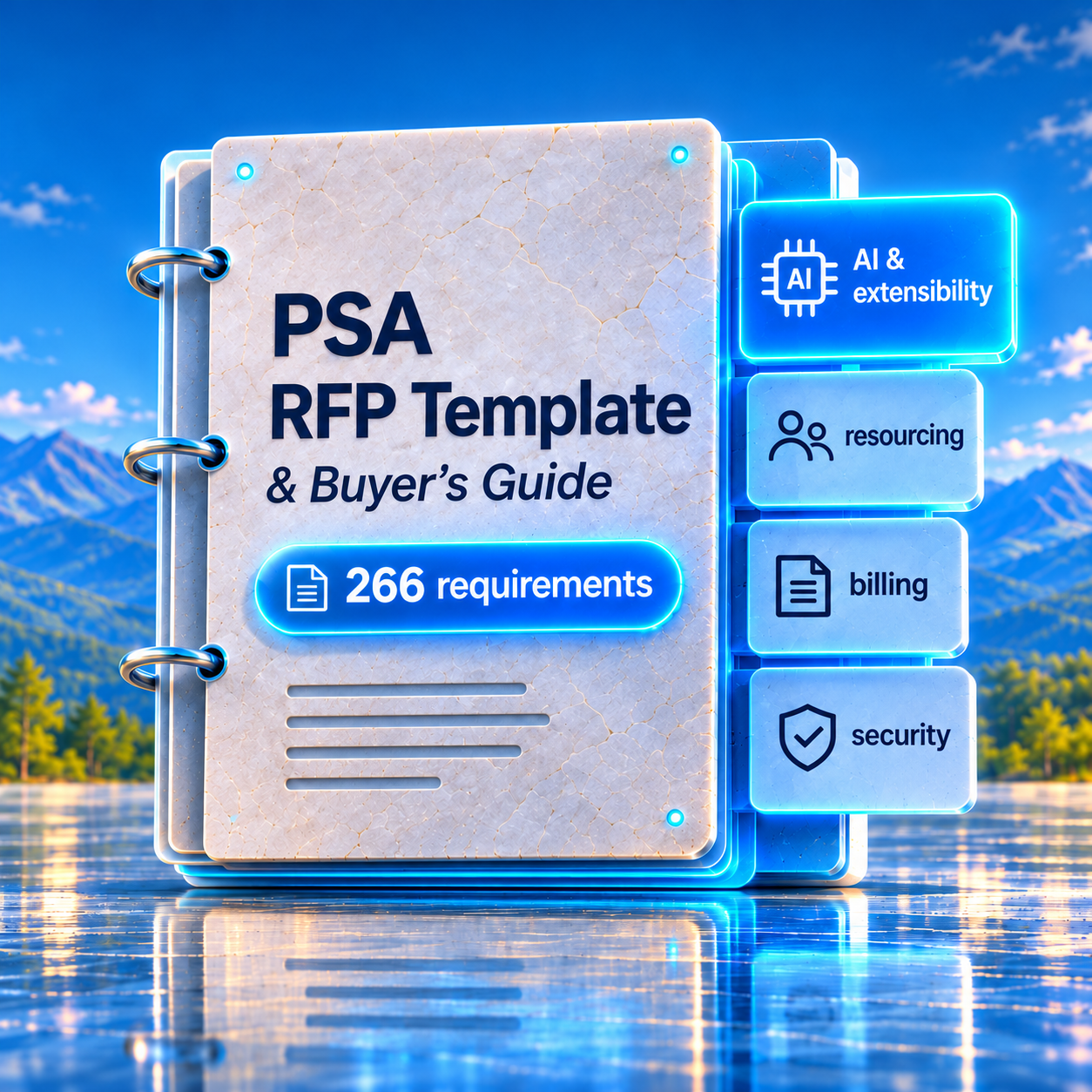
This guide is for the person writing the document. It gives you the eight sections a PSA RFP needs and 50 questions that make vendors show their work. It also covers a scoring method that explains itself, and how to test AI claims now that most vendors say they have agents. The template at the top holds all 268 requirements. Edit it, send it, and score every vendor with it, including us.
What this guide covers, and what it doesn't
This guide covers professional services automation (PSA) platform evaluation: software that runs project delivery, resourcing, time, billing and client collaboration for services teams.
It isn't about Personal Service Agreements, PSA Certified (IoT security), Public Service Announcements, PSA card grading, pretrial or pre-job safety assessments, prostate-specific antigen testing, or the Public Service Alliance of Ontario.
If you want RFP management software (tools that help you run RFPs), that's a different category. Looking for free PSA tools? See our best PSA software guide.
What a PSA software RFP is, and when you need one
A PSA platform runs project delivery, resource planning, time tracking, billing and client collaboration in one system. The RFP sets evaluation criteria, collects structured vendor answers, and produces a shortlist that finance, procurement and leadership can sign off.
A formal RFP costs your committee ten weeks or more, and costs you most of your evenings. So first ask, honestly, whether you need one.
You need a formal RFP when:
- the spend crosses your company's competitive-bid threshold
- procurement policy requires one for a purchase it classes as transformational
- you're re-bidding at the end of a multi-year term
- you're replacing an incumbent wired into your CRM, your ERP and your billing
You can skip it when the delivery team is small and the choice is obvious. You can also skip it when the incumbent has plainly failed and everyone agrees on the replacement, or when a hard deadline rules out a process that runs a full quarter.
The RFP rarely starts the journey. By the time you write it, you've usually seen two to four vendors and you have a favourite. The RFP formalises that shortlist for the people who weren't in the room, which is why the next section matters more than any feature list.
Write the RFP for the people who will never attend the demo

The people who constrain a PSA purchase hardest are finance and procurement, and they're also the least likely to meet a vendor. Finance sets the budget and the term. Procurement sets the scoring, the service levels and the exit terms. IT sets security. So the RFP has to answer their questions in writing, without you in the room to explain.
Think about who shows up to PSA demos. Delivery leaders, project managers, a resource manager, someone from operations. These are the people who feel the current setup every day. They lean forward when a vendor drags a consultant from one project to another and the capacity chart updates.
Now think about who sets the terms of the deal. Finance decides how much can be spent and over how many years. Procurement decides how vendors get scored, what the contract says about service levels, and what happens if you want out. IT decides whether the vendor clears security review at all. In most evaluations these three groups attend one vendor call at most, and some attend none.
That gap is where PSA purchases stall. The delivery team writes a document full of workflow requirements. Finance reads it and finds no total cost. Procurement finds no scoring method, so the recommendation reads like a preference. IT finds a line that says "AI features" and nothing about where your data goes when an agent reads it.
The question an evaluator dreads comes after the demo, from leadership, and it's blunt: can the product do this, yes or no? Your document has to carry that answer for every requirement, in a form someone can check without calling you.
A few specifics make each section travel. Give finance a three-year view rather than a first-year quote, because implementation fees, integrator costs and price uplifts land in years one and two. Give procurement the weights before any response arrives, so the winner looks earned. Give IT the AI questions in writing, because a vendor saying "we don't train on your data" in a demo isn't a contract term until it's in the response.
If a section can't travel without you, rewrite it until it can.
Why feature matrices fail as a PSA evaluation method
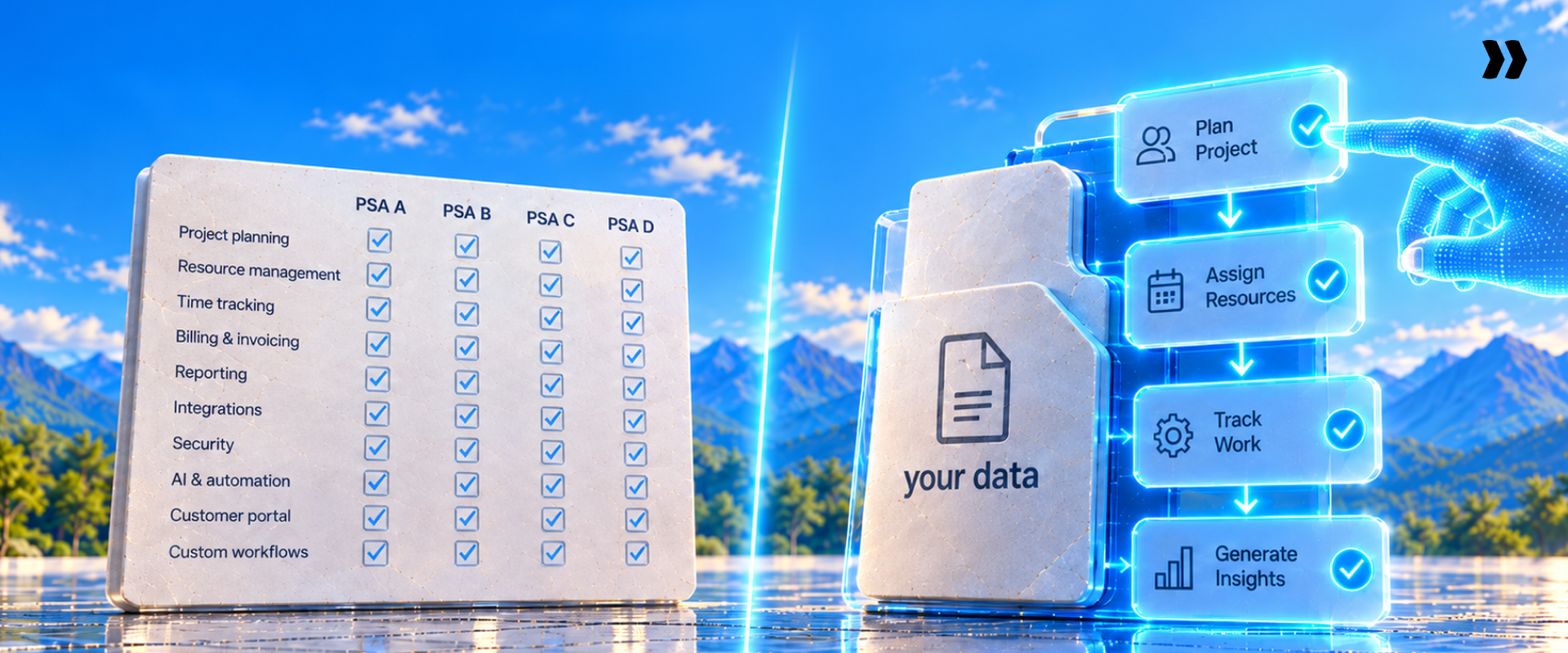
Every PSA vendor will tick "supports milestone billing." Ask one to bill a single project four different ways and the room changes. Three questions do most of the separating, and they line up with the three places PSA purchases tend to disappoint.
- Margin erosion. "Show me what a project manager sees when a project passes 80% of budget with 40% of the work left."
- Mixed billing. "Walk through one project with a fixed-fee discovery phase, time-and-materials delivery, a go-live milestone and a monthly retainer."
- Implementation reality. "What did your last three comparable implementations cost, and how long did they take, at the typical end and the conservative end?"
Feature counts haven't fixed the underlying problem. SPI Research's 2026 Professional Services Maturity Benchmark, which surveyed 509 firms, put average billable utilization at 66.4%, the lowest in the benchmark's 19-year history.
Most of those firms already own software with long feature lists. What moves that number happens inside the workflow, and a yes-or-no column can't see inside a workflow.
PSA vs work management vs onboarding tools: know what your shortlist is comparing

This is the most common reason scoring sheets produce nonsense. A typical shortlist holds a legacy PSA suite, the work-management tool your team already uses for tasks, and an onboarding tool someone saw at a conference.
Put all three through one checklist and the work-management tool wins on ease of use, the onboarding tool wins on the customer view, and the PSA wins on everything finance cares about. The totals come out close, and they tell you nothing.
Separate them first with five questions.
If you need capacity forecasting and billing, you're buying a PSA, and the other two compete for a different budget line.
The strongest competitor on most shortlists is the spreadsheet you already have. Score "do nothing" too, with its real costs attached: the hours someone spends reconciling it every month, the staffing calls made on stale numbers, the invoices that go out a week late.
The 8 sections every PSA RFP needs: professional services automation requirements by category
A complete RFP for PSA software has eight sections:
- AI and extensibility
- Company profile and scope
- CRM and ERP integration
- Resource management and capacity planning
- Time and expense tracking
- Billing, invoicing and revenue
- Security and compliance
- Implementation and support
The free template breaks these professional services automation requirements into 268 line items across 19 sections, with AI first.
The template opens with AI on purpose. In 2026 it's where vendor answers differ most, and where a polished demo can hide the most.
1. AI and extensibility
Which agents exist, what they do alone, what needs approval, and how your own AI tools connect. In the template: the agentic capabilities section, 38 requirements across eight sub-categories, from analytics to data migration and governance. Ask: "For each AI agent that's generally available today, show what it executes, what needs human approval, what data it can read, and what the audit trail shows when it gets something wrong."
2. Company profile and scope
Your side of the document: team size, billing models, current systems, regions, growth plans and target go-live date. The template doesn't include this, so add it as page one. Vendors answer far more precisely once they know you bill three ways across two currencies.
3. CRM and ERP integration
How deals become projects, and how project money gets back to finance. In the template: CRM integration and opportunity management (4 rows) and integrations (10 rows). Ask: "Show a closed-won opportunity creating a project, with budget and placeholder roles, and show exactly what syncs back."
4. Resource management and capacity planning
Who is available, who is overbooked, and whether you can staff the pipeline you're about to sign. In the template: resource planning and management (16 rows). Ask: "Show a six-month capacity forecast by role, against pipeline weighted by win probability, live."
5. Time and expense tracking
The raw material for every invoice and every utilization number. In the template: time capture, management and reporting (17 rows). Ask: "If someone logs time to a task they aren't assigned to, does the system flag it, block it or allow it? At entry, or at approval?"
6. Billing, invoicing and revenue recognition
Where margin is won or lost. In the template: financial management (22 rows), covering rate-card versions, budget alerts, and percent-complete and milestone revenue recognition. Ask for the four-part mixed-billing walkthrough from the section above.
7. Security, compliance and access
In the template: security and compliance (20 rows), including access control and AI data governance. Add AI data governance yourself: where AI processing runs, how long model providers keep your data, and whether it trains anyone's model. Most PSA templates run thin here, earlier versions of ours included.
8. Implementation and support
In the template: the miscellaneous rows, which cover configurability, migrating projects and timesheets, and self-implementation. Ask: "Name three customers like us who went live in the last 12 months, with a reference contact for each."
The template also covers project and portfolio management (21 rows), task management (20), automations (18), client experience (17), reporting and analytics (17), partner and contractor collaboration (10), process standardisation (8), project governance (8), files and forms (5) and team collaboration.
The PSA RFP question library: 50 questions by category
A good RFP question can't be answered well in a sentence. It forces a screen share, a document or a number. The template carries the full wording of each one.
AI and agentic capability questions (12)
AI comes first because the gap between demo and product is widest here. An agent running on clean sample data proves little about yours.
- Which agents are generally available today, and which are in beta or on the roadmap? Give dates for roadmap items.
- For each generally available agent, what does it execute, what needs human approval, and what data does it read?
- Walk through a failure: an agent misapplies a rate card and under-invoices. Where is it logged, who is told, and how is it reversed?
- Can any authorised user ask a margin or utilization question in plain language and get an answer computed live, within their permissions?
- Can the system explain why a metric moved, as well as report that it did?
- Is every AI-detected customer risk or opportunity linked to the exact call or email it came from?
- Can AI draft delivery documents from our calls and our templates, with every statement traceable to its source?
- Can AI read our statement of work (SOW) and draft a project plan with phases, tasks and dependencies for us to review?
- When we migrate our customers' data during implementation, who extracts it from the source system and who loads it into the destination: your agent, a connector, or our team?
- How are mapping, transformation and validation handled? How do files that arrive late get merged? Who signs off, and where?
- Can an admin write a timesheet or delivery policy in plain English, with conditions by role, region and project type, test it, and enforce it at the point of entry?
- Can our own AI agents read and write PSA data through an API or MCP? And how is your AI priced: included, metered or a separate product, and what would it cost at our volume?
Question 9 earns its place. Migrations rarely fail in the middle, where the data gets mapped. They fail at the edges: pulling data out of an old system nobody documented, and pushing it into a new one that rejects half of it on load. Ask who owns both edges, by name.
Core workflow mechanics questions (8)
These test whether the daily work holds together once the demo data is gone.
- Show the full path from a time entry to approval to invoice.
- Show a scope change moving from change order to billing.
- How are phase entry and exit gated?
- What happens when two projects request the same person for the same week?
- Show a portfolio-wide capacity view.
- What can clients see and do in the client portal?
- How does the system handle multiple currencies?
- What happens when a rate card changes in the middle of a project?
Pricing, contracts and hidden-cost questions (9)
Finance reads this section first. Make it easy for them.
- What is the total cost over three years and over five, including uplifts?
- Which license types exist (full, light, view-only, external), and what does each cost?
- Are client or partner users licensed per seat?
- Which term lengths do you offer, and what is the price uplift on each?
- Is the implementation fee fixed, or billed on time and materials?
- What is the typical range for systems-integrator fees on a project our size?
- Do sandboxes cost extra?
- Are API calls tiered or capped?
- How is AI consumption priced and forecast?
On question 24, agree your term policy with procurement before you shortlist. The timeline section explains why.
Implementation and support questions (8)
- What are your typical and conservative go-live times, and what drives the difference?
- Which named roles will we get, and are they dedicated or shared?
- Give three references comparable to us in size, segment and stack.
- What support do we get in the weeks right after go-live?
- How are your service levels defined and measured?
- Who owns training?
- Who owns adoption after go-live?
- How is out-of-scope work priced?
Security and compliance questions (8)
- Share your SOC 2 Type II report, or a bridge letter if you're between audit periods.
- Are you certified to ISO 27001, and to ISO 42001 for AI management?
- How is data encrypted, and who holds the keys?
- Where is our data stored, and can we choose the region?
- How do you handle GDPR and data processing agreements?
- Where does AI processing run, how long is data retained, and is any of it used for training?
- Which identity providers do you support for SSO and SAML?
- How is vendor staff access to our data logged?
A SOC 2 Type II report covers how controls operated over months, while a Type I covers one point in time, so ask for Type II (the AICPA's SOC 2 overview explains it). And if a vendor's paperwork still cites the EU-US Privacy Shield, ask what replaced it. The EU's top court struck it down in July 2020, and transfers now rely on the EU-US Data Privacy Framework or standard contractual clauses.
Data portability questions (5)
Nobody enjoys asking about the exit before signing. Ask anyway.
- What can we export, and in what format?
- Who pays for the export?
- What's the contractual timeline for returning our data?
- Are there fields that can't be exported?
- Can we speak to a customer who has exported?
The questions buyers most regret skipping are the ones on generally available versus beta status, migration ownership and exit terms. They feel awkward to ask in a sales cycle, and they're expensive to discover afterwards.
The 5-step PSA selection process
How to choose PSA software, in five steps:
- Assemble a cross-functional team.
- Build a requirements matrix.
- Shortlist three to five vendors.
- Run a bounded proof of concept instead of relying on a sales demo.
- Vet the systems integrator separately.
Most implementation horror stories trace back to skipping step 4 or step 5.
Step 1: Assemble a cross-functional team
Assign an owner to each RFP section before the document goes out. The AI section goes to whoever will run the AI day to day, which is rarely the person who liked the demo most. If nobody on the team will run it, that's a useful signal about how much AI should weigh in your scoring.
Step 2: Build a requirements matrix
Rank every requirement as must-have, should-have or nice-to-have, and tie each must-have to a measurable outcome: utilization, margin or time to go-live. Name your top three in the document. Flat checklists, where all 268 rows weigh the same, are how evaluations stall: every vendor scores around 80%, and nobody can explain the difference.
Step 3: Shortlist three to five vendors
Include a true PSA, the incumbent if it's being re-bid, and at least one vendor built around AI agents, so the committee sees the difference instead of reading about it. Score "do nothing" alongside them. Past five vendors, your committee stops reading responses properly.
[Embed: "Best PSA Software in 2026" (YouTube, May 12 2026)]
Step 4: Run a bounded proof of concept
A demo follows the vendor's script. A proof of concept follows yours. Give every finalist the same four tests on your own data and documents:
- set up a project from your most common SOW
- rebalance capacity across three overlapping projects
- pull the margin for one phase of one project
- run the AI capability you care about most on your own SOWs and call transcripts
Two weeks is usually enough. If your company doesn't allow recording bots on calls, test the AI on documents instead, and tell the vendor before the clock starts.
Step 5: Vet the systems integrator separately
MGI Research observes that buyers spend months choosing a PSA vendor and a fraction of that time choosing the integrator who will implement it. Ask the integrator for references at your size, how stable their staffing is (the team you meet in the sales cycle isn't always the team you get), and their experience with your exact platform version.
How to score vendor responses objectively

Most RFP evaluation criteria fail at one step. The weights get set after the responses arrive, and they drift toward whichever vendor the committee already liked. Procurement will spot that, and so will the vendor who loses. Lock the weights in writing first.
Here's a starting point you can adjust.
Then score every answer on one five-point rubric. This is what turns a PSA RFP scoring matrix into something your CFO can audit.
The two axes catch different evasions. "Configurable" sounds like yes until you learn it takes a consultant three weeks. "We have that" sounds like live until you learn it's in beta with a handful of customers. Many teams already improvise this, with full credit for out of the box and partial credit for configuration. The rubric makes it consistent, and makes your vendor evaluation scorecard a record you can defend.
The template already has these columns, plus a score that calculates itself and a Scoring tab that applies your weights.
Red-flag answers to listen for in PSA vendor demos
A vendor who can't give a price range now won't give a better one later. Treat "that's a configuration" as configurable, whatever it sounds like. And copy the habit of experienced evaluators, who try to break the demo first and ask questions after.
The PSA RFP timeline, worked backwards from go-live
Here's how that plays out. Say you want to go live on January 1 and your PSA implementation will take 12 weeks. Implementation has to start in early October, so selection has to land by then. Count back 10 to 15 weeks for the RFP and your first draft starts in late June or early July. Most teams start in September, then spend the spring explaining why January became April.
One more trap is contract length. Vendors often anchor on three-year terms. Procurement at many companies allows one. If nobody reconciles the two before the shortlist, you find out during commercials, which is the most expensive week of the whole process to find out anything.
PSA total cost of ownership: what the license price doesn't show

Run the arithmetic once and the license stops looking like the big number. Take an illustrative $60,000 annual license. On MGI's ratio, integrator costs land between $120,000 and $180,000, before you count a single internal hour. In year one, the license is the smallest line on the sheet.
Here are the lines finance will ask about.
- License mix. Full, light and external users are priced differently. Ask whether client and partner users are licensed per seat, because that cost grows every time you invite a customer in.
- Implementation and integrator fees. Get both in writing, separately, with what's fixed and what's billed by the hour.
- Data migration. MGI ranks data migration and data cleanliness first among the costs buyers underestimate. Historical projects, timesheets and rate cards all have to move, and someone has to check them.
- AI consumption. Some vendors include AI, some meter it, some sell it separately. Ask for an estimate at your expected usage, and ask what happens when you go over it.
- Parallel running. You'll run the old and new systems side by side for a few weeks at least. Budget the licenses and the double entry.
- Exit cost. What it costs to get your data out at the end of the term.
Who should be on your PSA evaluation team
Five roles, plus procurement:
- A professional services or delivery leader, who owns the requirements
- A project or resource manager, who is a daily user and runs the proof of concept
- A finance lead, for billing, revenue and total cost
- An IT or security lead, for security, integrations and AI governance
- An executive sponsor, who makes the decision
Procurement runs the process.
One tip worth copying: bring two or three project managers who aren't on the committee into the proof of concept. They have no stake in the decision, and their reaction in the first hour is the best early signal you'll get about whether people will adopt the thing.
Built-in vs bolted-on AI: three tests for any PSA vendor
Most PSA RFPs written before 2025 have no AI section at all. Most PSA purchases made in 2026 will be decided, at least partly, by one.
Start with what "agentic" means, because vendors use the word loosely. An AI assistant answers questions. An agent does a defined piece of work: it reads records, takes an action, and hands the result to a person for approval. In a PSA, that might mean turning a signed SOW into a draft project plan, blocking a timesheet that breaks a billing rule before it reaches the approver, or checking a customer's migration file before anything gets loaded.
Take that last example. A contract record with a start date after its end date will pass most import tools, because both fields contain valid dates. The record is still wrong, and it will quietly break a renewal report six months later. An agent that validates data against your business rules catches it. A chat window that summarises the file doesn't.
By late 2026, several vendors on a typical PSA shortlist will show you agents and mention an MCP server, so the labels have stopped separating them. These tests still do.
- The failure-trace test. Make an agent misapply a policy on purpose. Where's the evidence? Who gets told? How is it undone, and does the undo leave a record?
- The live-data test. Ask a margin question that spans time entries, budgets and allocations. Is the answer computed live, within your permissions, or read off a dashboard someone built last quarter?
- The plain-English governance test. Write a conditional rule, such as "consultants in the UK on fixed-fee projects can't log more than nine hours a day," and watch it get enforced at the point of entry, with no engineering ticket.
Add a fourth if your company is building its own AI: can your agents read and write PSA data through an API or through MCP? MCP, the Model Context Protocol, is an open standard introduced by Anthropic in November 2024 that lets AI assistants connect to business software. If your team already runs an assistant across your systems, you'll want the PSA to be one more system it can work with, without paying twice for the same capability.
Most buyers already think of AI as a ladder: an assistant that answers questions, a copilot that drafts things for you to finish, and agents that do delivery work while a person approves it. Ask each vendor which rung each feature stands on, then make them prove the top rung on your data.
Two more things belong in the AI section of your RFP. The first is governance. The NIST AI Risk Management Framework and ISO/IEC 42001, the international standard for AI management systems, give your IT team a shared vocabulary for asking how a vendor controls its AI. The second is the planning horizon. MGI Research advises planning three to five years ahead and treating a vendor's investment in AI as a selection factor in its own right. A PSA you sign this year will still be running when today's AI features look basic.
How Rocketlane scores against this template, including where it doesn't yet
Fair warning: this is where we talk about ourselves. We've stuck to the template's own rows, including the ones where we don't score full marks yet.
Where Rocketlane answers out of the box
On the portal row: your customers don't count against your seats, however many you invite.
The template's AI section, row by row
Nitro works at three levels: it helps run operations, watches delivery and flags what needs attention, and does delivery work itself. Here is each agentic row, with the agent that answers it and its status today.
If your team migrates customer data on every implementation, that's repeat work, and a setup saved once per source system pays back on every project after the first. Storable, in a public case study, cut its data migration time by 75%.
Where Rocketlane doesn't score full marks yet
- Resource Management Agent is coming soon. Until it ships, resourcing runs on the core skills matrix and allocations, so score that row on the core product.
- Nitro Analyst doesn't read task-level or phase-level data, expenses or invoices yet. Use standard reports for those, and score analysts on portfolio questions.
- Project Signals, built from work data such as Jira, is on the roadmap. Account Signals, built from calls and emails, are live today.
- Migration Agent doesn't validate referential integrity across multiple destination objects. For loads that span several related objects, plan a reconciliation check.
- If multi-entity ERP accounting on the Salesforce platform is your top requirement, weigh it heavily. That's where Salesforce-native suites are strongest.
How Nitro is priced
Rocketlane's Standard and Premium plans are priced per user and published on the pricing page. Nitro is quoted separately. Ask for an estimate at your expected volume during the demo, then hold us to it in the RFP response.
What buyers wish they'd asked: a hindsight checklist
Every evaluation team learns these the expensive way, once. Run this PSA software evaluation checklist before you send the RFP, and add each item to the section shown in brackets.
- Is it out of the box, or is it configuration? (Every section. Add a delivery-method column.)
- Is it generally available, in beta or on the roadmap? (The AI section first, then everywhere.)
- Show me a reference of my size, segment and stack. (Implementation.)
- What did your last three implementations cost in full, and how long did they take? (Implementation and pricing.)
- Which history migrates, how far back, and who does the work? (The miscellaneous rows.)
- What happens at go-live to the customisations we forgot to mention? (Implementation.)
- Who owns adoption once the implementation team leaves? (Implementation.)
- Is AI included or metered, and what will it cost at our volume? (Pricing.)
- What are the exit terms, and what does leaving cost? (Data portability.)
If your RFP answers these nine before contracting, you've done what most evaluation teams don't.
FAQ: late-stage PSA evaluation questions
What questions should go in a PSA software RFP?
Cover six areas: AI and agentic capability, core workflow mechanics, pricing and hidden costs, implementation and support, security and compliance, and data portability. The library above holds 50 questions across them, and the free template expands them into 268 requirements. Put AI first, because that's where vendor answers differ most in 2026.
How long does a PSA RFP take?
About 10 to 15 weeks from first draft to selection, or 8 to 11 weeks once distributed, if legal and security review runs alongside the proof of concept. If it runs afterwards, add three to four weeks. A January go-live usually means drafting in late June or early July.
How many vendors should get your PSA RFP?
Three to five. Fewer and you lose negotiating power; more and your committee stops reading responses properly. Include a true PSA, the incumbent if it's being re-bid, and at least one vendor built around AI agents. Score "do nothing" too, with the real cost of the spreadsheet you'd keep.
What are the hidden costs of PSA software?
Systems-integrator fees, data migration, client and partner user licenses, AI consumption, training, internal hours, parallel running and exit cost. MGI Research puts integrator costs at two to three times first-year license fees for midmarket and enterprise implementations, so a $60,000 annual license implies $120,000 to $180,000 for the integrator.
How do you score PSA vendor responses objectively?
Document the weights before any response arrives. Then score each answer on two axes: how it's delivered (out of the box, configurable, custom or roadmap) and how mature it is (generally available, beta or planned). A five-point rubric plus a proof of concept to break ties gives a recommendation that explains itself.
What is the difference between built-in and bolted-on AI in PSA software?
Bolted-on AI answers questions about what's on screen. Built-in AI works on the underlying records, acts with approval, respects permissions and leaves an audit trail. Three tests separate them: make an agent fail and trace the evidence, ask a live margin question, and watch a plain-English policy enforced at entry.
How long does PSA implementation take?
It depends on scope, integrations and how much history migrates, so ask every vendor for a typical and a conservative figure, and what drives the gap. Integrators usually add time. As one example, Rocketlane's typical go-live is 4 to 12 weeks. Check any figure against references your size.
Should we run a proof of concept or rely on vendor demos?
Run a bounded proof of concept. A demo follows the vendor's script; a proof of concept follows yours. Give every finalist four tests on your own data: build a project from a real SOW, rebalance three overlapping projects, pull margin for one phase, and run their AI on your documents. Two weeks is usually enough.