IT resource allocation: How modern services teams optimize utilization, staffing, and delivery in 2026

•
•
Summarize blog with






It is Thursday afternoon. A six-figure implementation deal just closed. You have 72 hours to confirm the project team.
You open the spreadsheet. Last updated Monday. You send five Slack messages. By Friday morning, you have a team. Sort of.
Three weeks later, your assigned consultant is at 120% capacity across three active engagements. Nobody flagged it before kickoff because nobody could see it. The client escalates in week six. Your margin takes the hit in week nine.
This is not a staffing failure. IT resource allocation failure is a data visibility failure. Availability, active allocations, skills, PTO, and pipeline commitments live in five disconnected systems. None update automatically when the others change.
Utilization targets become impossible to defend because the data lives across five disconnected systems. Organizations managing allocation manually lose an average of 15 to 20% of billable capacity to bench time, double-booking, and reactive staffing delays, and the damage compounds as delivery volume grows.
This guide covers how high-performing services teams build and optimize IT resource allocation—from capacity planning and skills-based staffing to AI-powered delivery coordination and utilization governance at scale.
Why does IT resource allocation maturity matter more than ever in 2026?
The operational gap between AI-powered services organizations and spreadsheet-driven delivery teams is widening fast.
Best-in-class delivery organizations now rely on predictive staffing visibility, utilization forecasting, skills-based allocation, and AI-assisted delivery coordination.
The teams still running manual allocation workflows increasingly struggle with staffing delays, implementation bottlenecks, consultant burnout, and slower onboarding velocity.
Organizations with mature allocation systems maintain 80 to 90% billable utilization, compared to 60 to 70% for teams relying on spreadsheets and reactive staffing, a gap worth 15 to 20% of annual revenue for most scaling PS firms.
Modern IT resource allocation has evolved from tactical scheduling into a strategic operational discipline that directly impacts profitability, onboarding speed, utilization efficiency, and delivery scalability.
Before improving allocation operations, services leaders need clarity on what modern IT resource allocation entails and why legacy allocation models are increasingly failing at scale.
What is IT resource allocation and what does it include?

IT resource allocation is the process of strategically assigning consultants, implementation teams, delivery capacity, and operational resources across projects based on skills, availability, utilization targets, customer complexity, and business priorities.
Modern allocation increasingly combines staffing optimization, capacity planning, forecasting, utilization management, and delivery governance within a single operational system.
That definition sounds clean in a slide deck. The operational reality is messier.
Most services teams first encounter the real definition of resource allocation when something breaks. A senior consultant gets double-booked across two enterprise implementations. A project manager learns on Monday morning that the specialist they need for a critical milestone is already committed elsewhere.
A delivery leader realizes their utilization numbers are off because the team is at capacity, but that capacity is invisible across five different systems.
Effective resource allocation is what prevents those moments. It is the operational system that keeps consultants working on the right projects, at the right utilization level, with the right skills applied to the right problems.
What are the core components of IT resource allocation?
IT resource allocation spans four interconnected categories:
- Human resources: implementation consultants, onboarding specialists, architects, technical SMEs, and project managers who execute delivery work
- Operational resources: onboarding bandwidth, implementation capacity, escalation coverage, and customer-facing delivery time that must be carefully distributed
- Technology resources: implementation environments, deployment tooling, automation systems, and provisioning infrastructure supporting delivery
- Financial resources: billable capacity, margin optimization, staffing efficiency, and revenue forecasting that connect allocation decisions to business outcomes
Managing these four categories in isolation creates the fragmentation that most scaling organizations eventually hit.
What is the difference between resource allocation and resource scheduling?
These terms are constantly conflated, and the distinction matters operationally.
Resource scheduling asks: "Who is free this week?" Resource allocation asks: "Who is the right consultant for this project, and can we sustain that assignment without overloading them or hurting delivery quality?"
What does IT resource allocation look like in modern services organizations?
Modern IT resource allocation and management workflows increasingly involve assigning consultants based on certifications and onboarding complexity, forecasting staffing demand from CRM pipeline visibility, reallocating specialists proactively when delivery shifts, balancing utilization against onboarding quality, and protecting team members from sustained overallocation.
The organizations that have figured this out treat resource allocation decisions as implementation-risk decisions, not calendar-management decisions.
Why does resource allocation become harder as organizations scale?
Allocation complexity increases as organizations manage larger implementation portfolios, cross-functional onboarding teams, regional delivery operations, specialized consultant skill sets, and compressed onboarding project timelines.
As services organizations grow, resource allocation shifts from a staffing coordination problem into a delivery systems problem. That shift is where most organizations get caught flat-footed.
Why does IT resource allocation become a scaling bottleneck?

Most services organizations do not hit scaling problems because they lack demand.
They hit scaling problems because their delivery systems cannot allocate project resources predictably at the volume and complexity required. The demand is there. The talent is often there. The operational infrastructure to connect the two efficiently is not.
Services leaders find themselves unable to answer questions that should be simple: "Can we support this new implementation starting next month?" "Which consultants actually have capacity?" "Where will our next staffing bottleneck emerge?" "Why are utilization targets slipping despite recent hiring?"
These are not talent questions. They are operational visibility questions.
What is the visibility crisis inside growing delivery organizations?
Resource managers at scaling organizations often operate across spreadsheets, PM tools, Slack channels, CRM systems, HR platforms, and utilization reports simultaneously. No single system reflects real consultant availability, future staffing demand, onboarding readiness, or staffing conflicts.
The information exists. It is just scattered across six different tools that do not talk to each other.
How does poor resource allocation cause revenue leakage?
A small drop in IT resource utilization can significantly impact implementation margins, consultant leverage, onboarding speed, and revenue predictability, often without organizations recognizing the operational cause immediately.
IT resource utilization is directly tied to financial performance. When resource availability is invisible, allocation decisions get made on gut feel. And gut feel at scale consistently underperforms systems-driven allocation.
For a 50-person services team billing at $150 per hour, a 10-percentage-point utilization gap costs approximately $750,000 in annual revenue; without a single headcount change. That is the direct financial cost of fragmented visibility.
Why does reactive staffing create operational chaos?
Common symptoms delivery leaders recognize:
- Project managers competing for the same specialists across multiple implementations
- Last-minute staffing escalations the week an engagement kicks off
- Projects starting without an optimal consultant match for the customer's complexity
- Overloaded consultants becoming delivery bottlenecks across several accounts
- Sales teams committing timelines without confirming delivery capacity first
These patterns are not personality or process failures. They are systems failures. The IT resource allocation process was not built to handle the volume and complexity of modern service projects.
Why does implementation complexity change resource economics?
Modern onboarding and implementation work increasingly requires specialized expertise, cross-functional coordination, tighter delivery timelines, stronger customer collaboration, and continuous operational visibility.
A consultant with the wrong skill set takes longer to deliver and creates a worse customer experience. A consultant at 120 percent utilization delivers inconsistently. Both situations erode project margins and customer satisfaction at the same time.
Why can services organizations no longer scale resource allocation with spreadsheets?
Spreadsheet-driven IT resource planning fails because staffing data becomes stale the moment it is entered, forecasting requires hours of manual reconciliation, utilization visibility is always delayed, staffing conflicts stay hidden until they explode, and delivery coordination becomes increasingly fragmented.
At a certain scale, the spreadsheet becomes a liability rather than a tool. Most organizations cross that line earlier than they expect.
Why do most IT resource allocation systems fail in real delivery environments?

The largest allocation failures are rarely caused by staffing scarcity.
They are caused by fragmented operational infrastructure. The team has the talent. The projects are there. The problem is that the operational infrastructure cannot connect the two predictably, especially under the pressure of scaling delivery complexity.
Understanding where allocation systems break is the first step to building one that actually holds.
Why do teams allocate based on availability instead of implementation fit?
Many organizations still assign consultants primarily based on who is available, who has bandwidth, and who can start fastest.
Availability-first allocation is efficient in the short term and expensive over time. That approach ignores onboarding complexity, technical expertise, customer fit, utilization impact, and implementation experience.
Common approach: Assigning the next available consultant to the next open project, repeating this across every new engagement without a systematic way to evaluate fit or utilization impact.
Right approach: High-performing delivery organizations match consultants based on implementation fit, onboarding complexity, customer requirements, utilization sustainability, and long-term delivery efficiency simultaneously. The result is better project outcomes and lower rework rates.
Why is skills intelligence missing from most allocation systems?
Many organizations track roles, departments, utilization, and availability. They do not track certifications, implementation depth, product expertise, onboarding experience, or customer complexity fit.
That gap means resource assignments are made using incomplete information. The right consultant might exist on the team. The system just cannot surface them when a staffing decision needs to be made.
Why is resource visibility fragmented across disconnected systems?
Most allocation transformations fail because organizations modernize their staffing tools without modernizing their forecasting discipline, allocation governance, utilization management, and delivery coordination. New tooling running old workflows produces the same results.
Why does utilization management happen too late in most organizations?
High-performing services organizations monitor allocation health continuously instead of reviewing staffing reactively. Many organizations review IT resource utilization after onboarding delays have already happened, after consultants are already overloaded, and after staffing inefficiencies have already compressed margins.
The difference is catching a problem at a 5 percent utilization deviation versus catching it when it has already reached 20 percent.
How do generic PM tools create hidden operational debt in resource allocation?
Using a generic project management platform as an IT resource allocation tool is a common workaround that eventually breaks at scale. Most project management software optimizes task coordination, workflow visibility, and project collaboration. It does not optimize staffing, utilization forecasting, consultant economics, or onboarding orchestration.
The tool was simply not designed for the job.
Why do legacy PSA systems struggle with modern delivery operations?
Many legacy PSA systems were built primarily for back-office reporting, finance workflows, and static services operations. Modern customer-facing services organizations require live delivery orchestration, customer collaboration, predictive staffing, and operational intelligence that most legacy platforms were not designed to provide.
The biggest resource allocation challenge in scaling services organizations is not staffing scarcity. It is operational fragmentation.
What is the difference between traditional and AI-powered IT resource allocation?
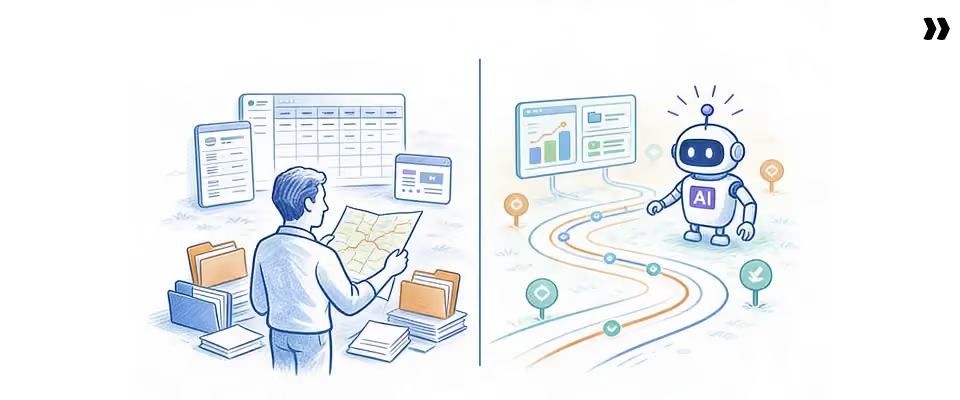
The gap between traditional and modern allocation operations is not incremental. It is structural.
Traditional IT effective resource allocation strategies rely heavily on spreadsheets, manual staffing coordination, reactive reallocations, delayed forecasting, and siloed project planning. Modern AI-powered allocation operations rely on live staffing visibility, skills-based allocation, predictive forecasting, utilization intelligence, and AI-assisted recommendations.
The shift is not just about speed. It is about the quality of decisions and the ability to identify problems before they become expensive.
How do traditional IT resource allocation models operate?
In a traditional model, a resource manager learns about a staffing conflict when a project manager sends a Slack message or flags a spreadsheet row. The correction happens reactively. By the time the conflict surfaces, the onboarding timeline has often already slipped and the customer has already felt it.
Traditional models depend on institutional knowledge, manual coordination, and delayed reporting. They work at small scale. They break at medium scale and above.
How does modern AI-powered resource allocation operate?
Why are AI-native PSA platforms replacing fragmented tooling?
Modern customer-facing services organizations are increasingly moving toward unified AI-powered PSA platforms because fragmented PM tools and spreadsheet workflows cannot support utilization optimization, predictive staffing, onboarding orchestration, or scalable delivery coordination simultaneously.
The value is not in any single capability. It is in having all of these capabilities connected inside one operational system.
Why are implementation teams outgrowing legacy PSA systems?
Many legacy PSA systems struggle with modern onboarding workflows, staffing intelligence, AI capabilities, customer collaboration requirements, and real-time operational visibility. The underlying architecture was built for a different era of services operations and the pace of change has outrun it.
Why does modern resource allocation require front-office and back-office orchestration?
Resource allocation now directly impacts onboarding velocity, customer communication, implementation quality, consultant leverage, and delivery scalability. It is no longer purely a back-office function. Every staffing decision has a direct front-office consequence for the customer.
Resource allocation maturity increasingly determines whether services organizations can scale onboarding, utilization, and delivery predictably.
What operating model enables effective IT resource allocation at scale?
The organizations that have solved IT resource allocation at scale are not necessarily using dramatically different tools than their competitors. They are using a fundamentally different operating model.
The strongest delivery organizations operationalize forecasting, utilization management, staffing intelligence, and allocation governance inside one connected delivery system instead of coordinating staffing manually across disconnected tools.
Why should capacity planning be continuous rather than quarterly?
IT resource capacity planning done quarterly creates a multi-month lag between operational reality and strategic response. Best-in-class organizations continuously forecast implementation demand, onboarding complexity, consultant availability, future staffing gaps, and hiring requirements instead of relying on static quarterly planning cycles.
By the time the quarterly resource allocation plan reflects current conditions, the conditions have changed again. Continuous forecasting closes that gap and makes the plan useful.
Why does skills-based staffing outperform role-based staffing?
High-performing services teams increasingly match consultants to projects based on onboarding complexity, certifications, implementation experience, utilization impact, and regional alignment rather than simple role availability.
This is the practical difference between efficient resource allocation and effective resource allocation. Efficiency assigns fast. Effectiveness assigns right.
Mature services organizations treat staffing decisions as implementation-risk decisions rather than calendar-management decisions. The strongest allocation systems optimize onboarding quality, utilization health, staffing sustainability, customer outcomes, and delivery scalability at the same time.
How do high-performing teams standardize allocation governance?
Mature IT resource allocation management increasingly includes staffing approval workflows, utilization thresholds, escalation routing, conflict resolution processes, and delivery prioritization rules.
Without governance, allocation decisions are inconsistent across project managers depending on who is making the call that day. With governance, the operational standard is embedded in the system rather than depending on individual judgment.
How do mature organizations treat utilization as a live operational metric?
IT resource utilization reviewed monthly is a lagging indicator that confirms what already went wrong. Utilization monitored continuously is an operational lever that shapes decisions before damage occurs. High-performing organizations continuously monitor billable utilization, bench capacity, staffing conflicts, onboarding velocity, and consultant overload risk instead of reviewing allocation health in monthly reports.
How does forecasting connect sales and delivery operations?
Best-in-class organizations increasingly connect CRM pipeline visibility, onboarding planning, staffing forecasts, delivery capacity, and hiring plans inside one operational system so that sales and delivery are never operating from different versions of reality.
When sales and delivery operate with separate data sets, staffing misalignment is the predictable result. Shared operational visibility makes resource allocation decisions faster and more accurate.
How do AI-powered operations reduce staffing coordination overhead?
Modern AI-powered PSA operations increasingly help teams identify staffing bottlenecks earlier, improve utilization predictability, recommend best-fit consultants, and automate operational coordination that would otherwise require hours of manual analysis.
The reduction in coordination overhead is not just an efficiency gain. It frees resource managers and project managers to focus on strategic allocation decisions instead of administrative ones.
How do high-performing teams run IT resource allocation workflows?

Understanding the principles is one thing. Understanding the actual workflow is another. Here is how the strongest delivery organizations run their resource allocation practices from start to finish.
Step 1: Forecast delivery demand before deals close
Leading organizations evaluate onboarding scope, customer complexity, implementation timelines, required expertise, and regional staffing resource needs before projects officially begin.
The fastest-scaling services organizations optimize onboarding speed before projects officially start. Forecasting IT resource allocation requirements earlier improves staffing readiness, utilization predictability, hiring confidence, and delivery scalability across the portfolio.
This means sales and delivery are aligned early. By the time a deal closes, the delivery team already has a staffing plan in motion rather than starting from scratch.
Step 2: Create soft allocations before projects begin
Soft allocations are tentative resource assignments for pipeline projects. They improve staffing readiness, capacity visibility, forecasting accuracy, and utilization predictability before onboarding officially starts.
Many organizations skip this step because it requires discipline when a project has not yet been confirmed. The organizations that do it consistently have fewer last-minute staffing crises when a deal closes unexpectedly fast.
Step 3: Match consultants based on implementation fit
High-performing staffing decisions balance technical expertise, onboarding experience, customer complexity, utilization sustainability, and consultant workload simultaneously.
This is where skills-based allocation creates a measurable advantage. An IT resource allocation matrix that maps consultant skills against project requirements makes this matching process systematic rather than intuitive and inconsistent.
Step 4: Monitor allocation health continuously
Modern allocation teams continuously monitor overallocation spikes, staffing delays, utilization drops, onboarding bottlenecks, and margin pressure instead of waiting for monthly IT resource allocation reports.
The difference between monitoring continuously and reviewing monthly is often the difference between a small correction and a full-blown escalation.
Step 5: Reallocate dynamically during delivery changes
Dynamic reallocation requires unified visibility. Mature organizations reallocate proactively when consultants take PTO, onboarding scope changes, escalations emerge, utilization spikes appear, or delivery timelines shift.
Without a single view of all active allocations, even the best-intentioned reallocation becomes a manual scramble with a high risk of creating new conflicts in the process of solving old ones.
Step 6: Tie staffing directly to utilization and margin performance
Best-in-class services organizations optimize onboarding quality, consultant leverage, staffing responsiveness, efficient resource allocation, and implementation profitability at the same time.
Every staffing decision has a margin implication. The strongest delivery organizations treat those implications as first-class operational data rather than a finance team concern that gets reviewed at quarter end.
Step 7: Use AI-powered PSA operations to reduce staffing coordination overhead
AI-powered PSA operations increasingly reduce manual staffing analysis, coordination overhead, delayed reallocations, utilization blind spots, and operational fragmentation while improving onboarding predictability and staffing responsiveness.
What best-in-class teams do differently: The strongest delivery organizations operationalize forecasting, staffing intelligence, utilization management, and allocation governance inside one connected operational system rather than coordinating resource assignments manually across disconnected tools.
Which KPIs do mature services organizations track for resource allocation?
IT resource allocation metrics are the difference between managing by feel and managing by data. Here are the indicators that mature services organizations treat as live operational signals rather than quarterly reporting numbers.
Mature services organizations treat IT resource allocation metrics as operational health indicators, not simply reporting KPIs. When one metric moves, it is usually a signal about something else that is about to move.
Billable utilization rate
Billable utilization directly impacts revenue efficiency, consultant leverage, and delivery profitability. Most mature services organizations target a sustainable utilization range rather than maximum utilization.
Pushing utilization too high increases burnout risk and delivery quality issues. Letting it fall too low creates margin pressure and bench cost. The operational target is a sustainable window, and the strongest organizations monitor it at the individual consultant level, not just at the team aggregate.
Staffing lead time
This measures how quickly an organization can fully staff onboarding and implementation projects without operational delays.
Long staffing lead times create onboarding delays, customer frustration, and revenue timing problems. Reducing staffing lead time is often one of the highest-leverage improvements a delivery organization can make, and it requires improving both skills visibility and forecasting discipline simultaneously.
Capacity coverage ratio
This measures whether future implementation demand exceeds available consultant capacity across the planning horizon.
The IT resource capacity planning conversation with sales leadership should be grounded in this metric. Without it, delivery teams make capacity commitments based on intuition rather than operational data.
Overallocation percentage
Sustained consultant burnout from overallocation increases onboarding instability, delivery risk, and attrition. The cost of replacing a senior consultant consistently exceeds the cost of managing utilization proactively.
IT resource allocation issues related to overallocation are especially difficult to catch in spreadsheet-based systems because the data is siloed across individual projects with no unified view.
Forecast accuracy
Poor forecasting creates staffing conflicts, delayed onboarding, reactive hiring, and margin pressure. Forecasting maturity increasingly determines operational scalability.
An IT resource allocation report that consistently shows large variances between planned and actual staffing is a sign that the forecasting model needs to be rebuilt, not patched with a better spreadsheet formula.
What are the most common IT resource allocation challenges and how do you solve them?
Even mature organizations face allocation challenges as onboarding complexity and delivery scale continue increasing. These are the most common IT resource allocation issues services organizations encounter and how modern teams address them.
These challenges tend to compound. A visibility problem creates a contention problem, which creates a burnout problem, which creates an attrition problem. Addressing the root cause early is significantly cheaper than addressing the downstream consequences.
Resource contention across multiple implementations
Without centralized staffing visibility, project managers compete for the same specialists, onboarding timelines slip, and utilization becomes unstable.
Modern organizations solve this through portfolio-wide staffing orchestration, where a single operational view shows all active resource allocations and surfaces conflicts before they escalate into delivery problems.
Scope creep destabilizing staffing plans
Many staffing failures begin when onboarding scope expands without corresponding allocation adjustments. The project grows. The staffing plan does not.
High-performing organizations continuously rebalance staffing during implementation changes instead of waiting for a formal replan cycle that may be weeks away.
Underutilized consultants and hidden bench capacity
Underutilization often results from weak forecasting, delayed reallocations, fragmented staffing visibility, and disconnected pipeline intelligence rather than simply low demand.
The IT resource allocation optimization problem here is not finding more work. It is matching available work to available talent faster and more accurately, which requires visibility that spreadsheets and generic PM tools cannot provide.
Consultant burnout from hidden overallocation
Mature teams monitor utilization spikes, escalation frequency, delivery delays, and workload imbalance to identify staffing strain before consultant burnout escalates into attrition.
Burnout is an allocation failure before it is a wellness issue. The operational signal exists in the data. Most organizations miss it because they are not watching the right IT resource allocation metrics in real time.
Sales and delivery misalignment
Many onboarding problems originate when sales commits timelines, onboarding models, and implementation expectations without validating delivery capacity operationally.
The fix is not a better handoff document. It is shared visibility between sales and delivery so that resource allocation aligns with what has actually been committed to customers before the deal closes.
Most resource allocation transformations fail because organizations modernize their tooling without modernizing their operational workflows.
How is AI changing IT resource allocation operations?
AI is not just changing what resource allocation tools can do. It is changing the fundamental operating model of services delivery.
The organizations adopting AI-powered resource operations are not moving slightly faster. They are operating with a qualitatively different level of visibility, intelligence, and coordination than teams still running manual workflows. The gap is structural, and it widens every quarter.
The shift from reporting systems to operational intelligence
Modern AI-powered PSA operations increasingly predict staffing bottlenecks, utilization risk, onboarding delays, consultant overload, and capacity resource shortages before delivery suffers. Traditional systems track staffing after delivery problems happen.
A reporting system tells you what went wrong. An intelligence system tells you what is about to go wrong. For services leaders managing dozens of concurrent implementations, that distinction is enormous.
Across Rocketlane's base of 750+ customers, teams using AI-powered staffing recommendations reduce time-to-staff by 60 to 70% and cut overallocation incidents by 40% within the first 90 days of deployment.
Traditional allocation workflows relied heavily on spreadsheets, staffing meetings, manual forecasting, and delayed IT resource utilization reporting. Modern AI-powered operations increasingly rely on predictive staffing visibility, operational intelligence, utilization forecasting, AI-assisted orchestration, and proactive delivery coordination.
What changes operationally with AI-powered resource allocation
AI-powered operations increasingly help organizations identify staffing risks earlier, improve allocation quality, optimize consultant utilization, reduce coordination overhead, and forecast onboarding bottlenecks before they impact customers.
The reduction in time spent on manual resource assignments is real. More importantly, the quality of those assignments improves because AI can evaluate more variables simultaneously than any resource manager can hold in their head during a Monday morning staffing call.
How Nitro transforms resource allocation workflows
Once staffing visibility and delivery operations are unified inside a modern PSA platform, AI capabilities like Rocketlane's Nitro help organizations identify staffing bottlenecks proactively, surface IT resource utilization risk earlier, evaluate allocation impact faster, optimize consultant coordination, and reduce operational overhead across the delivery organization.
This shifts IT resource allocation management from reactive staffing coordination toward predictive operational orchestration. A resource manager can ask the system which consultants match a specific implementation profile and get an answer in seconds. The same question in a spreadsheet-based system can take hours and still produce an incomplete answer.
Why AI changes professional services economics
AI-powered resource allocation increasingly helps organizations improve consultant leverage, reduce operational overhead, optimize onboarding scalability, increase delivery predictability, and scale implementation operations without proportional headcount growth.
For services leaders, the economic case comes down to one question: can the team handle more projects at the same quality level without burning out? AI-powered allocation increasingly makes that possible.
The future of agentic PSA operations
The next generation of PSA platforms will increasingly orchestrate staffing dynamically, optimize utilization continuously, predict onboarding risks proactively, and coordinate delivery operations in ways that remove the manual coordination tax that currently consumes so much of a resource manager's week.
AI-powered PSA operations are increasingly transforming IT resource allocation from delayed staffing coordination into predictive operational orchestration.
Why are modern services organizations moving to AI-powered PSA platforms?

The migration away from fragmented tooling is accelerating. Understanding why helps services leaders make the case internally and choose the right operational path forward.
Modern services organizations need resource management tools that reflect how delivery work actually operates today, not how it operated a decade ago.
Why do spreadsheets fail for IT resource allocation at modern delivery scale?
Spreadsheets increasingly fail because they lack live staffing visibility, utilization intelligence, forecasting automation, operational governance, and onboarding orchestration.
IT resource allocation in a spreadsheet requires constant manual maintenance. The data is always slightly out of date. The decisions made from that data are correspondingly unreliable.
Why can PM tools not solve staffing optimization at scale?
Most project management software optimizes workflows, tasks, and collaboration. It does not optimize staffing orchestration, consultant economics, onboarding coordination, or utilization forecasting.
This is not a failure of PM platforms. They solve the problems they were designed to solve. The problem is using them for problems they were not designed to solve, specifically the complex, multi-variable challenge of allocating resources across a growing implementation portfolio.
Why are services organizations replacing fragmented tooling with unified PSA platforms?
Modern organizations increasingly prefer unified operational systems that combine staffing visibility, onboarding coordination, IT resource utilization intelligence, delivery orchestration, and AI-powered workflows inside one platform.
Resource allocation complexity eventually outgrows spreadsheets, PM tools, and static PSA workflows once onboarding scale increases, staffing coordination becomes fragmented, utilization pressure rises, and delivery operations become harder to orchestrate simultaneously.
When do organizations typically outgrow manual resource allocation?
Organizations usually reevaluate their operational systems when utilization targets begin slipping, staffing delays start increasing, onboarding complexity scales faster than team capacity, consultants start showing signs of overload, and forecasting confidence weakens.
These signals often appear together. If two or three are present simultaneously, the organization has likely passed the point where incremental improvements to existing tools will address the underlying problem.
Why do modern services teams prefer unified operational visibility?
Leading organizations increasingly want staffing intelligence, onboarding orchestration, utilization visibility, AI-powered forecasting, and delivery coordination inside one connected operational system rather than spread across five tools that require manual reconciliation.
The efficiency gains from consolidation are real. But the more significant benefit is the operational clarity that comes from having one source of truth for staffing, utilization, and delivery performance at the same time.
Why is Rocketlane a strong fit for modern customer-facing services teams?
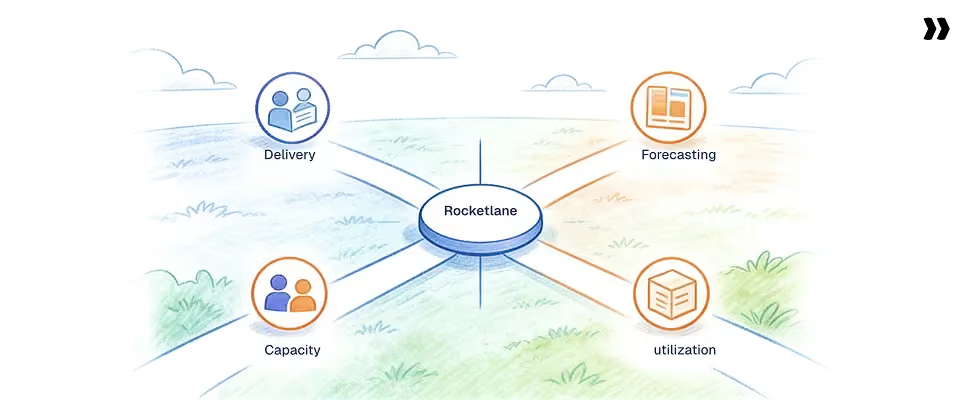
For scaling customer-facing professional services organizations, Rocketlane is a strong fit for IT resource allocation because it combines AI-powered staffing visibility, onboarding orchestration, utilization intelligence, forecasting, and customer-facing delivery coordination inside one unified PSA platform.
Rocketlane is an agentic execution platform, the shift from merely tracking work to actively executing it is exactly what separates purpose-built PSA operations from generic project tools with staffing add-ons.
Trusted by 750+ customers with a 4.7 G2 rating and a 94% G2 recommendation rate, Rocketlane secured a $60M Series C from Insight Partners in March 2026.
Revenue more than doubled year-over-year, and average deal size grew 4.5x since 2023 for teams that operationalized resource allocation through the platform. Unlike legacy systems that rely on batch processing to reconcile staffing and utilization data, Rocketlane runs on no batch processing -- real-time data flows across staffing, delivery, and financials so resource managers always have a current picture, not a lagging one.
How does Rocketlane compare to other IT resource allocation platforms?
For services teams evaluating PSA platforms for resource allocation, the table below compares the capabilities that matter most for teams managing 20+ concurrent implementations.
Which IT resource allocation approach is right for your team?
Why does Rocketlane approach resource allocation differently from legacy PSA tools?
Most legacy PSA systems focus primarily on reporting, finance workflows, and back-office operations. Rocketlane combines front-office delivery execution, staffing intelligence, onboarding orchestration, utilization visibility, and AI-powered operational workflows inside one modern PSA platform.
The distinction matters because customer-facing professional services is fundamentally a front-office function. IT resource allocation that only optimizes for back-office efficiency misses the most important operational variable: delivery quality and the customer experience that drives retention and expansion.
How does Rocketlane provide unified visibility across staffing, delivery, and utilization?
Rocketlane enables real-time staffing visibility, proactive allocation coordination, reduced double-booking, centralized resource intelligence, and faster onboarding staffing decisions.
The heat map view showing resource availability and IT resource utilization across the entire consultant team provides the kind of visibility that most services organizations currently approximate with spreadsheets and weekly status meetings.
How does skills-based staffing in Rocketlane improve allocation quality?
Rocketlane supports detailed skills visibility, consultant proficiency tracking, availability intelligence, utilization-aware staffing, and onboarding-fit staffing decisions at the portfolio level.
The ability to filter by skill, certification, and availability simultaneously turns what was a multi-hour staffing search into a fast, accurate match that resource managers can complete and confirm in minutes.
How does Nitro transform resource management from reactive to predictive?
Nitro helps services organizations forecast staffing bottlenecks earlier, identify utilization risk proactively, optimize consultant allocation, reduce staffing coordination overhead, and improve onboarding responsiveness.
The resource management agent capability within Nitro allows teams to use natural language to ask questions about staffing and receive actionable answers immediately, without pulling data from multiple systems and reconciling it manually.
What changes operationally after moving to Rocketlane for resource allocation?
Our analysis of 750+ customer implementations shows that organizations moving to Rocketlane typically see staffing lead time drop from a median of 4.2 days to under 6 hours within the first quarter, with overallocation incidents falling by 35 to 45% and billable utilization improving by 12 to 18 percentage points over the first six months.
One US-based SaaS implementation firm managing 30+ concurrent enterprise onboardings eliminated its weekly staffing escalation meeting entirely within 60 days of deployment -- freeing 6 hours per week of delivery leadership time that had previously gone to resolving allocation conflicts manually.
Organizations moving to Rocketlane typically improve onboarding predictability, staffing responsiveness, utilization visibility, allocation coordination, and delivery scalability while reducing staffing chaos, reporting overhead, and operational fragmentation.
"The visibility we now have across our team's availability, skills, and project load has completely changed how we staff. What used to take hours of back-and-forth now takes minutes."
Rocketlane customer, VP of Delivery, enterprise SaaS firm (G2 review)
What to know before you buy: addressing common Rocketlane objections
Teams evaluating Rocketlane for IT resource allocation often raise four concerns. Here is how each resolves in practice.
Objection 1: "It is too expensive for our team size." Rocketlane's total cost of ownership compared to fragmented tools consistently shows a 5 to 10 point margin lift, translating to $250,000 to $500,000 per year in savings for mid-size PS teams. For most firms, the utilization gains alone -- typically 12 to 18 percentage points within six months -- cover the platform cost many times over.
Objection 2: "Our reporting requirements are too complex for a standard tool." Rocketlane's Nitro Analyst answers resource, utilization, and staffing questions in plain language from live data. Teams get the signals they need -- overallocation risk, bench exposure, margin by project -- while work is still in flight, not in a month-end report.
Objection 3: "The learning curve will slow us down." Rocketlane ships with a pre-built Playbook library covering implementation, onboarding, and staffing workflows. Most teams reach go-live in 4 to 8 weeks with a dedicated customer success manager. Staffing templates and skills libraries are pre-configured for common PS team structures, reducing setup time significantly.
Objection 4: "We only need resource scheduling, not a full PSA." Rocketlane is a full PSA platform -- delivery execution, resource management, financial reporting, and client collaboration in one system. Resource allocation only reaches its full impact when it is connected to the project timelines, billing milestones, and utilization targets it governs. Standalone scheduling tools cannot close that loop.
What do best-in-class services organizations do differently with resource allocation?
The organizations outperforming operationally in professional services delivery tend to follow similar principles regardless of company size or vertical.
Understanding what separates them from the rest is useful for any services leader trying to build a more scalable, more profitable delivery operation.
Why do best-in-class teams treat resource allocation as a revenue system?
Effective resource allocation decisions increasingly impact onboarding margins, implementation velocity, consultant leverage, customer outcomes, and delivery scalability.
The shift from treating resource allocation as an administrative function to treating it as a revenue system changes how organizations invest in it, govern it, and measure it. The best-performing delivery organizations made that shift a few years ahead of everyone else.
How do leading teams connect sales, delivery, and staffing operations?
Best-in-class organizations increasingly unify CRM forecasting, staffing planning, onboarding coordination, utilization management, and delivery governance inside one connected operating model.
When these systems operate separately, the operational seams between them become delivery bottlenecks. A deal closes on Friday. The resource manager finds out Monday. The customer expects a kickoff by Wednesday. That timeline is only achievable when the systems are connected.
How do high-performing organizations operationalize AI for resource allocation?
Leading organizations increasingly use AI operationally for staffing optimization, onboarding forecasting, IT resource utilization intelligence, delivery risk identification, and operational orchestration.
The organizations still running AI pilots while managing allocation on spreadsheets are building a competitive disadvantage, not just an operational inefficiency.
Why do top-performing teams standardize workflows before scaling?
High-performing services organizations standardize staffing governance, forecasting discipline, utilization management, allocation escalation workflows, and onboarding coordination before scaling implementation operations aggressively.
Scaling a broken workflow produces a bigger broken workflow. The organizations that standardize first and scale second consistently outperform the ones that try to do both simultaneously.
IT resource allocation increasingly determines whether services organizations can scale onboarding efficiently, improve utilization sustainably, protect implementation margins, reduce consultant burnout, and grow delivery operations predictably without proportional operational overhead.
Best-in-class services organizations increasingly treat resource allocation as a strategic operating system rather than an administrative scheduling function.
Conclusion
IT resource allocation is no longer simply a staffing coordination problem.
For modern customer-facing professional services organizations, it increasingly determines onboarding scalability, implementation velocity, consultant leverage, utilization efficiency, profitability, and long-term operational maturity.
The organizations scaling delivery most effectively have replaced fragmented staffing operations with unified PSA visibility, predictive forecasting, AI-assisted staffing, utilization intelligence, and agentic operational workflows. The competitive advantage increasingly belongs to services organizations that operationalize resource allocation proactively instead of managing staffing reactively.
The gap between those two operating models is not closing. It is widening every quarter.
For services teams trying to close it, the path typically starts with one honest question: how much of your resource allocation process is still happening in spreadsheets, and what is that costing you in utilization leakage, onboarding delays, and consultant burnout?
That is exactly the problem Rocketlane is built for. As a modern AI-powered PSA platform, Rocketlane brings together staffing visibility, utilization intelligence, onboarding orchestration, and AI-driven resource management into one operational system that grows with the team. For services organizations moving from fragmented tooling to unified delivery operations, it represents a genuine step toward the kind of allocation maturity that drives predictable, profitable growth at scale.

Authored by

Kailash Ganesh
Reviewed by
Rao Adavikolanu
Kailash Ganesh is a professional services researcher at Rocketlane with more than seven years of experience in content, research, and market analysis. He studies how enterprise PS teams are adopting agentic AI to transform delivery operations, has evaluated every major PSA platform in the category, and writes from the perspective of a practitioner who watches enterprise PS teams make these exact decisions daily.
Table of Contents

Regsiter for the live webinar


Great consultants didn't join your team to spend Fridays writing documentation.
Table of contents
18 of Forbes Cloud 100 chose Rocketlane. The best PS teams aren't waiting around.
FAQs
What is IT resource allocation and what does it include?
IT resource allocation is the process of strategically assigning consultants, implementation teams, and delivery capacity across projects based on skills, availability, utilization targets, and business priorities. Modern IT resource allocation combines capacity planning, staffing optimization, and delivery governance inside one operational system.
Why is IT resource allocation important for professional services organizations?
Effective IT resource allocation improves utilization, onboarding predictability, staffing quality, and consultant leverage while reducing burnout, staffing conflicts, and margin leakage. For professional services teams, it directly determines both delivery quality and profitability across the entire implementation portfolio.
What are the biggest IT resource allocation challenges?
The biggest IT resource allocation issues include fragmented staffing visibility, inaccurate capacity forecasting, consultant overallocation, skills mismatches, and disconnected operational systems. These challenges often compound: poor visibility creates contention, which creates burnout, which creates attrition.
What is the difference between resource allocation and capacity planning?
Resource allocation focuses on assigning consultants and delivery capacity to active onboarding and implementation work. IT resource capacity planning focuses on forecasting whether future implementation demand can be supported operationally given current staffing levels, skills availability, and pipeline commitments.
How do modern services organizations improve IT resource utilization?
Best-in-class organizations improve IT resource utilization through predictive staffing, unified PSA visibility, AI-assisted allocation, live operational intelligence, and skills-based matching rather than availability-first assignment. They also monitor utilization continuously rather than reviewing it in monthly reports.
What are the most important IT resource allocation metrics?
Key IT resource allocation metrics include billable utilization rate, staffing lead time, capacity coverage ratio, forecast accuracy, bench utilization, and overallocation percentage. These function as leading indicators of delivery health rather than lagging financial reports.
Why do spreadsheets fail for IT resource planning at scale?
Spreadsheets lack real-time staffing visibility, utilization intelligence, forecasting automation, and operational governance. As IT resource planning complexity grows with onboarding volume, spreadsheets create fragmentation that makes accurate allocation decisions increasingly difficult and time-consuming.
What are the best resource management software for IT allocation?
Modern AI-powered PSA platforms are increasingly preferred because they combine onboarding orchestration, staffing visibility, utilization intelligence, forecasting, and operational coordination inside one connected system rather than requiring multiple disconnected resource allocation tools.
How does AI improve IT resource allocation decisions?
AI improves IT resource allocation by predicting staffing bottlenecks before they emerge, identifying utilization risk early, recommending consultants based on skills and real-time availability, optimizing allocation quality across the full portfolio, and automating operational coordination that would otherwise require significant manual effort every week.













Copyright © 2026 Rocketlane Corp. All rights reserved.


















.webp)