Same Team, 3x Projects: How SaasGenie Built a Delivery System That Scales


•
•
Summarize blog with






In September 2024, SaasGenie—a five-month-old bootstrapped services startup—landed three new projects worth $75K in a single week. It should have been a moment to celebrate. Instead, Raj Rajasekar, the company's founder, felt dread. He didn't know if his team could deliver them.
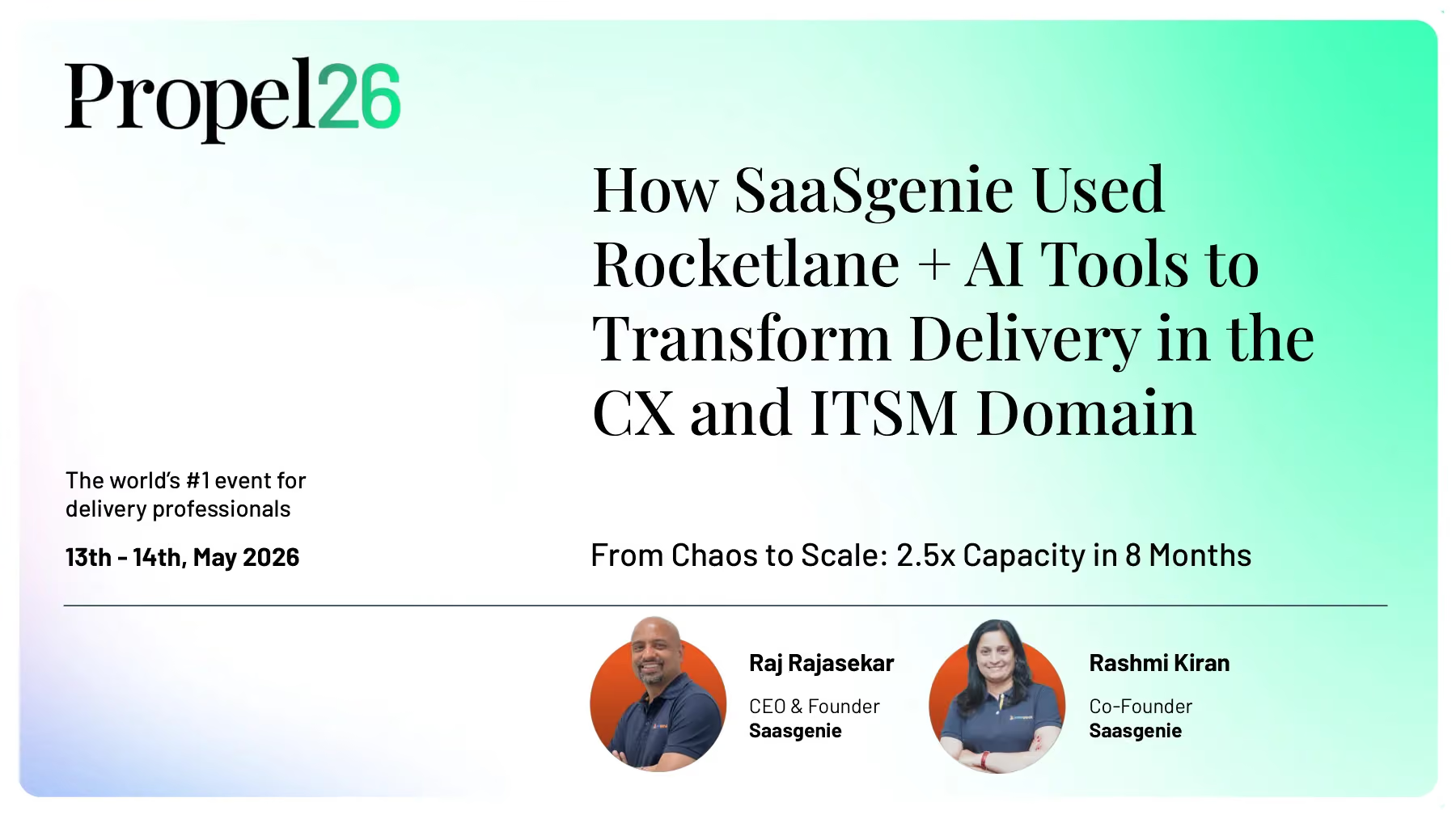
Raj Rajasekar and Rashmi Kiran, co-leads at SaasGenie, took the stage at Propel 26 to share what happened next: a 12-week build that turned a team running on instinct and overtime into a delivery operation capable of handling two to three times the project volume—with the same 35 people.
Read on for the key takeaways from the session.
Why a 35-Person PS Team Was Drowning in Busywork
SaasGenie was completing only 60% of its projects on time in September 2024. Engagement managers were working every weekend, sending status reports, tracking consumed and remaining hours across customers, and manually answering questions that customers could have—and should have been able to—answer themselves.
Utilization across the team was running above 120 hours. People were threatening to leave.
"It's not the first weekend," Rashmi said, describing a conversation with one of their highest-performing engagement managers. "She's been working the last two months, every weekend."
The deeper problem wasn't effort—it was process. Every engagement manager was running their own workflow. Customers had to email to ask for project status.
Resource decisions were made on gut feel: who's probably available this week, who might be free next week, no data behind any of it. Leadership couldn't see project health without asking someone to compile it manually.
"I don't even know the company was running for five months," said Raj. "We had 100 plus projects on a gut basis—based on vibes."
The firm needed structure before it could add speed. That was the first principle the team agreed on before building anything.
The 12-Week Build: Foundation First, Then Intelligence, Then AI
SaasGenie ran their transformation in three distinct layers over 12 weeks—and Rashmi was direct: skipping the first one would have broken everything else.
Weeks 1–4: Foundation. Before any tooling went live, the team brought all project managers together to build a common process. Templates were created for each product line that SaasGenie supports.
Rocketlane objects were mapped to the data the team needed for capacity models and resource planning. This phase also included change management: a core team of product PMs and consultants was trained on Rocketlane so they could coach the broader team.
"This is the most important, and it was the most difficult," said Rashmi. "Not technically—but the process."
Weeks 5–8: Intelligence. With the foundation in place, the team connected Rocketlane to HubSpot. When a deal closes in HubSpot, a project is automatically created in Rocketlane—with project data, customer context, and resource skill sets already populated for the PM.
A capacity model was built from that integrated data. "We wanted data to tell us who is available and who is not," Rashmi said. "We did not want to have those insights without data."
Weeks 9–12: AI automation. Only after the data was clean did the team add AI—and they introduced it into workflows one at a time to manage change. Status reports, meeting minutes, documentation, customer email responses, and time tracking were added sequentially, with the team validating each result before moving to the next.
The entire stack ran on one core philosophy: Rocketlane provides structure and a single source of truth. AI provides speed.
Together, they make scale possible. "Rocketlane alone will not bring us anything," Raj said. "With AI, we are able to eliminate the busy work. And that's how both of them together—we are able to scale our delivery."
The Four AI Workflows That Freed the Delivery Team
SaasGenie built its AI layer around four operational workflows, each following the same 80/20 rule: AI handles 80% of the work, a PM reviews and approves the remaining 20%.
Status reports. SaasGenie uses Rocketlane's native AI for this. The report surfaces pending tasks, completed milestones, and flagged risks in a structured format. The PM reviews and sends. Customers no longer need to ask for updates—they're delivered proactively.
Meeting minutes. AI recording tools capture calls and produce formatted output: action items, decisions made, and next steps. The PM reviews the notes and sends them to the customer. "The PM just reviews the meeting notes and sends it out," said Rashmi.
Documentation. Discovery notes from recorded meetings feed into Claude or ChatGPT to generate first-draft SOPs and configuration documentation. Product consultants add screenshots and expertise, and then the document is ready. The AI handles structure; humans handle judgment.
Customer email responses. Emails that previously required reading context, drafting a reply, and tracking back through the project thread are now drafted by AI. A PM reviews and sends. Response time dropped significantly.
Beyond these four, SaasGenie built three proprietary tools for their highest-friction delivery areas: an AI-powered data migration tool that reads legacy schemas, maps fields, and runs quality checks (cutting migration time by 50%); a system configuration accelerator using Claude Code to configure products directly from discovery transcripts; and an integration builder that uses AI to generate API specs and build reusable modules.
"These three areas—data migration, configuration, integrations—are where delays and escalations happen," said Raj. "Whatever we could do with AI, we did. And we focus human effort on the critical, sensitive work AI can't handle."
4 Key Takeaways from Raj Rajasekar and Rashmi Kiran on Scaling PS Delivery
Structure before speed—every time. The instinct when you're overwhelmed is to move faster. SaasGenie's counterintuitive lesson: slow down first and build the foundation. Common templates, standardized processes, and clean Rocketlane objects.
Without this, AI automation has nothing reliable to work on. "You can't build AI on top of chaos," as their session partner, Joey Poarch, said the same morning—and SaasGenie's 12-week journey proves it.
Never automate everything at once. Each of SaasGenie's AI workflows was introduced individually. Show results first, then earn buy-in for the next change. "Don't ever automate everything at once—it's not worth it," said Raj. The same applies to integrations: use native connections before building custom ones.
The 80/20 rule protects quality and team trust. AI does 80% of the work; humans review 20%. This isn't a temporary workaround—it's a deliberate operating model. It prevents AI errors from reaching customers, keeps the team engaged in meaningful work, and ensures the output stays trustworthy. "We are not really eliminating any of the resources," Raj said. "We are saving all the busy work for them."
The ROI compounds fast. SaasGenie invested approximately $60K across Rocketlane and AI tools. The return they're attributing to the transformation: $1M–$1.4M in value.
On-time project delivery moved from 60% to 90%. Partner escalations dropped substantially. The 35-person team now handles two to three times the project volume it did in September 2024—and engagement managers are no longer working weekends.
Conclusion
SaasGenie's session at Propel 26 was a ground-level proof of concept for something the day's keynote described in theory: PS teams that use structure and AI together can scale delivery without scaling headcount.
The 12-week build Raj Rajasekar and Rashmi Kiran described wasn't complicated. Foundation first—common templates, shared processes, clean data.
Then, intelligence integrations that populate Rocketlane with the context PMs need.
Then, AI workflows were introduced one at a time, each validated before the next. The flywheel that followed didn't require new hires or new products. It required a team willing to standardize before they automated.
For any PS organization still running on gut feel and spreadsheets, SaasGenie's lesson is clear: the system that gets you to 35 people and 60% on-time delivery will not get you to 2x or 3x scale. You need to build before you can grow.
Based on live session data from Propel 26 (May 2026) and aggregate outcomes from 750+ Rocketlane customers.
Check out the rest of our Propel 26 recaps here for more insights from the industry's best.
Table of Contents

Regsiter for the live webinar


Great consultants didn't join your team to spend Fridays writing documentation.
Table of contents
18 of Forbes Cloud 100 chose Rocketlane. The best PS teams aren't waiting around.
FAQs













Copyright © 2026 Rocketlane Corp. All rights reserved.


















.webp)