

.avif)
The salesperson has left. The project manager has left. And the only people left are the delivery team and the client's project team—who, it turns out, have been asking for the wrong things the entire time.
The actual goal of the project, the one the client justified to their CFO, was never in the room.
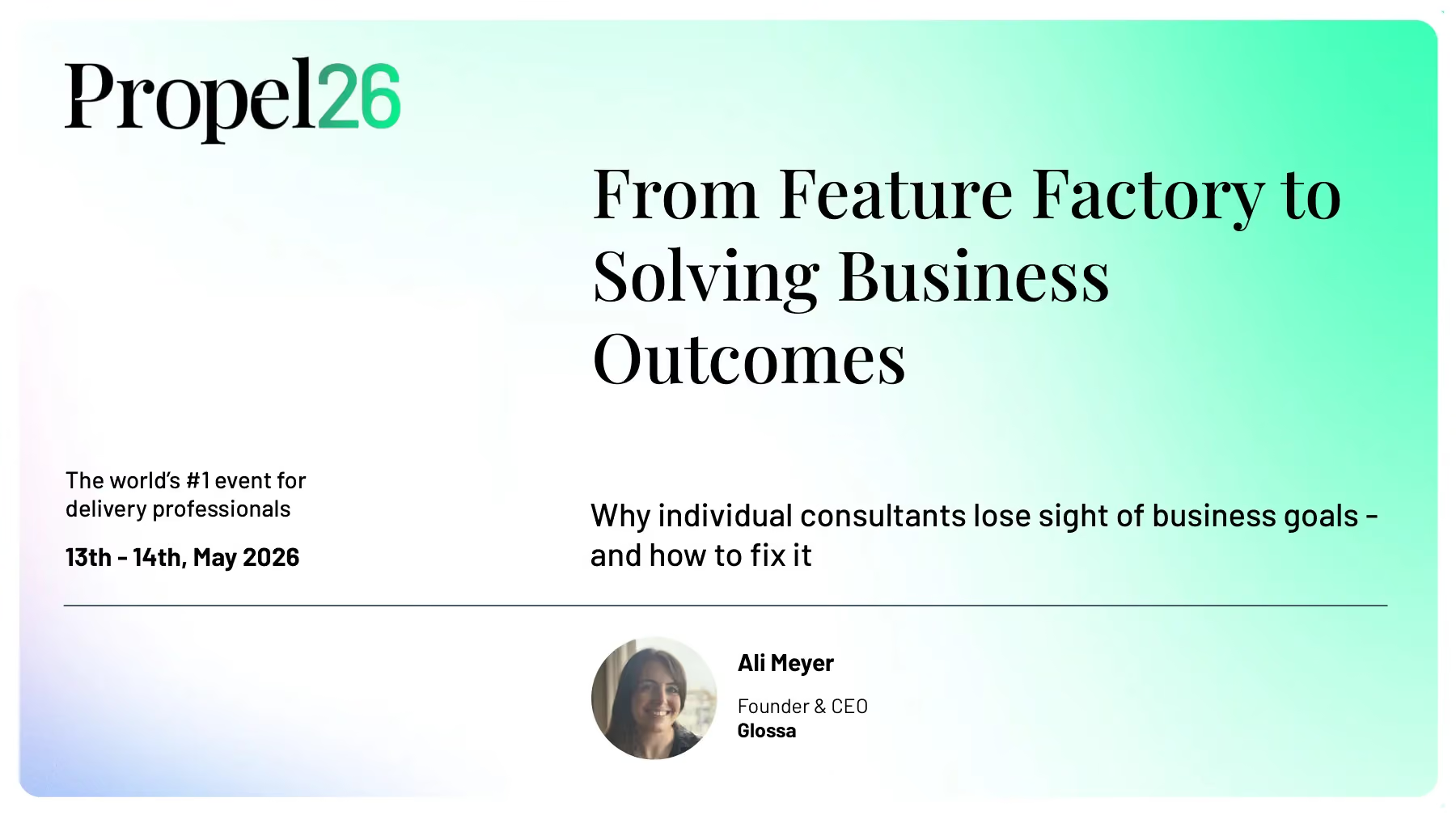
Ali Meyer, founder of Glossa, an AI requirements management tool, opened her Propel 26 session with a story from her own career that nobody in the room wanted to hear—because everyone recognized it.
She has worked in implementations for over a decade: as a Salesforce consultant, in product at Salesforce, and as head of product at a startup buried in red account implementations.
Her message was direct: very bad things happen when outcomes get dropped between sales and delivery, and the industry has been letting it happen for too long.
Read on for the key takeaways from the session.
The Story Nobody Wants to Admit Is Theirs
Meyer's red account was a global insurance carrier. Complex implementation. Long sales cycle.
When she got pulled in, the team was already past the original go-live date and still gathering requirements with the client project team—because the salesperson who sold the deal had left, taking all the context with them.
The project was moving. Requirements were being defined. Meyer thought they were making progress from red toward yellow.
Then, in a meeting with the client executive, a new item surfaced. It wasn't a small addition. It wasn't possible in the product. The exec's response: that's not my problem—that's what sales told me.
What followed was the revelation that made everything click: the entire justification for the implementation was to eliminate a team doing manual work. The product needed to automate everything that the team did.
That outcome had been agreed upon in the sales cycle. And it had never reached delivery, the client project team, or anyone actually building the solution.
"This whole time we had been taking requirements from the client project team, building around the problem, all the things that they wanted," Meyer said. "When really we had missed the whole goal of the project."
She asked the room two questions.
First: have sales ever sold something you've been on the hook for that wasn't quite possible in the product? Almost every hand went up.
Second: Have you ever had a miscommunication between the client exec and the client project team? Same result.
Why Outcomes Keep Getting Dropped
The handoff problem isn't a people problem. It's structural.
Sales conversations are rich with context: pain points, ROI justification, the business goal the client is trying to hit, and the outcome that justified the purchase in the first place.
That information exists. Then the handoff happens. Maybe it's a 20-minute call. Maybe it's a voice memo. And what actually gets transmitted to delivery is a list of features—not the outcomes behind them.
"The person writing the SOW is doing a translation in their head," Meyer said. "This pain point can be solved by feature A. This other pain point can be solved by feature B." Delivery builds feature A and feature B. The project is considered successful when both ships are on time. Nobody goes back to check whether the original pain points were actually solved.
The downstream effects compound. Projects balloon because the delivery team has no outcome to anchor to when clients request more scope.
Live clients churn because the product technically works, but it isn't solving their specific business problems. Every project feels like a special snowflake because the repeatability of features doesn't translate to the repeatability of outcomes.
"You are exacerbating a lot of problems that were always latent," Meyer said, "but are now going to be so much more pronounced in an AI world."
Three Steps to Anchor Delivery to Outcomes
Meyer offered a practical framework—not a business model overhaul, but a set of lightweight steps any delivery team can apply to an active project today.
Step 1: Define your outcomes. A well-defined outcome has three components: a baseline value, a target value, and a financial impact. How does this outcome save, protect, or generate revenue? Without that, there's no way to measure whether delivery succeeded. "This is not rocket science," Meyer said. "This is just goal setting—but for your project."
Step 2: Align your outcomes. Defining outcomes is only half the work. The harder part is making sure every stakeholder—the client exec, the client project team, your architects, your BAs, your PMs—is working toward the same goal.
Meyer's principle: translate, don't transmit. Repeating what the executive said verbatim to the project team doesn't create alignment.
Translating the outcome into terms that resonate with each group does. "Document them, come back to them frequently," she said. "People forget. People renegotiate. You'll be shocked how often."
Step 3: Tie requirements to outcomes. Once outcomes are defined and aligned, every requirement should map to one of them.
If a requirement can't be traced to an outcome, one question surfaces immediately: Why are we doing this? If an outcome has no associated requirements, another follows: how are we delivering it?
This mapping keeps scope narrow, gives delivery teams the language to push back on requests that don't serve the project goal, and creates the foundation for a repeatable services catalog built around outcomes rather than features.
"If you can see what mechanisms you're using to deliver these outcomes across clients," Meyer said, "you can start building a library of repeatable ways to deliver them."
Rocketlane enters the picture downstream: once requirements are structured and mapped to outcomes, they can be plugged directly into Rocketlane as tasks.
Meyer noted that Glossa and Rocketlane already share mutual customers—Glossa captures and structures the discovery context first, and Rocketlane takes it from there into delivery.
4 Key Takeaways from Ali Meyer on the Sales-to-Delivery Handoff
Every bad project traces back to bad requirements. Scope creep, client churn, projects that balloon, products that technically work but don't solve anyone's problem—these are all symptoms of the same root cause: outcomes that were never documented, aligned, or carried through to delivery.
The sales-to-delivery handoff is where outcomes go to die. Sales captures rich context during the discovery cycle. By the time delivery starts, that context has been compressed into a feature list. The fix isn't a longer handoff meeting—it's a structured process that captures outcomes in the sales cycle and makes them legible to delivery teams.
Translate rather than transmit. Alignment isn't achieved by forwarding what the exec said. It requires a consultative layer—explaining the outcome in terms that the project team, architects, and client users can each act on. This is how you build trust across the chain and keep everyone building toward the same goal.
Outcome-tied requirements are the foundation for scale. Once you can see which mechanisms delivered a specific outcome across multiple clients, you can build a repeatable library of delivery patterns. That's not repeatability of features. It's repeatability of outcomes—far more flexible and far more valuable.
Conclusion
Ali Meyer's session at Propel 26 made a case that's easy to dismiss until you've lived it: the sales-to-delivery handoff isn't a coordination problem—it's a structural gap that turns good products into red accounts.
The fix isn't a new business model or a pricing overhaul. It's three steps: define outcomes with a baseline, a target, and a financial impact; align those outcomes across all stakeholders who touch the project; and tie every requirement back to an outcome so the delivery team always has an anchor when scope pressure arises.
In an AI-first market where delivery speed is accelerating, and the cost of rework is compounding, getting requirements right before the project starts isn't a nice-to-have. It's the difference between a project that delivers what was promised and one that delivers what was asked for.
Based on live session data from Propel 26 (May 2026) and aggregate outcomes from 750+ Rocketlane customers.
Check out the rest of our Propel 26 recaps here for more insights from the industry's best.






























.webp)