AI in PS delivery: A 2026 guide for professional services leaders
.avif)


•
•
Summarize blog with






It is Monday morning. The Head of Professional Services has 60 active implementations on her portfolio. She knows three of them are probably at risk. She does not know which three. Her resource manager flagged two senior consultants at 140% allocation this morning, an accidental discovery.
At 2 PM, she has a leadership review where someone will ask which projects are on track, what utilization looks like this quarter, and whether the team can absorb the 12 deals that closed last week.
She does not have a data problem. She has a delivery architecture problem. Manual, fragmented PS delivery cannot surface those answers in real time, no matter how hard the team works.
AI is changing this. Not with promise, but with measurable outcomes for teams running exactly this kind of complexity across back-office and front-office work. Customer expectations keep climbing, delivery time keeps compressing, and headcount budgets keep flat. Something has to give.
What is AI in PS delivery, and what it isn't
AI in PS delivery is the application of intelligent agents inside professional services operations. The agents automate administrative overhead, monitor delivery risk in real time, and execute project work that currently consumes consultant and PM capacity. It is not a chatbot, not a reporting dashboard, and not a generic AI tool used informally alongside delivery.
This ICP has been burned by hype, so the definition matters. Three distinctions hold the line.
First, AI in PS delivery is not "AI features" bolted onto a legacy PSA. A legacy PSA with an AI feature still requires manual context entry. The AI sees only what someone typed in. It has no knowledge of the project, phase, client, or last call.
Second, AI in PS delivery is not general-purpose AI used informally. ChatGPT helping a PM draft a status email is useful. It is not professional services AI transformation. The PM is still the integration layer between the tool and the project data.
Third, real AI in PS delivery operates inside live project data, with full portfolio context, and executes work autonomously within defined parameters. The agents see what the system sees: timesheets, allocations, milestone status, client communications, budget burn. They take action without a human initiating each step.
That last distinction is what changes the math. AI that runs inside the delivery system, not next to it, is what produces the 40% capacity gain teams keep reporting. Anything less is a productivity tool, not a delivery model.
How does traditional PS delivery compare to AI-powered delivery?
What is the three-level AI transformation framework for PS delivery?
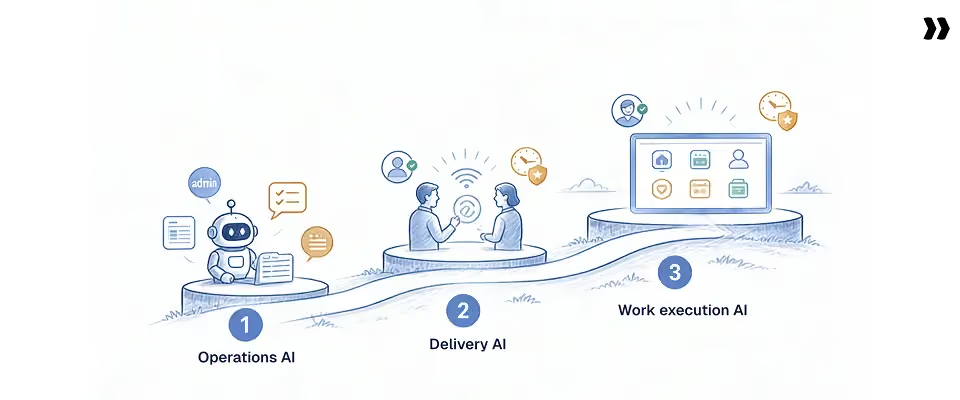
AI transformation in PSA delivery operates across three levels: operations AI (Level 1) that automates business management; delivery AI (Level 2) that proactively monitors and surfaces risk; and workforce AI (Level 3) that executes delivery work autonomously.
Most PSA vendors have reached Level 1. Few have genuine Level 2. Almost none have Level 3.
This is the AI in the PSA delivery framework that holds the other sections of this guide together. The level a vendor reaches sets the ceiling on ROI. Level 1 saves admin time. Level 2 prevents expensive mistakes. Level 3 multiplies delivery capacity without headcount.
Most of the AI noise in PS right now lives at Level 1. That is becoming table stakes. The teams building a real competitive advantage are deploying Level 2 and Level 3, and finding that almost no legacy PSA vendor can take them there.
Each level builds on the one before. Teams that try to start at Level 3 without Level 1 foundations struggle. The sequence matters, and it sets the structure for the rest of this guide.
Level 1: How AI is eliminating the admin tax on PS teams
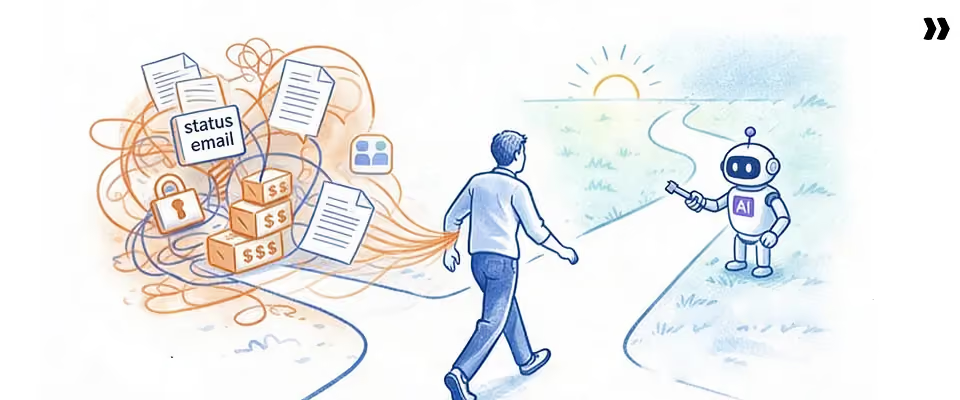
This is where most mid-market PS teams should start. The ROI is immediate, the risk is low, and the AI in the PS delivery process at this level is production-ready today. Three operations AI capabilities lead the value.
1. Timesheet governance and compliance
- The pain: Compliance errors caught at invoice. Weekly correction cycles consuming manager time. Billing leakage no one can trace.
- The change: AI enforces compliance rules written in plain English at the point of entry, before timesheets reach the review stage.
- What it does: Rules like "flag entries over 8 hours without notes" or "block time on completed phases" set once by a manager, enforced automatically at scale. This is one of the highest-impact workflows that reduce handle time across PS delivery teams.
- Real outcome: Zero late corrections, billing leakage closed within the first billing cycle, delivery accuracy that holds at invoice, and visible impact from the first Friday after go-live.
2. Portfolio analytics on demand
- The pain: "I spend hours running scripts and manipulating spreadsheets to answer one leadership question." The CFO walks in; the PS leader cannot answer without a three-day data pull.
- The change: Natural language queries across all portfolio data. "Which projects are at risk of overrunning this quarter?" "What is our blended utilization for the past 30 days?" Answered in seconds.
- What it does: Two modes inside the same agent. A financial mode covering portfolio questions on utilization, margin, capacity, which delivery routes drive profit, route optimization across the portfolio, and at-risk flags. An account mode covering meeting prep, QBR context, and escalation briefings.
- Real outcome: Four to eight hours per week recovered per PS ops manager. CFO-ready data at the click of a button.
3. Meeting intelligence and handoff automation
- The pain: "Every single handoff, 100% of engagements, the CSM asks the customer, 'Did the PM tell you about this?' No, they didn't."
- The change: AI captures, transcribes, and connects meeting content directly to project records. Action items, blockers, and decisions update automatically post-call.
- What it does: Integrates with Gong (existing call recording stays as source of truth) or a native note-taker. This is how AI improves employee engagement and experience in the workplace at the operational layer: less reporting toil, more real work.
- Real outcome: 10+ hours per week saved per implementation manager on status updates, delivery notifications, follow-ups, and manual note transfer. Successful delivery becomes repeatable, not heroic.
The pattern across all three is that each delivers Automated Admin & Reporting that removes work, not adds it. That is why Level 1 adoption rates beat every prior software category PS teams have rolled out.
Level 2: How AI is moving PS teams from reactive to predictive
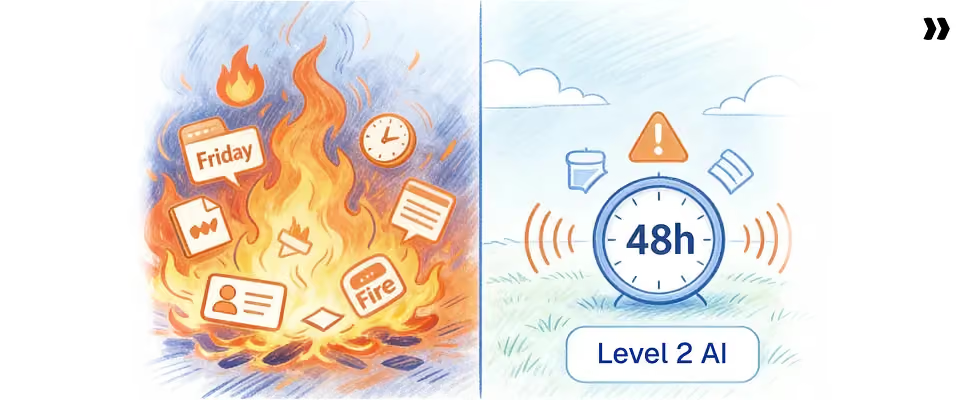
The Level 1 reader is asking, "How do I save my team time?" The Level 2 reader is asing, "How do I see the trouble I cannot see today?" Two signal modes do the work, and they should never be merged. When either fires, the team can adjust delivery routes before slippage compounds into a missed go-live, optimizing routes through the implementation while options still exist.
Project signals
- What it monitors: Critical tasks overdue with no update, budget burn rate trending above plan, delivery schedules slipping past committed delivery windows, no project activity logged for X days, EAC and ETC deviating from the plan.
- The pain: "There is no automated alerting that gives me a key insight: hey, this is going upside down."
- What changes: Governance agents flag when budget is at 80% against 60% completion, before the conversation becomes a crisis. Delivery leaders see problems forming, not after they have formed.
- What it monitors: Call transcripts and email sentiment, including champions going quiet, budget anxiety language in communications, competitor mentions, expansion cues (a client mentioning a second team needing implementation), and stakeholder disengagement patterns.
- The pain: Churn detected after damage is done. Expansion revenue slipping between QBRs.
- What changes: Risk intervention while options still exist. Expansion cues surfaced to CS alongside risk signals.
This is where AI in PS delivery management stops looking like efficiency and starts looking like leverage. The same leadership team makes better calls earlier, with cleaner data.
Level 3: When AI executes the delivery work itself
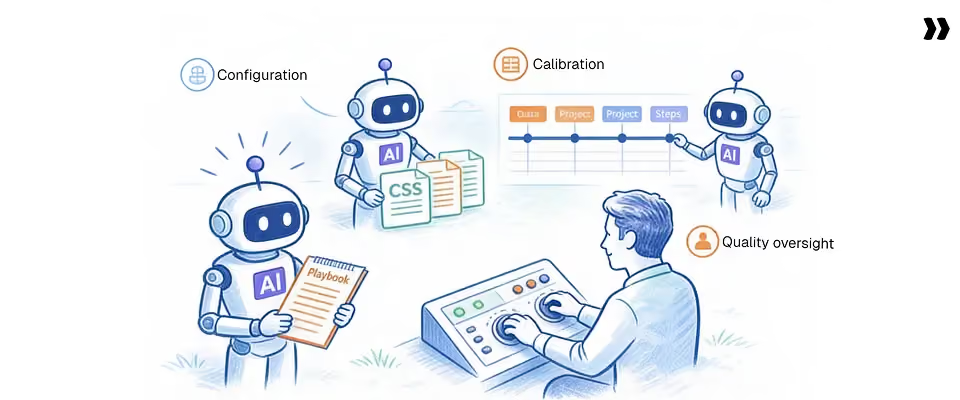
This is the differentiation layer. Think of Level 3 as the last-mile delivery solutions for PS work: the last mile is where value is actually produced and shipped to the client, not just tracked in a dashboard. This is the shift from merely tracking work to actively executing it.
The three Level 3 agents below live on the advanced tier, generate clean delivery sequences end-to-end, and represent where the real capacity multiplier is being built right now.
1. Documentation Agent (advanced tier)
- The pain: "Documentation is non-negotiable, but the last thing anyone wants to do mid-implementation is write documents." Documentation debt accumulates. Knowledge lives in one PM's head. Handoffs lose context.
- What it does: Generates solution design documents, handoff notes, SOW compliance summaries, and status reports from meeting transcripts and project activity. Source attribution included: every section shows which call or email it drew from.
- Real outcome: 16 to 17 hours down to 1.5 to 2 hours for complex design documents (80% to 90% reduction).
"We stopped treating documentation as a tax on delivery. It now ships with the project, not after it." Head of Implementation, enterprise billing platform, 90 days post go-live.
How does Rocketlane use AI to improve project documentation? The Documentation Agent does exactly this work and directly answers the "how Rocketlane uses AI for PS delivery" question that buyers raise at this stage.
2. Workforce Agent (advanced tier)
- The pain: The first week of every project goes to setup: translating the SOW into tasks, building the project plan, assigning resources, and setting dependencies. Before any billable work happens.
- What it does: Reads the SOW, maps deliverables to tasks and phases, sets dependencies, assigns resource types, builds the ready-to-execute plan. It also automates configuration work within the client's environment, not just within the PSA.
- Real outcome: 60% to 70% reduction in project setup time. Delivery begins on day one, not day five. The Rocketlane AI Workforce Agents redefine what "billable" means by eliminating the non-billable runway.
3. Migration Agent (advanced tier)
- The pain: Data migrations taking five days and 10 to 15 hours per project. Custom scripts. Manual validation. Edge cases at go-live.
- What it does: Natural language transformation rules. AI maps fields, transforms data, and validates against the target schema in real time. Flags errors before they become go-live blockers. Produces a reusable playbook for the next migration on the same platform.
- Real outcome: 50% to 80% reduction in manual migration work.
The shift at Level 3 is not about volume. It is about what gets produced. AI agents at this tier generate value-based deliverables: the onboarding guide that used to take a CSM four hours now ships within minutes of kickoff.
The migration checklist that lived in a senior consultant's head is codified, templated, and executed by an agent. PS teams that reach Level 3 stop selling time and start selling outcomes, because the deliverables produce themselves at a quality threshold the team has already approved.
No other agentic PSA category vendor currently offers all three Level 3 capabilities in a single integrated platform. For teams limited by documentation speed, project setup overhead, or migration complexity, this is where the capacity multiplier lives.
How are professional services teams adopting Level 3 AI in 2026?
PS teams adopt Level 3 in waves. The first wave runs a 6- to 8-week pilot with one agent (typically Documentation or Workforce) against a single delivery vertical. The second wave expands the agent to all verticals after measuring time-to-deliverable reduction.
The third wave layers in the second agent. Teams that compress all three waves into one project routinely under-perform, as Project Management Institute research on phased AI rollouts also flags.
What AI can't do yet: an honest assessment for 2026
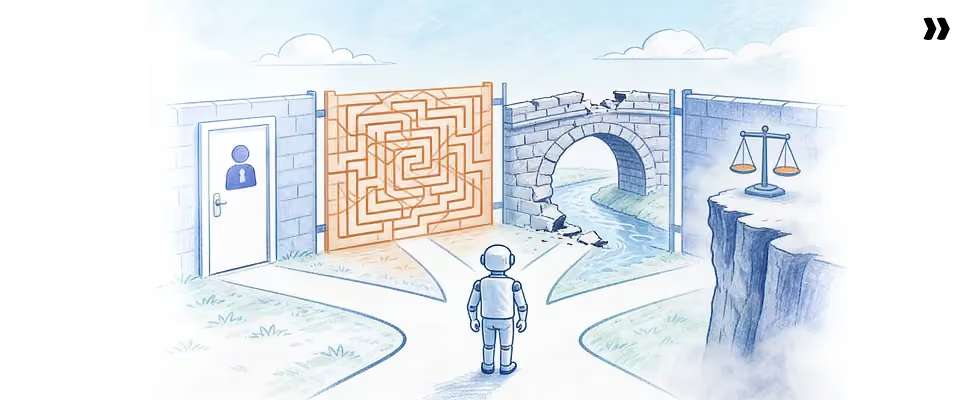
AI does not only change your tools. It changes your professional services operating model. Teams that adopt Level 1 and Level 2 AI without updating how work is scoped, staffed, and priced capture a fraction of the available productivity gain. The operating model has to keep pace with technology.
That said, here is precisely where the current generation of AI stops.
What works reliably in production today:
- Timesheet governance and compliance enforcement
- Portfolio analytics and reporting in natural language
- Meeting capture, summary, and project record connection
- Project and account signal monitoring (risk and expansion)
- Documentation generation from structured meeting content (with human review step)
- SOW to project plan conversion for standard engagement types
What is still maturing:
- Resource AI: currently in active rollout; available to customers in early access; not fully GA. The next high-adoption Level 1 capability once released broadly.
- Complex multi-variable resource optimization for 100+ person teams
- Migrations with highly non-standard source schemas
- AI output quality in data-sparse situations: context window matters; AI is only as accurate as the data it accesses
What always requires human judgment:
- Relationship-critical decisions with strategic accounts
- Complex scope negotiations and change order conversations
- Novel project types with no historical pattern to draw from
- Final review and approval of all AI-generated customer-facing deliverables
What honest adoption looks like: start with Level 1, where ROI is immediate, and risk is low. Add Level 2 signal monitoring once the data foundation is set. Invest in Level 3 only, with adequate upfront time for template design.
Teams that rush Level 3 without defined templates see inconsistent output quality. The platform is not plug-and-play. The first 4 to 8 weeks of configuration determine the ceiling.
How to evaluate AI for PS delivery: 5 questions that separate real from hype
These are the questions that should structure every demo conversation.
Question 1: What level of transformation does this platform offer today, not on the roadmap?
Ask for a live demo of each level. Watch specifically for Level 2 and Level 3. Red flag: "We are adding that in Q3" for capabilities being used as key selling points. Test: "Show me how the platform catches a project going over budget before the PM notices."
Question 2: Is the AI native to the platform or bolted on top?
Native AI operates inside live project data with full context. Agents know the project, the phase, the customer, what was discussed in the last call. Bolt-on AI is a separate tool or API layer requiring manual context transfer. It loses context at every boundary. Test: ask "what does the AI know when a PM opens a project?" If the answer is "only what the PM entered," it is bolt-on.
Question 3: Does the AI learn from your data and processes?
Define governance policies in plain English and have them enforced automatically. Train the documentation agent on your team's template structure. Improve output quality as historical project data grows. Red flag: AI that produces identical output for every customer regardless of their delivery methodology.
Question 4: What does human-in-the-loop look like?
Review and approve AI outputs before they reach customers. Override or adjust AI decisions without fighting the system. Provide a clear feedback mechanism to improve AI accuracy over time. Red flag: "fully autonomous" framing with no articulated review step.
Question 5: Does every AI output include source attribution?
AI-generated documentation should show which call or email each section was drawn from. Every agent action should be auditable. There should be a complete log for compliance-sensitive use cases. Red flag: AI outputs with no citations, no audit trail, no explainability.
Which PS teams should prioritize AI first: a decision routing guide?

Which AI capability delivers the fastest ROI for your team's specific situation? Use this table to route your starting point. As delivery volumes scale and resource management gets harder, the right starting agent shifts.
The routing inflection point is reached when complexity (measured by concurrent projects, team size, and handoff frequency) exceeds what one PS operations person can track manually. That typically happens with around 30 concurrent projects across a 20+-person team.
Below that threshold, Level 1 operations AI delivers immediate ROI with low implementation risk. Above it, Level 2 signal monitoring is essential to maintain consistent delivery quality. Level 3 is the right investment when documentation debt, migration risk, or project setup overhead directly limits the team's ability to take on new engagements.
How do global PS teams adopt AI delivery in their region
North America: The largest market for AI-powered PSA adoption. Primary drivers: utilization improvement (the strongest revenue multiplier at $150 to $250/hour billing rates), CFO-ready margin visibility, and Salesforce or HubSpot integration.
US PS teams with Gong already deployed connect meeting intelligence directly to existing call recording, no duplicate tooling required. Compliance requirements for healthcare-adjacent PS (HIPAA) and financial services (SOX audit trails) require AI platforms with full audit logs and granular permission controls.
EU (Germany, Benelux, Nordics, France): GDPR data residency is non-negotiable: verify AI data processing location before shortlisting any platform. Multi-entity billing across EUR, GBP, and CHF adds a strong AI ROI case for eliminating cross-border reconciliation overhead. Timesheet governance AI carries higher value in EU compliance contexts where working time regulations (the German Arbeitszeitgesetz, the French 35-hour rule) require granular, auditable time records that manual systems fail to produce reliably.
UK (post-IR35): IR35 compliance requires strict separation of contractor and FTE time records with audit-ready trails for HMRC review. AI timesheet governance enforces this separation mechanically, at the point of entry, not during manual review. PS teams without this capability carry material risk: one HMRC investigation costs £10K to £50K+ in professional fees alone.
APAC (India, ANZ, SEA): The fastest-growing PS adoption market in 2026. India-based PS teams serving US and EU clients run at 85% to 90% utilization targets, higher than Western benchmarks, which makes operations AI ROI proportionally larger. Real-time tracking across distributed APAC teams (India and ANZ time zones) is the top pain point. Platform implementation speed (8 to 12 weeks versus 6-month legacy PSA rollouts) gives fast-scaling APAC organizations a real competitive edge.
MENA (UAE, Saudi Arabia, Egypt): Multi-currency billing (AED, SAR, EGP) and post-2018 VAT compliance are table-stakes requirements. Friday work-week configuration is required for Saudi Arabia-based teams. Data residency is critical for government-adjacent client work: verify before shortlisting. AI documentation and governance capabilities see high adoption velocity in MENA due to compliance documentation requirements in financial services and public sector-adjacent PS engagements.
Want to talk through which AI capabilities match your team's pain points and size? [Talk to a Rocketlane expert]
What is the difference between AI tools and an agentic execution platform?
An AI tool answers questions or drafts content; a human still has to apply the output. An agentic execution platform takes action inside live systems on the user's behalf. The distinction matters for PS leaders evaluating AI in PS delivery: a tool saves minutes, an agentic execution platform saves headcount.
How Rocketlane approaches AI-powered PS delivery
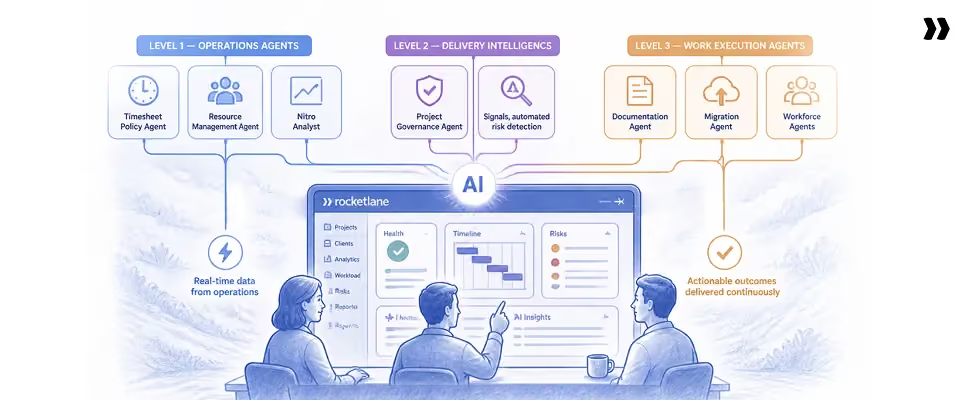
This is what it looks like when an AI-native PSA implements the three-level framework. AI in PS delivery is only as good as the data it accesses. The reason Rocketlane's agents produce higher-quality output than bolt-on AI tools is that they operate inside a unified data model and learn from historical data across hundreds of past engagements.
Project status, timesheet data, resource allocations, financial performance, client communications, and meeting transcripts all live in one system. No context lost at tool boundaries.
Platform implementation runs 8 to 16 weeks to go-live, against 6 to 8 months for legacy PSA alternatives. First measurable ROI typically lands within 30 days of go-live.
Why does AI in PS delivery work better inside a single platform?
AI accuracy is a function of context. When project status, timesheets, allocations, financials, client emails, and call transcripts live in one data model, the AI agent sees the full picture and acts on it cleanly.
When they live in 5 different tools, the agent operates with partial context, and accuracy collapses. Gartner's 2025 PSA market research highlights data unification as the leading predictor of AI ROI in services organizations.
Nitro: Rocketlane's agentic AI layer for PS delivery
This is the most concrete answer to "how is AI changing PS delivery methods" for mid-market readers.
Level 1: operations AI (PS efficiency foundation)
- Timesheet Policy: Plain-English compliance rules enforced at point of entry, before timesheets reach review. Rules like "require notes for entries over 8 hours" or "flag time on completed phases" applied automatically at scale. Compliance at point of entry, not at review.
- Nitro Analyst, financial mode: Natural language portfolio questions answered instantly from live data. Utilization by team, margin by project type, capacity forecast for next quarter, all available in seconds without building a report.
- Nitro Analyst, account mode: Meeting prep and QBR context. "I have an escalation call with Acme in 20 minutes; what do I need to know?" Pulls relevant signals, open blockers, recent milestones, and sentiment history automatically.
- Governance Agents: Budget burn, milestone velocity, and scope signals monitored continuously across every project in the portfolio. Threshold alerts fire when a project hits 80% budget at less than 60% completion. Phase gate enforcement runs without manual PM oversight.
- Nitro Meetings: Captures, transcribes, and connects meeting content directly to project records. Action items, open blockers, and decisions updated automatically post-call. Integrates with Gong (existing call recording stays as source of truth) or a native note-taker.
- AI Fills: Standardizes meeting summaries and follow-up emails using templates and transcript data. Consistent handoff quality at scale regardless of which PM ran the call.
Level 2: delivery AI (proactive intelligence)
- Nitro Signals, account mode: Monitors call transcripts and email sentiment across accounts. Flags churn risk (a champion going quiet, budget anxiety language), expansion cues (a client mentioning a second team needing onboarding), and escalation warnings. Early warning, not post-mortem.
Level 3: workforce AI (execution at scale, advanced tier)
- Documentation Agent: Generates solution design documents, handoff notes, SOW compliance summaries, and status reports from meeting transcripts and project activity. Every AI-generated section includes source attribution: the specific call or email it drew from.
- Workforce Agent: Converts SOWs into fully structured, ready-to-execute project plans. Tasks, phases, dependencies, resource types, built before day one. Also automates configuration work in the client's own environment, not only inside the PSA. 60% to 70% reduction in project setup time. Delivery starts day one, not day five.
- Migration Agent: Guides customer data migrations end to end. Natural language transformation rules. AI validates data against target schema in real time. Flags mapping errors before they become go-live blockers. Produces a reusable playbook for the next migration on the same platform.
- Resource AI (in active rollout): Analyzes skills, availability, cost rates, and historical performance to recommend optimal team composition (load balancing mode or margin maximization mode). Available in early access; full rollout in progress.
What to know before you buy: 4 objections addressed
These are the questions the CFO and leadership team will ask. Each one has an answer that holds up under scrutiny.
Objection 1: "AI in PS delivery is still too immature."
Level 1 capabilities are production-ready today and deliver measurable ROI within 60 to 90 days. Timesheet governance, portfolio analytics, and meeting intelligence run across hundreds of PS teams. Level 3 is emerging; the right approach is to pilot specific, bounded use cases rather than full deployment.
The question is not "is AI mature?" It is "which capabilities are mature enough for us today, and which do we pilot carefully?"
Objection 2: "Our data isn't clean enough to get value from AI."
Legacy PSA tools built pre-AI require clean, structured historical data to function. AI-native platforms deliver value from the first project that runs through them: documentation generated from live meetings, timesheet policies enforced from week one, signals surfaced from new call transcripts.
You do not need a data migration project to start. You need one project live on the platform.
Objection 3: "Our team won't adopt another new tool."
Adoption failure with AI in PS delivery almost always signals AI that added friction rather than removed it. The right entry point is AI that eliminates work the team already resents: timesheet compliance reminders, manual status update compilation, post-call documentation from memory.
Teams that see AI removing their administrative burden adopt it faster than any previous software category. The early win sets the adoption trajectory.
Objection 4: "I can't justify the budget without clearer ROI."
Use the time savings multiplier. Hours saved per week per person, times team size, times fully-loaded hourly rate, times 48 weeks, equals annual savings. For a 20-person team recovering 10 hours/week each at $75/hour fully-loaded: $720,000/year.
Add utilization improvement value: each 1 percentage point of utilization gain for a 20-person team at $150/hour adds $62,400/year in revenue.
The platform pays for itself in fewer admin hours, fewer escalations, and a real reduction in operational costs across the services org. Payback on mid-market AI PSA investment runs 60 to 90 days on time savings alone.
Conclusion
The Head of PS who opened this guide, 60 active implementations, three of them probably at risk, going into a leadership review blind, does not have a data problem. She has a delivery architecture problem.
The teams closing that gap in 2026 are not hiring more implementation managers or building better spreadsheet dashboards. They deploy Level 1 operations AI to eliminate the administrative tax, add Level 2 signal monitoring to catch problems while there is still time to act, and where the scale justifies it, use Level 3 workforce AI to multiply delivery capacity without proportional headcount growth.
The three-level framework gives you a precise diagnostic: which level applies to your current pain, what the ROI looks like at each stage, and which capabilities are production-ready today versus still maturing. The sequence matters. Level 1 first. Level 2 once the data foundation is set. Level 3 only with the template design investment to back it up.
Rocketlane is built for exactly this sequence: an agentic PSA platform with Nitro running across all three levels in a single data model, so PS leaders stop choosing between operational efficiency, delivery intelligence, and execution scale. They get all three, sequenced sensibly, with delivery time compressed and measurable ROI in the first 60 to 90 days.
Table of Contents

Regsiter for the live webinar


Great consultants didn't join your team to spend Fridays writing documentation.
Table of contents
18 of Forbes Cloud 100 chose Rocketlane. The best PS teams aren't waiting around.
FAQs
What is AI in PS delivery?
AI in PS delivery applies intelligent agents inside professional services operations to automate admin overhead, surface delivery risk, and execute project work autonomously. It runs inside live project data, with full portfolio context, not as a standalone tool sitting next to delivery.
How is AI changing professional services delivery in 2026?
AI is changing PS delivery on three fronts: operations automation that removes 20% to 30% of admin work, proactive delivery intelligence that surfaces risk 2 to 4 weeks earlier, and work execution that generates design documents in 1.5 hours instead of 16. AI is now a delivery layer, not a reporting dashboard.
What AI capabilities in PS delivery have the best ROI right now?
Three Level 1 capabilities lead 2026 ROI: timesheet governance (zero late corrections, billing leakage closed in cycle one), portfolio analytics in natural language (4 to 8 hours/week reclaimed per ops manager), and meeting intelligence (10+ hours/week per implementation manager). Payback runs 60 to 90 days.
What is the difference between Level 1, Level 2, and Level 3 AI in PS delivery?
Level 1 runs the business better: analytics, compliance, resource recommendations, meeting intelligence. Level 2 monitors continuously and surfaces signals before failures. Level 3 executes delivery work directly: documentation, SOW conversion, migrations. Most vendors stop at Level 1. Few hit Level 3.
How long does it take to get value from AI in PS delivery?
Level 1 delivers visible time savings within 30 to 60 days of go-live (the first Friday after timesheet automation, in many cases). Level 2 takes 4 to 8 weeks of project data to calibrate. Level 3 needs 4 to 8 weeks of upfront template design. Platform go-live runs 8 to 16 weeks.
What are the main challenges of implementing AI in professional services?
Four challenges lead: change management (AI that adds tasks fails; AI that removes admin work adopts fast), data foundation (fragmented tool stacks limit AI context), upfront template investment for Level 3 agents, and expectation calibration. The biggest failure mode is treating AI as a software rollout, not a process redesign.
How does AI improve resource management in professional services?
AI improves resource management by analyzing availability, skills, certifications, cost rates, and historical performance in seconds, replacing the manual "who's available?" process. It flags over-allocation 3 to 4 weeks before delivery impact, enabling rebalancing while options exist. Rocketlane's Resource AI is in active rollout.
How do I build a business case for AI investment in PS delivery?
Use the time savings multiplier: hours saved per week per person, times team size, times fully-loaded hourly rate, times 48 weeks. A 20-person team recovering 8 hours/week at $75/hour gives $576,000/year. Add 1 utilization point at $150/hour: another $62,400/year. Payback: 60 to 90 days.
What does a successful AI transformation pilot project outcome look like?
A strong AI transformation playbook pilot project outcome runs 60 to 90 days, targets one high-friction workflow (timesheets or status reporting), and measures one outcome: hours reclaimed per person per week. Teams with a defined process, baseline metric, and named owner consistently reclaim 6 to 10 hours per person per week at Level 1.
What are the best AI tools for professional service firms?
The best AI tools for professional service firms are purpose-built for PS workflows, not horizontal AI repurposed. Look for native AI agents that understand utilization targets, billing policies, and client deliverables. Rocketlane's Nitro is the only platform running admin, intelligence, and execution agents inside one data model.












Copyright © 2026 Rocketlane Corp. All rights reserved.
















.webp)