Agentic PSA Is Here: What Rocketlane Announced at Propel 26

•
•
Summarize blog with






Most professional services teams think they've adopted AI.
They haven't.
They've adopted productivity tools.
AI writes meeting notes. AI summarizes calls. AI drafts documentation. AI helps teams complete work faster.
Those use cases matter. They've delivered real efficiency gains across onboarding, implementation, customer success, and professional services organizations.
But they're only the beginning.
The bigger shift now underway is far more consequential.
AI is no longer just helping people do work. It's starting to do the work itself.
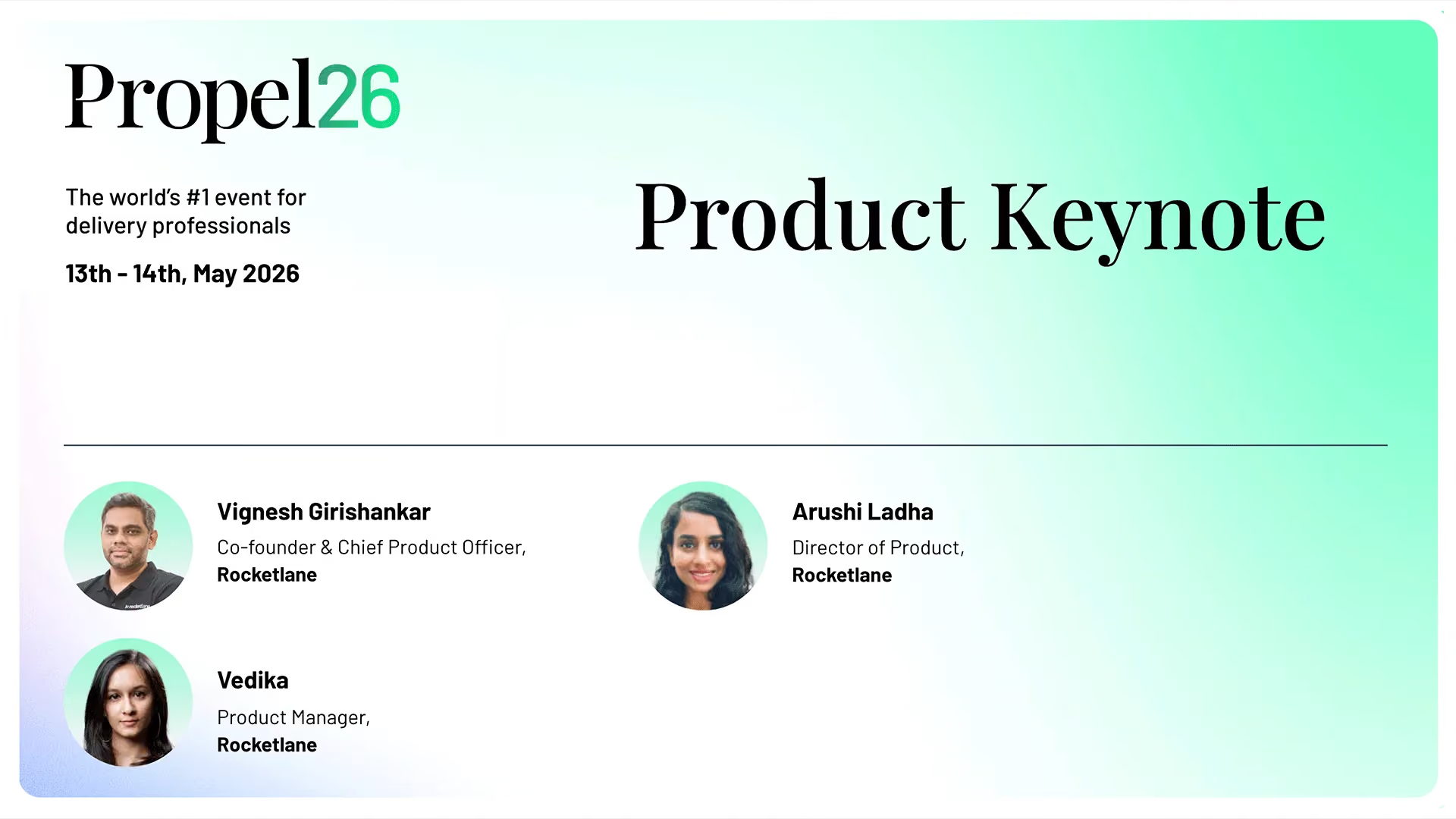
At Rocketlane's Propel 26 conference, industry leaders explored what this next phase of AI could mean for professional services organizations. The discussion moved beyond copilots and productivity tools to a future in which AI agents actively participate in delivery workflows, execute operational tasks, surface risks, and take ownership of work that previously required human intervention.
The question is no longer whether AI can assist delivery teams.
The question is what happens when AI becomes part of the delivery team.
Why AI Is Moving Beyond Productivity
The first wave of AI adoption focused on reducing effort.
Organizations identified repetitive tasks that consumed valuable time and looked for opportunities to automate them.
- Documentation.
- Meeting summaries.
- Status reporting.
- Knowledge retrieval.
The results were significant.
Teams recovered hours every week. Administrative work became easier. Delivery organizations improved efficiency without increasing headcount.
But productivity gains only go so far.
Eventually, every leadership team starts asking a different question: If AI can help complete work faster, can it complete the work itself?
That's where the next wave of innovation is headed.
Rather than functioning as passive assistants, AI agents are increasingly being designed to execute workflows, monitor delivery health, gather information, identify risks, and recommend actions without requiring constant human oversight.
The difference may sound incremental.
It's not. It fundamentally changes how work gets done inside professional services organizations.
What Happens When AI Starts Doing the Work?
One of the strongest themes from the discussion was the transition from assistance to execution.
Historically, software helped people complete tasks.
Now, AI is beginning to complete tasks on people's behalf.
That distinction matters. Consider a typical implementation project.
A traditional AI assistant might summarize a customer meeting and generate notes.
A delivery-focused AI agent embedded inside a PSA can go much further. It can summarize the meeting, update project documentation, identify schedule or scope risks, notify stakeholders, recommend corrective actions, generate follow-up tasks, and automatically update project records.
The human remains responsible for decisions. But they no longer spend their time coordinating execution.
They spend their time guiding outcomes. This is where the industry is headed.
The future isn't AI replacing project managers, consultants, or implementation professionals.
It's AI taking ownership of routine execution work so those professionals can focus on judgment, strategy, and customer leadership.
Why Human Judgment Becomes More Valuable
Whenever AI adoption is discussed, concerns about replacement inevitably follow.
The panel took a different view.
As AI takes on more execution work, human expertise becomes more important—not less.
Execution and judgment are fundamentally different capabilities.
AI can process information quickly.
It can identify patterns across thousands of data points. It can automate workflows and execute predefined actions.
What it still struggles with are the challenges that define successful customer transformations.
- Organizational dynamics.
- Stakeholder alignment.
- Executive influence.
- Change management.
- Business context.
Customers don't succeed because the software was configured correctly.
They succeed because people change how they work.
Processes evolve. Teams adopt new behaviors.
Organizations align around new outcomes.
Those are deeply human problems.
As AI takes on more operational execution, professional services teams gain the capacity to focus on the work customers value most.
How Professional Services Teams Should Prepare
The next phase of AI isn't simply a technology shift. It's an operating model shift.
Professional services leaders need to start rethinking roles, skills, and team design.
The capabilities likely to become more valuable include:
- Business consulting
- Change management
- Strategic discovery
- Outcome design
- Executive communication
- Decision-making and judgment
Technical expertise will remain important.
But increasingly, technical execution will be supported by AI.
The consultants who thrive over the next decade won't simply know how to implement software.
They'll know how to help customers transform.
This shift is already influencing how leading organizations think about talent.
As more execution work becomes automated, the most valuable employees will be the ones who can connect technology investments to measurable business outcomes.
Why Operational Foundations Matter More Than Ever
One idea surfaced repeatedly throughout the discussion:
AI is only as effective as the systems it operates within.
Many organizations rush to deploy AI before creating consistency in their processes, delivery operations, and data structures.
That limits what AI can actually accomplish.
AI performs best when it has access to structured information, repeatable workflows, and a reliable delivery context.
Without those foundations, organizations often struggle to move beyond basic productivity gains.
With them, AI can become an operational partner. This is one reason Rocketlane's approach to AI is different.
Nitro isn't a standalone assistant bolted onto delivery work.
It's embedded directly inside the system of record for professional services delivery.
Because Nitro has first-party access to project plans, customer conversations, resources, time tracking, project financials, risks, and delivery workflows, it can move beyond helping teams work faster and begin helping them execute work more effectively.
That context is what allows AI to evolve from assistant to teammate.
And it's why operational maturity increasingly determines AI maturity.
Organizations that build strong delivery foundations today will unlock the most value from AI tomorrow.
AI Doesn't Replace Services Teams. It Multiplies Them.
A common misconception is that AI's primary purpose is to reduce headcount.
The panel challenged that idea directly. The bigger opportunity isn't replacing people. It's expanding what teams can accomplish.
When AI handles documentation, reporting, coordination, risk monitoring, and other repetitive activities, consultants recover time to reinvest in higher-value work.
- Customer strategy.
- Adoption planning.
- Executive alignment.
- Outcome realization.
In other words, AI doesn't reduce the need for professional services.
It changes where professional services create value.
The organizations that benefit most won't be the ones that automate the most tasks.
They'll be the ones who use automation to increase each person's impact on the team.
4 Key Takeaways from the Next Phase of AI
AI Is Moving from Assistance to Execution
The next generation of AI tools won't simply support work. They'll increasingly perform operational work themselves.
Human Judgment Becomes More Valuable
As execution becomes automated, strategic thinking, consulting, and customer leadership become stronger differentiators.
Professional Services Roles Will Evolve
Organizations should invest in consulting, change management, business advisory, and outcome-focused capabilities.
Operational Maturity Enables AI Maturity
Strong delivery systems, structured data, and consistent processes remain prerequisites for successful AI adoption.
Conclusion
The first phase of AI in professional services was about productivity.
The next phase is about participation.
AI is becoming more than a tool. It's becoming an active contributor to how work gets done. From project coordination and risk management to workflow execution and operational governance, AI agents are beginning to take ownership of activities that once required significant human effort.
That doesn't make professional services less important.
It makes professional services more strategic.
The organizations that thrive won't be the ones that automate the most work. They'll be the ones that combine AI-driven execution with human expertise, judgment, and customer leadership.
That's the opportunity Rocketlane is built for.
A delivery operations platform where AI handles execution, governance, risk detection, and workflow automation—while your team focuses on strategy, transformation, adoption, and customer outcomes.
Because when AI starts doing the work, the value of human expertise doesn't disappear.
It becomes easier to see.

Authored by

Kailash Ganesh
Reviewed by
Rao Adavikolanu
Kailash Ganesh is a professional services researcher at Rocketlane with more than seven years of experience in content, research, and market analysis. He studies how enterprise PS teams are adopting agentic AI to transform delivery operations, has evaluated every major PSA platform in the category, and writes from the perspective of a practitioner who watches enterprise PS teams make these exact decisions daily.
Table of Contents

Regsiter for the live webinar


Great consultants didn't join your team to spend Fridays writing documentation.
Table of contents
18 of Forbes Cloud 100 chose Rocketlane. The best PS teams aren't waiting around.
FAQs













Copyright © 2026 Rocketlane Corp. All rights reserved.
















.webp)