Multi-resource scheduling in project management: Frameworks, techniques, and tools (2026 guide)
•
•
Summarize blog with






Picture this. It is the second week of a critical delivery phase.
A migration milestone is scheduled for Friday.
Three contributors are assigned: a data engineer, a functional consultant, and a QA specialist.
The client has approved the scope and the plan looks clean.
On paper, everything looks good.
In reality, the data engineer is also supporting a late-stage integration elsewhere.
The consultant is waiting on clarifications from discovery. The QA specialist is available only after midweek due to another release cycle.
This is what delivery risk looks like in 2026. Not missed deadlines, but invisible misalignment.
Not lack of ownership, but lack of synchronization.
Multi-resource scheduling is the discipline that governs this synchronization.
Resource scheduling today is less about assignment and more about synchronization to align timing, dependencies, cognitive load, and cross-project exposure simultaneously for efficient resource management.
Multi-resource scheduling is especially critical for complex projects where multiple dependencies and contributors must be managed to keep everything on track.
It is a core component of effective resource management, emphasizing the strategic coordination of all resources to achieve operational efficiency and align with broader business goals.
When structured deliberately, it stabilizes milestone pacing, protects margin assumptions, and preserves forecast credibility.
This guide explores how multi-resource scheduling works, how it differs from multi-project coordination, why it breaks under scale, and how mature professional services teams operationalize it in 2026.
Multi-resource scheduling definition explained
In structured project environments, a “resource” is broader than a person assigned to a task. Effective scheduling requires clarity on what qualifies as a resource and how each category introduces constraint.
Resource constraints play a critical role in project planning and execution, as they directly impact risk management, workload balancing, and the ability to optimize portfolios.
Resources typically fall into four categories:
- Human resources: Team members, subject-matter experts, contractors, or shared specialists whose skills drive task execution.
- Non-human resources: Equipment, environments, infrastructure, licenses, or technical systems required for work to proceed.
- Financial resources: Budget allocations tied to phases, milestones, or contractual commitments that limit how effort can be deployed.
- Time-bound constraints: Availability windows, shift schedules, dependency timing, and milestone deadlines that restrict when resources can realistically contribute. These resource constraints must be carefully analyzed to ensure efficient resource scheduling and project success.
Each category constrains the others.
To ensure timely delivery, it is essential to align resource allocation with project deadlines and the overall project schedule.
Multi-resource scheduling exists to coordinate these layered constraints in a deliberate, structured way. Keeping all contributors on the same page is crucial to avoid miscommunication and inefficiency.
What is multi-resource scheduling?

Multi-resource scheduling is the structured planning and coordination of multiple resource types such as people, equipment, timelines, and budgets, across project tasks and phases to ensure optimal utilization, balanced workload, and improved delivery outcomes.
Multi-resource scheduling involves coordinating multiple resources for specific tasks, ensuring that each task receives the right combination of inputs.
Project managers play a crucial role in overseeing resource allocation, scheduling, and workload balancing across these projects to ensure successful project delivery and prevent bottlenecks.
This differs from single-resource scheduling by accounting for interdependencies between resources working simultaneously on the same or multiple projects.
A resource manager plays a key role in this process by maintaining real-time resource allocation and supporting decision-making, which helps prevent manual errors and ensures that all resources are effectively aligned.
Tracking and automating resource assignments is essential to improve efficiency, prevent overbooking, and accurately forecast future needs.
Where single-resource scheduling asks, “Is someone assigned?”, multi-resource scheduling asks, “Are all required inputs aligned at the same time, under the same constraints, to move the milestone forward predictably?”
What is multi-project resource scheduling?
Multi-project resource scheduling is the structured coordination of shared resources across multiple concurrent projects to ensure portfolio-level capacity remains realistic, balanced, and sustainable.
This is closely related to multi-project resource planning, which focuses on improving visibility and prioritization of resources across all projects, helping organizations address the complexities and challenges of managing resources within project portfolio management.
Multi-resource scheduling vs. single-resource assignment
Single-resource assignment allocates one individual or asset to a task and assumes progress depends primarily on that assignment being made.
It works well when tasks are independent, linear, and low in coordination intensity.
Multi-resource scheduling recognizes that:
- Tasks often require multiple contributors working in overlapping time windows
- Progress depends on synchronized inputs, not isolated effort
- Equipment, environments, and approvals can be as constraining as people
- Financial and milestone constraints influence how effort can be deployed
- Task dependencies significantly increase scheduling complexity, as dependencies between tasks can cause schedule overlaps and require careful management and rescheduling in a multi-project environment.
Effective management of project work requires aligning multiple resources and setting clear deadlines to ensure productivity and efficiency.
Consider a configuration and validation cycle. A consultant prepares mappings, a developer applies them, and a QA specialist validates output in a staging environment.
Assigning each person independently does not guarantee coordinated progress.
If availability windows do not overlap or dependencies are not sequenced correctly, execution compresses even though every task appears “staffed.”
Why is multi-project planning difficult?

Multi-project planning becomes difficult for a simple reason: coordination scales faster than visibility.
When managing multiple projects, it is crucial to use project management tools that provide real-time insights, resource allocation, and reporting to efficiently handle several projects at once.
Scheduling projects is especially important to optimize resource allocation and prevent overload, ensuring that teams can work efficiently and project timelines are met.
Effective resource scheduling is essential for project success, team morale, and efficient resource management because it addresses the challenges of:
Limited visibility
Most teams believe they have visibility because they have allocation sheets.
What they often lack is layered visibility into:
- Planned allocation vs actual effort
- Task-level convergence windows
- Role-level intensity peaks across projects
- Real-time signals from project time tracking
- Understanding resource demand to ensure adequate staffing and avoid shortages
Accurate capacity planning and resource forecasting are also crucial for preparing for future projects, as they help predict staffing needs, manage workload distribution, and ensure readiness for upcoming initiatives.
Without integrated project-based time tracking and scheduling views, leaders see who is assigned, but not how effort is actually unfolding.
Take, for instance, a consultant allocated at 70% across projects. If actual burn rate during complex phases routinely exceeds estimates, that 30 percent buffer simply doesn’t exist.
Without accurately tracking time on projects, capacity models drift from reality. You need visibility to connect allocation, task sequencing, as well as time and project tracking.
Monitoring actual project progress is essential to ensure resource allocation aligns with real execution and to make timely adjustments.
Resource conflicts
Resource conflicts often look like this: A specialist may be formally allocated at sustainable levels across projects. Yet two of those projects may enter integration-heavy phases in the same week.
This is where a multi-resource scheduler capability becomes necessary. It surfaces not only who is assigned, but when critical overlap occurs.
Resource management tools play a crucial role here by enabling the creation of resource schedules, implementing resource plans, and enhancing project visibility and efficiency.
Managing a shared resource pool is essential in these scenarios to prevent conflicts and scheduling overlaps across multiple projects.
Without structural conflict detection:
- Context switching increases
- Task cycle time extends
- Milestones compress
- Forecast credibility weakens
Skill mismatches
Planning often assumes capacity is interchangeable. In practice, depth matters.
A senior integration architect and a mid-level engineer may both have availability. However, with sub-optimal resource allocation, you could see rework and extended review cycles.
This is not a time management problem. It is a skill-alignment problem.
To optimize outcomes, it's essential to identify and prioritize your most valuable resources for critical project phases, ensuring that key personnel and assets are assigned where they have the greatest impact.
Multi-project planning becomes difficult when skill intensity is not modeled alongside capacity. Effective management of project teams and the use of integrated tools can minimize silos, improve workflow, and enhance overall project outcomes.
Competing deadlines
It is also important to regularly review and adjust schedules to accommodate changes in project scope, timelines, and resource availability for successful project execution.
Even the most well-distributed portfolios experience deadline compression during windows of quarter-end launches, contractual milestone gates, and client-driven release cycles.
Aligning resource scheduling with project timelines is crucial in these situations to ensure timely completion and prevent delays.
Competing deadlines amplify through:
- Specialist bottlenecks
- Approval dependency strain
- Equipment and environment contention
In these moments, standard time management methods break down because project planning must account for intensity peaks, not just average load.
Changing priorities
In dynamic delivery environments, priorities shift mid-phase. Without adaptive allocation models and responsive tracking project tasks, these shifts cascade across the portfolio.
Project priority should guide resource allocation decisions during these shifting phases to ensure that resources are directed toward the most valuable and strategically important projects.
Multi-project planning becomes difficult when systems cannot re-evaluate allocation based on real-time signals from project time tracking and milestone progression.
Poor time tracking
Many planning failures trace back to weak execution data. Poor project-based time tracking creates three distortions:
- Capacity appears stable when it is not.
- Task variance remains invisible until milestone slip.
- Portfolio and resource forecasts detach from execution reality.
Tracking billable hours is essential for improving profitability and project management efficiency, as it helps organizations maximize the percentage of time employees spend on billable tasks versus non-billable activities.
Accurate time and project tracking make this complexity visible and measurable.
The deeper issue
Multi-project planning is difficult because it requires solving for two simultaneous coordination layers:
- Distribution across the portfolio
- Convergence within tasks
Planning becomes manageable when visibility connects allocation, synchronization, and execution data in one system. Without that structural integration, complexity compounds quietly until strain becomes visible at the milestone level.
6 major aspects of multi-resource scheduling
Multi-resource scheduling becomes effective only when its structural components are deliberately designed.
This makes resource scheduling process a critical activity for managing coordination and dependencies in environments with multiple projects and shared resources.
Six aspects determine whether coordination remains stable as project complexity increases.
Capacity visibility
Capacity visibility means knowing who is available, when, and at what intensity — across all active work.
However, capacity visibility is not simply seeing allocated hours. It is understanding actual effort patterns.
Understanding resource capacity is essential to optimizing utilization and preventing overburdening, ensuring that workloads are balanced and resources are used effectively.
Allocation accuracy
Allocation accuracy, at its core, is the discipline of matching effort demand to realistic availability. Effective resource planning plays a critical role here, ensuring that workload is balanced and resources are allocated based on actual capacity, which helps avoid overcommitment and resource gaps across multiple projects.
Allocation is often treated as a binary decision: assigned or unassigned. In practice, it is a precision discipline because simply assigning a resource to a task does not guarantee effective execution.
Accurate allocation considers depth of focus, cognitive load, and convergence windows.
Dependency mapping
Many tasks require sequential or parallel contributions from multiple roles and resources. Take, for instance, a configuration phase that depends on upstream discovery clarity. If discovery overruns by even a few days, the configuration’s planned start date becomes shaky.
Explicit dependency mapping makes these chains visible to reduce cascading delays and protects milestone pacing.
Timeline coordination
Timeline coordination ensures that required resources overlap during the correct execution window. A systematic scheduling process helps align resource availability with project phases, making sure that resources are allocated precisely when needed for each execution window.
Availability alone is insufficient. A contributor free next week cannot unblock a milestone due this week.
Timeline coordination ensures scheduling decisions are sensitive to phase sequencing and milestone pacing.
Skill-based assignment
Skill-based assignment recognizes that capacity is not interchangeable.
A mid-level contributor may technically fill a slot assigned to a senior specialist. Yet if complexity exceeds their depth, you have to be prepared for rework cycles.
Skill-based scheduling improves quality and protects downstream effort stability.
Allocating valuable resources to high-priority tasks ensures that key personnel and assets are focused where they can have the greatest impact, maximizing project success.
Forecast adjustment
Forecast adjustment closes the loop between planning and execution.
As project-based time tracking reveals recurring variance patterns, future allocation assumptions must be recalibrated. If integration tasks repeatedly exceed estimates, future schedules should reflect that reality.
Resource forecasting is crucial here, as it helps predict future resource needs and proactively prevents bottlenecks by adjusting plans based on anticipated workloads. Forecast adjustment prevents repeating strain across successive projects.
5 Types of multi-resource scheduling

Different delivery environments operate under different primary constraints. The type of multi-resource scheduling you apply depends on what is fixed, be it capacity, deadlines, skills, or infrastructure.
In structured project environments, enterprise resource planning (ERP) systems or professional services automation (PSA) integrate resource management, project management, finance, and logistics to provide seamless connectivity and real-time insights for efficient business operations.
Here are the core types used in structured project environments.
1. Resource-constrained scheduling
Resource-constrained scheduling assumes capacity is limited and relatively inflexible, requiring careful management of limited resources to optimize project outcomes.
Timelines adjust to reflect realistic availability rather than ideal sequencing.
This model is common in specialist-heavy environments where certain expertise cannot scale quickly.
Instead of forcing deadlines, schedules stretch or phase sequencing shifts to prevent overload and quality erosion.
2. Time-constrained scheduling
Time-constrained scheduling treats deadlines as fixed and non-negotiable so that resource allocation flexes to meet milestone commitments.
This approach often appears in contractual or regulatory environments where delivery dates carry financial or compliance consequences.
It may require temporary capacity expansion, reprioritization across projects, or intentional buffer compression to protect the timeline.
3. Skill-based scheduling
Skill-based scheduling prioritizes expertise alignment over generic availability.
Not all contributors are interchangeable, even if role titles appear similar.
In technically complex phases, assigning insufficient depth increases rework and downstream correction cost.
This model emphasizes matching task intensity with appropriate expertise to preserve execution proportionality.
4. Multi-project scheduling
Multi-project scheduling coordinates shared resources across concurrent initiatives. In a multi-project environment, managing resources becomes increasingly complex due to dependencies and shared resource pools, making specialized scheduling tools essential for efficient coordination.
The goal is to prevent overallocation and stabilize portfolio-level capacity.
It becomes critical in professional services teams where specialists operate across multiple client engagements.
Portfolio balance does not eliminate task-level coordination challenges, but it protects systemic sustainability.
5. Equipment + human scheduling
Equipment + human scheduling addresses environments where infrastructure or tools must align with contributor availability.
In domains such as construction, lab testing, infrastructure migration, or environment-dependent validation cycles, access to equipment becomes a first-class constraint.
You need coordinated availability to prevent idle time, cost leakage, and execution bottlenecks.
7 Key benefits of multi-resource scheduling
By optimizing resource allocation and reducing costs, multi-resource scheduling significantly enhances operational efficiency. Its impact is visible in:
Improved resource utilization
Resource utilization improves when contributor availability aligns with phase intensity rather than calendar allocation alone.
Effective workload management plays a key role in avoiding unforeseen resource gaps and balancing team capacity, ensuring that teams can meet demand peaks efficiently.
Over time, this alignment produces steadier capacity patterns across the portfolio.
Teams gain a clearer understanding of where true demand peaks occur, which strengthens hiring, sequencing, and intake decisions.
Reduced scheduling conflicts
Structured convergence modeling exposes role overlap and dependency strain before execution begins.
This reduces mid-phase reassignments, lowers coordination overhead, and protects cognitive continuity for high-leverage contributors.
The outcome is smoother execution and fewer unplanned adjustments during critical milestones.
Better deadline adherence
Milestones are completed on schedule when all required contributors and constraints align within the planned execution window.
This alignment strengthens schedule credibility. Completion dates become grounded in synchronized availability rather than optimistic sequencing assumptions.
Leveraging advanced analytics and optimization tools further enhances scheduling effectiveness and operational efficiency.
Increased transparency
Explicit scheduling logic clarifies how tasks, dependencies, and contributor timing intersect within each phase.
Stakeholders can see not only who is assigned, but how synchronized inputs support milestone pacing.
This transparency improves project governance conversations.
Advanced scheduling tools provide valuable insights through analytics and visibility, enabling better decision-making.
Allocation discussions shift from anecdotal workload perceptions to structured convergence analysis.
More accurate forecasting
Forecasting improves when historical convergence patterns inform future planning assumptions.
When project-based time tracking reveals recurring intensity spikes or phase-level variance, schedules can recalibrate proactively.
Accurately predicting future resource requirements is crucial to prevent bottlenecks and ensure smooth project execution.
Over time, this feedback loop strengthens estimation discipline.
Rolling forecasts stabilize because they reflect empirical execution behavior rather than static allocation templates.
Lower burnout risk
Burnout often correlates with repeated peak-intensity overlap in specialized roles.
When critical contributors are required simultaneously across multiple high-demand phases, cognitive load accumulates.
Multi-resource scheduling distributes intensity across time windows, creating more sustainable workload patterns.
This supports long-term capacity resilience and reduces attrition risk among high-skill roles.
Higher delivery reliability
Delivery reliability increases when milestone completion depends on synchronized coordination rather than reactive adjustment.
Consistent alignment across contributors, tools, and timing reduces downstream variance and protects execution flow.
Over successive projects, this consistency compounds.
Teams build predictable performance patterns that strengthen client confidence and portfolio stability.
7 Key techniques of multi-resource scheduling

Multi-resource scheduling fails quietly before it fails visibly.
Mature delivery teams treat multi-resource scheduling as an operational discipline supported by defined processes, shared visibility, structured decision rules, and the use of resource management tools.
These tools are essential for supporting structured decision-making and improving visibility across projects.
The techniques below help convert allocation into coordinated execution control based on how intensity clusters, how dependencies compound, and how shared specialists absorb hidden sequencing pressure.
1. Load leveling
Most teams level hours. Mature teams level cognitive intensity.
Here is something many leaders underestimate: high-complexity work degrades performance nonlinearly when clustered. An architect handling two concurrent integration designs in the same week does not perform at 50% efficiency on each. Context switching and decision fatigue introduce hidden lag.
Load or resource leveling works when teams:
- Map upcoming deep-work phases across projects.
- Identify where specialist-heavy phases overlap.
- Intentionally stagger high-intensity milestones, even if overall hours remain constant.
2. Capacity heat mapping
Heat maps are often treated as visual dashboards, but their true value lies in pattern recognition. Over time, experienced operators notice that specific roles spike at predictable lifecycle transitions.
When these spikes align across projects in the same portfolio window, scheduling volatility increases. Heat mapping across 8–12 weeks exposes systemic alignment points such as:
- Overload rarely originates from surprise demand.
- It originates from synchronized lifecycle transitions across projects.
Heat mapping lets you de-synchronize those transitions.
3. Critical path adjustments
In multi-resource environments, the critical path evolves during execution. As effort accumulates, certain dependencies become more fragile than originally scoped.
For example:
- A data validation task initially scoped as routine becomes dependency-heavy once data inconsistencies surface.
- A client approval step begins gating multiple parallel tasks.
Experienced teams revisit the critical path weekly during active phases. They ask: Which task, if delayed by two days, would create the widest ripple?
4. Rolling forecast updates
In services environments, integration and coordination phases frequently exceed the scoped effort.
Not because estimates are careless, but because cross-team complexity compounds in motion.
Teams that rely only on initial allocation models allow variance to accumulate silently.
Mature teams feed task-level variance from project time tracking directly into forward allocation windows.
This approach enables more accurate forecasting of future resource needs, ensuring optimal allocation and helping to prevent overloading or resource shortages.
5. Buffer allocation
Most buffers are placed at the project end. That placement protects completion date optics but does not stabilize convergence.
Minor overruns during integration or validation phases tend to create cascading reallocation pressure.
Experienced teams place micro-buffers adjacent to dependency-dense phases instead:
- Before integration begins.
- Between build and validation.
- Around multi-stakeholder review cycles.
6. Cross-project prioritization
Shared specialists inevitably face overlapping milestone demand. Without predefined prioritization logic, allocation shifts become reactive and politically driven. That erodes predictability.
Mature delivery organizations define criteria in advance:
- Which milestone protects revenue recognition?
- Which project carries contractual penalties?
- Which account holds strategic expansion value?
7. Structured task management
Task structure determines how visible convergence risk becomes.
If tasks are loosely defined, it becomes difficult to see which roles must overlap and for how long. This obscures convergence windows.
Consistent task hierarchies enable:
- Clear multi-role assignment visibility. Planning to schedule resources in advance is essential to avoid bottlenecks, ensuring that workloads are balanced and deadlines are met.
- Dependency mapping at the task level.
- Accurate project-based time tracking against convergence phases.
Over time, structured task data reveals which task types repeatedly generate strain. That allows template refinement across the portfolio.
What experienced teams eventually learn
Multi-resource scheduling stabilizes when teams:
- Desynchronize lifecycle peaks across projects
- Protect dependency drivers weekly.
- Use execution data to reshape forward allocation.
- Define prioritization logic before pressure builds.
- Standardize task architecture so patterns surface.
How to manage multiple resources effectively
Managing multiple resources is rarely a staffing problem. It is a visibility, sequencing, and feedback problem.
Teams struggle when allocation decisions are made in fragments — one project at a time, one week at a time, without seeing how convergence builds across the portfolio.
Effective multi-resource management requires a system that connects planning, execution, and recalibration.
Project management software plays a crucial role in centralizing planning, execution, and feedback, enabling teams to efficiently manage resources across multiple projects.
Here is a practical framework that leading delivery leaders use.
Step 1: Centralize visibility
All active projects, upcoming phases, specialist allocations, and key dependency windows must live in a shared view.
Spreadsheets per project create blind spots because convergence happens across projects, not inside them.
Centralized visibility means:
- A single view of who is assigned where.
- Forward-looking phase timelines (at least 8–12 weeks).
- Clear visibility into overlapping milestone windows.
- Integrated management software consolidates allocation and milestone data, providing a comprehensive platform for improved visibility and decision-making.
When visibility is fragmented, conflicts surface late. When it is centralized, strain becomes predictable.
Step 2: Define capacity per role
Capacity should be defined at the role level before it is allocated at the project level.
This includes:
- Realistic available hours (accounting for internal commitments, context switching, leave).
- Sustainable utilization thresholds.
- Phase-based intensity limits for deep-focus roles.
Experienced services teams define capacity closer to sustainable performance levels. That margin absorbs unexpected convergence without destabilizing delivery.
Step 3: Prioritize work
Multi-resource environments always contain more demand than available specialist bandwidth.
Work must be ranked using explicit criteria, such as:
- Milestone sensitivity.
- Revenue impact.
- Contractual exposure.
- Strategic importance.
Without structured prioritization, resource movement becomes reactive.
With clear prioritization logic, trade-offs remain consistent even under pressure.
Step 4: Assign based on skill and availability
Availability alone is insufficient. Assignments must align capability and timing simultaneously.
Effective assignment requires matching:
- Skill depth to task complexity.
- Experience level to dependency sensitivity.
- Availability window to milestone timing.
To ensure projects are completed effectively and within constraints, it is essential to optimize resource allocation by efficiently assigning labor, equipment, and facilities across all tasks.
An available resource without the required expertise increases rework risk. A highly skilled specialist assigned outside the convergence window increases sequencing risk.
Step 5: Track actual time
Planning without execution feedback creates drift.
Project-based time tracking provides the signal necessary to understand:
- Where effort consistently exceeds assumptions
- Which roles absorb hidden coordination load
- Which phases expand under real conditions
Time data should be reviewed at task and phase levels, not only at project totals.
Step 6: Rebalance regularly
Multi-resource management is a recurring governance rhythm.
Rebalancing includes:
- Reviewing upcoming convergence windows.
- Adjusting sequencing to smooth specialist intensity.
- Revisiting the critical path under constraint.
- Updating resource forecasts based on observed burn.
Scheduling equipment and people together

Multi-resource scheduling becomes materially more complex when human and non-human resources must align precisely within defined windows.
This is especially relevant in environments such as construction, field operations, infrastructure rollouts, manufacturing deployments, where work advances only when people and equipment converge at the same time.
To ensure proper alignment, it's crucial to assess how many resources are needed for each task, evaluating both the number of people and equipment required.
Here are the structural dynamics teams must manage.
Shared dependency
Certain tasks require the simultaneous availability of both human expertise and physical or digital infrastructure.
Effective scheduling maps these shared dependencies explicitly at the task level. Each task should identify:
- Required human roles
- Required equipment or infrastructure
- Dependency sequence and duration overlap
Coordinated availability
Equipment calendars and personnel calendars often live in separate systems. That separation creates blind spots.
Coordinated availability means:
- Viewing operator schedules and equipment reservations in the same timeline.
- Confirming overlap windows before milestone commitments.
- Accounting for setup and teardown time in addition to usage time.
In practice, experienced teams treat equipment time as fixed-capacity blocks. People can sometimes be reallocated; equipment constraints are often harder to flex. Scheduling must reflect that asymmetry.
Cost implications
Idle equipment carries direct cost. Idle specialists carry opportunity cost.
When equipment is booked, but human resources are delayed, rental fees or depreciation continue accruing. When specialists are present, but equipment access is delayed, billable productivity declines.
Multi-resource schedulers must model:
- Equipment rental or ownership cost per day
- Opportunity cost of specialized personnel
- Rescheduling impact across adjacent projects
Financial visibility should accompany scheduling decisions, not follow them. Monitoring the project budget throughout the scheduling process is essential to prevent overspending and increase transparency with stakeholders.
Downtime avoidance
Downtime risk increases when dependency density rises.
Weather, permit delays, supplier delivery, or inspection rescheduling can disrupt planned overlap windows. Effective scheduling anticipates these risks by:
- Including a buffer around equipment-intensive phases
- Sequencing preparatory tasks so human expertise is fully ready when equipment windows open
- Confirming upstream dependencies before locking equipment slots
Essential features of multi-resource scheduling tools
Multi-resource scheduling tools matter when complexity increases beyond what human memory can manage.
Organizations need resource management software with real-time insights, scenario planning, and integration capabilities to coordinate overlapping projects, manage shared specialists, and track equipment dependencies.
These tools provide dashboards and intuitive interfaces that improve visibility, scalability, and integration with financial management systems, supporting better capacity planning and profitability analysis.
The features below are critical because they reduce specific failure modes inside multi-resource environments.
Real-time capacity dashboards
Most teams know who is allocated this week, but a serious multi-resource scheduler helps them know:
- Role-level allocation across future windows
- Concentration of high-dependency phases
- Allocation relative to sustainable capacity, not just total availability.
Without this, overload is detected only after it affects milestone flow. With it, teams can smooth intensity before strain becomes visible in execution data.
Multi-project visibility
Without portfolio-wide visibility, teams unknowingly synchronize integration phases, validation windows, or go-live events.
A strong tool allows:
- Viewing all active projects on one timeline
- Overlaying milestone phases across engagements
- Seeing shared specialist demand in the same time band
The capability is desynchronization. It enables intentional staggering of lifecycle peaks.
Skill tagging
Allocation by role title hides risk.
Consider this: Two engineers are both available, but only one has deep experience in complex data migrations. Assigning based on availability alone increases the likelihood of extended review loops and rework.
Skill tagging allows:
- Matching task complexity with expertise depth
- Avoiding repeated reliance on the same senior contributors
- Distributing specialist intensity more deliberately
The capability is the alignment of complexity with competence, which directly affects milestone stability.
Conflict alerts
Conflicts in multi-resource environments are rarely obvious double-bookings.
They often appear as:
- A specialist assigned to two convergence-heavy tasks in the same week.
- Equipment reserved during a window where no qualified operator is available.
- Milestones compressing due to cascading minor shifts.
The capability here is early signal detection. Adjustments are far less disruptive before execution begins.
Forecast modeling
As portfolios grow, intake decisions have ripple effects.
Adding one new project may not appear disruptive in isolation. However, if that project introduces another integration-heavy phase in an already dense window, strain compounds.
Forecast modeling allows teams to:
- Simulate the impact of new intake
- Test shifting milestone windows
- Evaluate resource concentration scenarios
The capability is scenario awareness. Teams can see second-order effects before committing to them.
Time tracking integration
Scheduling without execution feedback becomes speculative.
When project-based time tracking integrates directly with allocation views, patterns surface:
- Integration phases consistently exceed planned effort
- Specific roles absorb hidden coordination time
- Certain lifecycle transitions create variance clusters
Reporting and analytics
Reporting becomes meaningful when it answers systemic questions.
Teams managing multi-resource environments need to understand:
- Which roles show chronic convergence pressure
- Which phase types repeatedly generate variance
- Whether utilization patterns are stable across quarters
- How capacity behaves as project volume increases
Analytics enable long-term refinement of templates, hiring strategy, and intake pacing. Data-driven decision making transforms multi-resource scheduling from a reactive process into a strategic function, leveraging insights for continuous improvement.
The capability is pattern visibility across time, not just operational monitoring.
Multi-resource scheduling & time tracking

Multi-resource scheduling and project time tracking are often treated as separate systems. In practice, you need to look at them as a control loop where:
- Scheduling defines how work should unfold.
- Time tracking reveals how work actually unfolds.
When those two remain disconnected, forecasting becomes optimistic, and allocation drifts from reality.
When they operate together, scheduling improves with every delivery cycle and you see that:
Scheduling is planning
Multi-resource scheduling determines:
- Which roles must overlap on a task
- When those overlaps must occur
- How long phases are expected to take
- How shared specialists are distributed across projects
It encodes assumptions: effort required, sequencing logic, dependency timing, and intensity windows.
Time tracking is execution measurement
Project-based time tracking captures:
- Actual effort consumed at the task level
- Where phases expand beyond planned intensity
- Which roles absorb hidden coordination load
- How effort is distributed across lifecycle transitions
Time tracking turns assumptions into measurable patterns.
Without it, scheduling remains static. With it, teams can see whether convergence windows are realistic or consistently compressed.
The feedback loop improves forecast accuracy
The real value emerges when time tracking feeds back into scheduling decisions.
For instance, if you see that integration phases repeatedly exceed estimates by 15–20%, your future convergence windows must widen. Or if certain roles consistently operate at unsustainable intensity during validation cycles, you must adjust sequencing accordingly.
Over time, this feedback loop produces:
- More realistic phase durations
- Better role-based capacity planning
- Reduced convergence volatility
- Stronger milestone credibility
How scheduling and time tracking work together
Overcoming common challenges in multi-resource scheduling
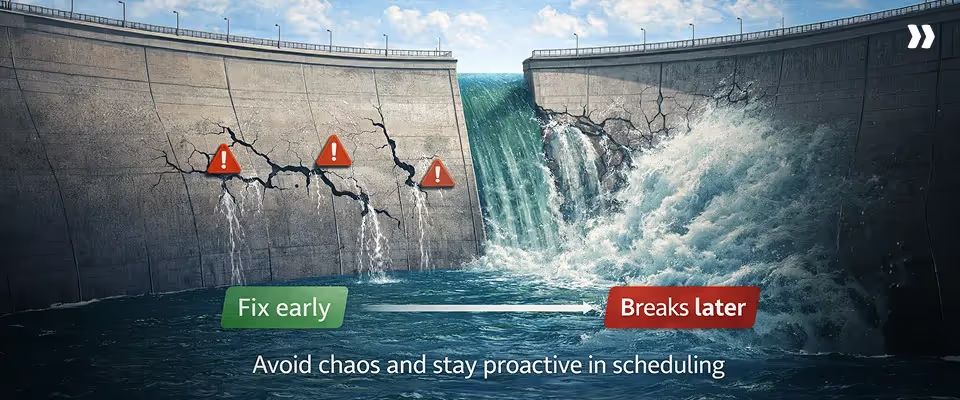
When it comes to multi-resource scheduling, failure modes are about:
- Missing visibility at the right time
- Discipline eroding under pressure
As portfolio complexity increases, coordination habits either mature into structured systems or regress into reactive adjustments. The challenges below show up repeatedly in:
Resistance to process discipline
Multi-resource scheduling introduces structure: defined task hierarchies, standardized allocation views, and recurring reviews. Some teams perceive this as overhead, especially when delivery pressure is high.
What helps:
- Keep task structures consistent across projects so contributors do not relearn systems each time.
- Tie scheduling reviews directly to milestone outcomes, not administrative compliance.
- Limit the process to what improves convergence visibility.
Inaccurate time data
Scheduling quality depends on execution feedback. When project time tracking is delayed, bulk-entered, or loosely categorized, the feedback loop weakens.
What helps:
- Require time entry at the task level, not only at the project level.
- Review planned vs actual effort weekly during active phases.
- Highlight recurring variance patterns in scheduling discussions.
Spreadsheet chaos
Spreadsheets function well at a small scale. As concurrent projects increase, version control, visibility fragmentation, and manual reconciliation create blind spots.
What helps:
- Consolidate allocation and milestone timelines into a single shared system.
- Avoid parallel tracking sheets across departments.
- Standardize reporting cadence so portfolio views remain aligned.
Lack of cross-team visibility
When each team views only its own project load, shared specialists experience hidden overlap. Convergence pressure accumulates without collective awareness.
What helps:
- Use portfolio-wide allocation views.
- Review shared specialist demand across projects weekly.
- Make upcoming milestone windows visible across teams.
Visibility across engagements reduces accidental synchronization of high-intensity phases.
Reactive planning
Reactive planning appears when rebalancing happens only after conflict surfaces.
Under reactive conditions:
- Specialists are shifted mid-phase.
- Milestones compress to compensate.
- Forecasts adjust late.
What helps:
- Review forward-looking capacity 6–12 weeks ahead.
- Use rolling forecast updates informed by project-based time tracking.
- Reassess critical path drivers during active phases.
Proactive scheduling shifts pressure from execution to planning, where adjustments are less disruptive.
Implementation strategies for multi-resource scheduling
Multi-resource scheduling cannot be introduced as a tool-first initiative. It requires clarity in how work is structured, how roles converge, and how execution data feeds back into planning.
For teams beginning to formalize multi-resource coordination, the transition works best when approached in phases.
Phase 1: Process clarity
Before introducing systems, clarify how work is structured.
This includes:
- Defining consistent task hierarchies across projects
- Identifying which phases require multi-role overlap
- Establishing role-based capacity assumptions
- Agreeing on how project-based time tracking will be captured
At this stage, the goal is shared understanding. If task structures vary widely or convergence windows are undefined, scheduling tools will amplify confusion rather than reduce it.
Phase 2: Visibility tools
Once process clarity is established, the next step is enabling shared visibility across planning and execution.
In multi-project environments, allocation decisions, milestone sequencing, and project time tracking often live in separate systems.
That separation makes convergence risk harder to detect because no single view shows how roles, tasks, and effort interact in the same window.
At this stage, teams benefit from tools that bring together:
- Portfolio-wide allocation views across all active engagements
- Forward-looking role capacity dashboards (8–12 weeks out)
- Shared milestone timelines across projects
- Integrated time and project tracking data at the task level
The goal is a unified operational view where resource assignment, phase progression, and actual effort consumption are visible together.
When visibility spans both allocation and execution, convergence pressure becomes observable earlier. Teams can see not just who is assigned, but how those assignments are tracking against real effort patterns — and adjust sequencing before instability spreads.
Phase 3: Pilot rollout
Introducing multi-resource scheduling across the entire portfolio at once can overwhelm teams.
A focused pilot works better:
- Select a small set of concurrent projects
- Apply structured task templates
- Monitor convergence windows weekly
- Use time tracking data to inform small sequencing adjustments
The pilot reveals friction points in task structure, capacity or project assumptions, and reporting cadence. It also builds internal confidence before broader rollout.
Phase 4: Governance cadence
Multi-resource scheduling stabilizes when it becomes part of recurring project governance.
This typically includes:
- Weekly forward-looking allocation reviews
- Monthly capacity trend analysis
- Quarterly template refinement based on variance patterns
Over time, this rhythm transforms multi-resource scheduling from a coordination exercise into a structured delivery capability.
Future trends in multi-resource scheduling technology

As project complexity increases and delivery environments become more data-rich, scheduling systems are beginning to incorporate predictive modeling, automation, and adaptive intelligence.
The following trends reflect where scheduling technology is heading.
AI-assisted allocation
AI-assisted resource allocation analyzes historical assignment patterns, effort variance, and skill utilization to recommend resource matches.
Instead of manually scanning availability and expertise, teams receive allocation suggestions that consider:
- Task complexity
- Past performance patterns.
- Dependency timing
- Role intensity windows
The practical shift is from reactive staffing to data-informed recommendation. Human judgment remains central, but AI reduces blind spots and accelerates decision-making in complex portfolios.
Predictive capacity modeling
Predictive capacity modeling uses historical time and project tracking data to forecast demand concentration before it materializes.
These systems:
- Detect recurring lifecycle peaks
- Identify roles with chronic convergence strain
- Estimate future capacity gaps under projected intake scenarios
Rather than relying solely on current allocation views, predictive models anticipate pressure based on patterns across prior delivery cycles. This improves hiring strategy, intake pacing, and sequencing design.
Automated conflict detection
Conflict detection is evolving beyond simple double-booking alerts.
Advanced systems analyze:
- Convergence density across milestone windows
- Dependency chain fragility
- Role overload during high-complexity phases
Automation increasingly surfaces subtle scheduling risks that may not be obvious in static views to reduce manual oversight effort and strengthen early signal detection.
Integrated financial planning
Scheduling systems are increasingly integrating financial context into allocation decisions.
This includes:
- Role-based cost modeling
- Margin sensitivity analysis by phase
- Revenue timing alignment with milestone progression
When financial exposure connects directly to scheduling data, teams can go beyond evaluating feasibility to evaluating economic impact.
Agentic scheduling systems
Agentic scheduling represents a shift toward adaptive coordination, where the system observes patterns in motion and prompts human intervention before instability spreads.
Emerging agentic systems operate continuously in the background, monitoring allocation shifts, effort variance, and milestone pacing.
These systems:
- Identify emerging convergence strain automatically
- Recommend sequencing adjustments
- Surface forecast instability signals early
Multi-resource scheduling in practice: How Rocketlane approaches it

Multi-resource scheduling becomes meaningful when it survives scale.
In a professional services organization managing 20+ concurrent implementations, shared architects, integration specialists, and customer stakeholders are constantly intersecting.
Intake fluctuates. Scope evolves. Effort expands in some phases and compresses in others.
In that environment, scheduling cannot sit in isolation. It must connect structure, allocation, time tracking, financial context, and execution governance in one system.
Here is what that looks like inside a real professional services (PS) environment.
What this means operationally
Inputs
The starting point is full visibility. Not just confirmed projects, but the near-term pipeline at realistic probability levels. Skills are mapped explicitly, not assumed. Statements of work are broken down into phase-level convergence requirements, so scheduling begins with task structure rather than headcount allocation.
Process
Assignments are made at the task-phase level, not simply at the project level. If a migration phase requires three consultants and one architect to overlap for two weeks, that convergence window is defined explicitly.
Dependencies between co-assigned resources are mapped early. Time tracking is tied directly to those task assignments, so effort accumulation reflects actual convergence intensity.
Outputs
Because time tracking is connected to resource assignment at the task level, margin analysis reflects real effort distribution per deliverable. Utilization data is visible by both role and project.
Conflict detection occurs before client-facing deadlines shift. Capacity forecasts extend 8–13 weeks ahead, allowing intake and sequencing adjustments early.
How Rocketlane supports this approach
Rocketlane’s approach to professional service automation (PSA) does not treat multi-resource scheduling as a standalone resourcing module.
It is embedded inside a milestone-driven execution system, where structure, allocation, time tracking, customer collaboration, and financial visibility operate together.
It combines resource assignment, project delivery, and project-based time tracking in one system with:
Structured execution as the foundation
Rocketlane teams begin with standardized execution templates. These encode:
- Phases and milestone sequencing
- Expected dependencies
- Role participation patterns
- Deliverable definitions
When a new project is created, its structure already reflects proven delivery flows.
Multi-resource scheduling begins at the milestone level, not at a generic “project allocation” layer.
Teams can see who is assigned and how the phase is tracking in real time, without reconciling allocation spreadsheets and separate time tracking tools.
Convergence windows, effort burn, and forward capacity sit in the same operational view.
What this means inside Rocketlane?
Structured execution as the foundation
Rocketlane teams begin with standardized execution templates. These encode:
- Phases and milestone sequencing
- Expected dependencies
- Role participation patterns
- Deliverable definitions
When a new project is created, its structure already reflects proven delivery flows.
Multi-resource scheduling begins at the milestone level, not at a generic “project allocation” layer.
Skill-aware allocation inside the workflow
Rocketlane’s resource management layer connects assignments directly to structured tasks. Skills are tagged in the team directory, enabling allocation decisions that reflect expertise depth so that:
- Phases are visible on the shared timeline
- Assigned contributors are attached directly to that milestone-driven task
- Capacity views update instantly across all projects
Allocation and execution share the same structure.
Time tracking embedded in execution
Rocketlane integrates project-based time tracking directly into tasks and milestones.
When contributors log time:
- Effort attaches to the specific deliverable
- Phase-level burn updates in real time
- Role-level utilization recalculates across the portfolio
- Margin exposure reflects actual effort patterns
There is no reconciliation step between allocation and tracking. They are part of the same workflow. This connection allows forecast updates to reflect real execution signals rather than static plans.
Rocketlane Nitro: Agentic scheduling inside live execution
Most AI systems surface data. Rocketlane’s Nitro evaluates it.
Nitro is a network of specialized AI agents embedded directly into Rocketlane’s workflow architecture.
These agents operate continuously against structured data such as milestones, dependencies, assignments, time logs, cost rates, and customer interactions.
This network of agents includes:
- Resource Management Agent: Analyzes allocation density across projects and identify where convergence strain is building. They evaluate forward-looking milestone overlap, specialist concentration, and utilization thresholds 8–13 weeks out. The system highlights emerging instability while there is still sequencing flexibility.
- Project Governance Agent: Monitors milestone pacing and dependency integrity. When effort burn outpaces milestone completion, or when downstream phases compress, signals surface early. Leaders see forecast fragility as it forms, not after escalation.
- Time Policies Agent: Monitors compliance and anomaly patterns in time logs, preserving data integrity so allocation and financial forecasts remain reliable.
- Project Health Agent: Synthesizes effort variance, allocation strain, milestone progression, and dependency shifts into dynamic health scoring. That score is traceable to real execution signals.
- AI Analyst: Identifies recurring patterns, such as integration phases that consistently expand, roles that carry hidden coordination load, lifecycle transitions that create volatility. These insights inform template refinement and hiring strategy.
Why this matters for multi-resource scheduling
Multi-resource scheduling becomes exponentially more complex as project volume grows. Static dashboards show allocation. Agentic systems interpret it.
Because Rocketlane integrates:
- Milestone-driven structure and skill-aware resource assignment with Skill Matrix
- Embedded project time tracking
- Role-based financial modeling
- Customer-facing collaboration through a dedicated customer portal
- Continuous AI signal evaluation
- Agentic AI execution
Nitro can operate across the entire delivery system rather than in isolated data silos.
The result?
Convergence windows are monitored in motion. Forecast stability reflects real burn patterns.
Margin exposure updates dynamically as effort accumulates. Capacity forecasts evolve as new pipeline enters.
That is where Rocketlane moves ahead of traditional PSA and generic project management tools.
Instead of layering intelligence on fragmented data, it embeds agentic evaluation directly inside structured execution.
Multi-resource scheduling, in this model, becomes adaptive governance that is continuously monitored, continuously recalibrated, and tightly connected to financial and delivery outcomes.
Conclusion
Multi-resource scheduling is no longer a nice-to-have.
In 2026, it is the difference between portfolios that look balanced on paper and delivery systems that stay stable under real-world strain.
When people, equipment, approvals, budgets, and time windows must converge inside the same milestone phase, simple assignment logic breaks down.
What matters is synchronized execution: the right inputs, aligned at the right time, under the right constraints.
Teams that operationalize multi-resource scheduling treat it as a control discipline. They design for capacity visibility, skill-based alignment, dependency mapping, and timeline coordination—then use time tracking as execution feedback to recalibrate forecasts and protect margin assumptions.
Techniques like load leveling, heat mapping, rolling forecasts, and structured prioritization reduce convergence strain before it becomes a deadline problem.
The goal is not perfect plans. It is resilient execution—where delivery remains predictable even as priorities shift, complexity rises, and scale increases.
This is where Rocketlane steps in and helps you create a margin-driven multi-resource management plan.
See how efficient, governed, agentic multi-resource scheduling works inside Rocketlane, book a demo with our expert team.

Authored by

Kailash Ganesh
Kailash Ganesh is a professional services researcher at Rocketlane with more than seven years of experience in content, research, and market analysis. He studies how enterprise PS teams are adopting agentic AI to transform delivery operations, has evaluated every major PSA platform in the category, and writes from the perspective of a practitioner who watches enterprise PS teams make these exact decisions daily.
Table of Contents

Regsiter for the live webinar


Great consultants didn't join your team to spend Fridays writing documentation.
Table of contents
18 of Forbes Cloud 100 chose Rocketlane. The best PS teams aren't waiting around.
FAQs
What is multi-resource scheduling?
Multi-resource scheduling is the process of coordinating people, equipment, time windows, and budgets across tasks and projects to ensure synchronized execution. It aligns interdependent roles within milestone timelines, balances workload, and connects allocation decisions to real execution data for predictable delivery.
What is the difference between multi-resource and multi-project scheduling?
Multi-resource scheduling coordinates multiple resource types within a single project or phase. Multi-project scheduling balances shared resources across multiple projects at the portfolio level. The first focuses on task-level synchronization; the second prevents cross-project over-allocation and workload conflicts.
What are the different types of scheduling in project management?
Common scheduling types include resource-constrained scheduling, time-constrained scheduling, skill-based scheduling, multi-project scheduling, and equipment-plus-human scheduling. Each method prioritizes different constraints such as deadlines, capacity limits, expertise alignment, or cross-project resource coordination
What are the key benefits of multi-resource scheduling?
Multi-resource scheduling improves utilization, reduces resource conflicts, strengthens deadline adherence, increases visibility into demand, enhances forecast accuracy, lowers burnout risk, and improves delivery reliability by synchronizing people, equipment, and timelines within shared milestone windows.
How do you manage multiple resources effectively across projects?
Effective multi-resource management requires centralized portfolio visibility, defined role-based capacity limits, milestone-driven prioritization, skill-aligned task assignment, project-based time tracking, and weekly rebalancing to prevent over-allocation and protect execution stability.













Copyright © 2026 Rocketlane Corp. All rights reserved.


















.webp)