Forward-deployed engineer: The complete guide for modern enterprise AI SaaS & Professional services teams
•
•
Summarize blog with






Introduction
If you’ve spent enough time in SaaS or Professional Services, you already know: shipping a great product doesn’t guarantee customers will succeed.
You can have a brilliant engineering team, a powerful AI engine, and record-breaking enterprise wins… yet still watch implementations stall once your product hits real-world customer environments.
Not because the product is weak — but because customer systems, data, and workflows rarely match the assumptions in your playbook.
This is exactly where Forward Deployed Engineers (FDEs) come in.
You’ve seen the role at Palantir, Intercom, Rippling, and the new wave of AI-first companies. Some treat FDEs as their secret weapon because nothing else gets enterprise customers to value fast enough.
But here’s the deeper truth:
👉 FDEs aren’t a trend—they’re a response to a new enterprise AI tech reality: faster products, faster expectations, and buyers wanting outcomes now.
FDEs operate at the intersection of rapid AI product velocity and messy customer environments, bridging the gap so teams can deliver real, provable outcomes.
So let’s break it down—starting with the basics.
What is a forward-deployed engineer? What does that mean?
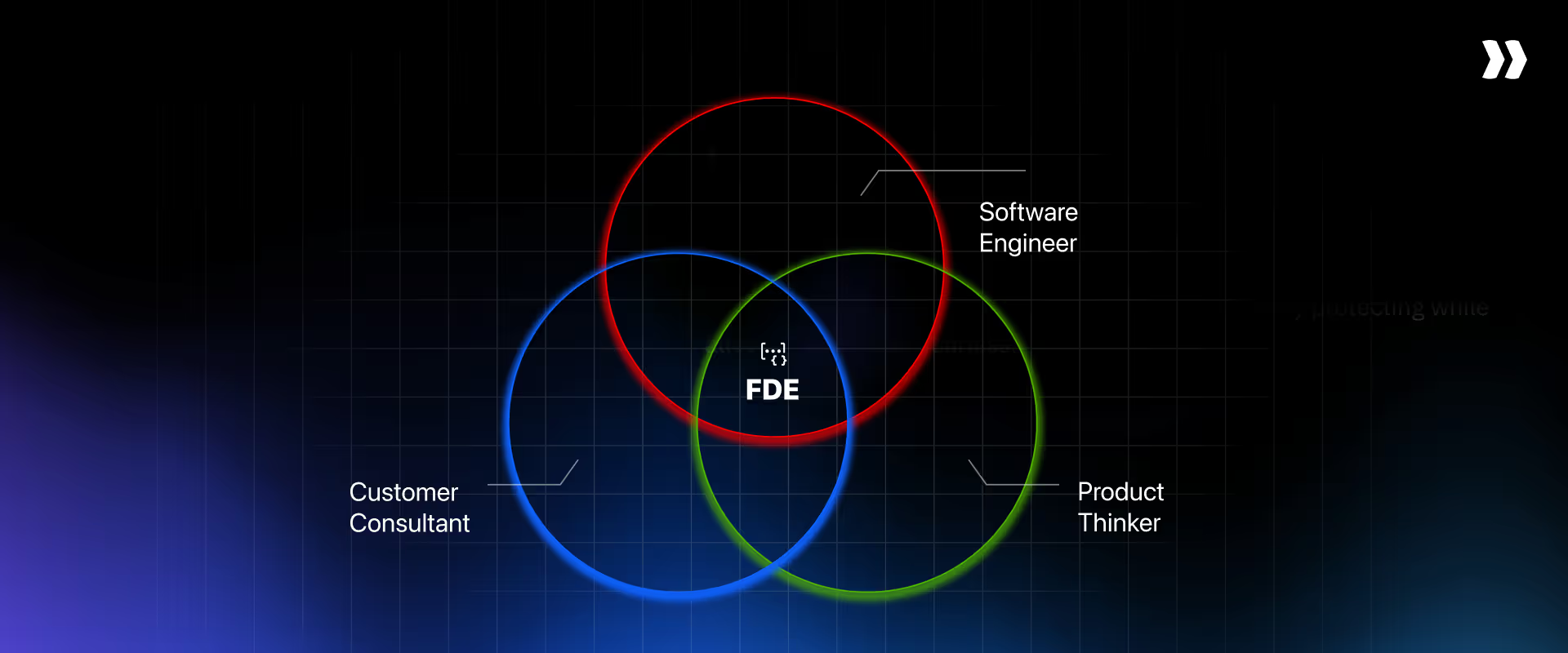
A Forward Deployed Engineer (FDE) is a customer-embedded engineer who works directly inside a client’s environment to make a complex software product actually work for them in the real world.
In simple terms:
⭐ An FDE is an engineer who implements, tailors, troubleshoots, and operationalizes your product from inside the customer’s reality, not from behind a ticketing system.
FDEs are technical enough to build and configure solutions, but they also understand the customer’s business deeply—its workflows, constraints, and value drivers. That clarity helps them solve the real problem, not just the stated one.
Imagine having a senior engineer sitting beside you during implementation — someone who can instantly handle the problems that normally drag timelines for weeks:
- Messy or incomplete data
- Unpredictable workflow exceptions
- That “we need this integration, or we can’t go live” moment
- The engineering team that’s fully booked for three sprints
An FDE is the person who says: “Don’t worry—I’ll build it.”
They bridge the exact gap that PS and onboarding teams deal with every day:
- Product limitations meeting real-world processes
- Workflows that need more than configuration
- Engineering bandwidth shortages
- Sales commitments needing technical muscle
- Non-technical buyers adopting deeply technical tools
- AI/automation features needing rapid field iteration
You’re already solving these problems manually, painfully, and slowly.
FDEs solve them fast, cleanly, and without derailing your roadmap.
History of the forward-deployed engineer role? Why top Enterprise AI companies create the FDE role?
The Forward Deployed Engineer role didn’t start as a trendy job title.
It emerged because fast-growing software companies ran into a harsh reality:
Enterprise customers live in environments far more chaotic than product teams ever anticipate.
If you rewind to the early 2010s, companies like Palantir were working with massive enterprises—governments, airlines, banks—who all had one thing in common:
Customers didn’t need more features. They needed engineers who could make those features work within fragmented data systems, legacy workflows, and high-stakes operational constraints.
So Palantir embedded engineers directly inside customer teams.
Not as consultants — but as builders who could write code, untangle data pipelines, adapt workflows, and uncover constraints no discovery call ever reveals.
The impact was immediate: faster deployments, stronger adoption, and product insights that shaped the roadmap.
And it worked.
Customers got faster outcomes. Engineering got priceless field insights. The product evolved faster. Everyone won.
Fast forward a few years.
As enterprise SaaS complexity & AI progress took off increased with more configuration, deeper integrations, and AI-driven workflows, other companies began hitting the same wall.
Intercom, Rippling, Stripe, Datadog, OpenAI, and dozens more realized that powerful products require an engineering presence in the field.
Thus, the modern FDE: engineers who implement, customize, and translate real-world constraints into product evolution.
Not a trend — a structural answer to enterprise reality.
Why the FDE model is gaining traction in enterprise AI tech and Professional Services?
The rise of the Forward Deployed Engineer (FDE) model isn’t a trend—it’s a market correction.
Products have become more powerful, more AI-driven, and more integration-heavy.
But customer environments? They’ve stayed messy, full of fragmented data, legacy workflows, half-documented systems, and teams that aren’t equipped to operationalize complex tools independently.
This widening delivery gap is exactly why FDEs are surging, and here are some reasons why.
1. Enterprise tech & AI complexity is outpacing buyer capability
Automation, AI, complex applied AI use cases, and integration-heavy platforms now require engineering-level support that non-technical teams simply can’t operationalize on their own.
2. Implementations are choking revenue velocity
PS teams repeatedly stall on data issues, edge cases, and integration blockers. FDEs eliminate these delays before they become escalation chains.
3. Engineering bandwidth is stretched thin
Every enterprise AI company feels the pull: urgent customer issues vs critical roadmap work. FDEs absorb the former so that engineering can stay focused.
4. The last-mile gap that AI can’t solve alone
FDEs act as field sensors — capturing real usage patterns and feeding insights back to the product faster than traditional methods can.
5. Why ROI matters in modern PS delivery
FDEs help PS teams deliver cleaner, faster, more predictable implementations—improving margins and reducing risk.
FDEs are the human layer that makes AI-orchestrated service delivery actually work.
Why do you need an FDE in the first place? (5 key objectives)

You don’t hire an FDE because it’s trendy — you hire one when customer outcomes depend on engineering-level involvement.
Here are the five core objectives that make FDEs indispensable:
1. Complex products require hands-on technical acceleration
AI features, multi-step workflows, and integration-heavy platforms create blockers that configuration-only teams can’t solve.
FDEs unblock these instantly — preventing multi-week delays that inflate TTV and frustrate enterprise buyers.
2. Enterprise buyers need help operationalizing outcomes
Buyers pay for results, not technical effort.
FDEs turn promised outcomes into functioning workflows — ensuring customers hit ROI timelines rather than slip into escalation cycles.
3. GTM and engineering often operate in different timelines
Sales sell outcomes fast. Engineering ships' roadmap slowly.
FDEs sit in the middle — translating customer constraints into technical execution without pulling engineering off the roadmap.
4. Customers have problems they can’t articulate
Most enterprise blockers aren’t spoken — they’re discovered.
FDEs uncover workflow gaps, edge cases, and hidden requirements that prevent adoption long before they become churn risks.
5. Field learnings fuel smarter product roadmaps
Every FDE engagement becomes a live R&D loop.
They surface patterns, edge cases, and high-impact workflow insights that shape product direction and accelerate roadmap accuracy.
Key skills required for a forward-deployed engineer to bring great ROI for PS teams
A great forward-deployed engineer isn’t just a strong developer — they’re a rare hybrid who can build, communicate, and problem-solve inside messy, high-stakes customer environments.
Here are the core skills that directly translate into ROI for professional services teams:
1. Technical depth that goes beyond “Config.”
FDEs must be able to write clean code, build integrations, fix edge cases, and navigate APIs or data pipelines. This lets PS teams deliver faster without waiting on engineering.
2. Rapid problem identification
Top FDEs can walk into a customer’s world and instantly spot the real blocker — even when the customer can’t articulate it. This skill saves weeks of back-and-forth.
3. Customer empathy + Clear communication
They translate technical concepts into simple language. This keeps enterprise stakeholders aligned and reduces friction during onboarding.
4. Founder-like ownership
FDEs don’t just “help with setup.” They own the customer outcome end-to-end, making decisions that speed up delivery and improve adoption.
5. Comfort with ambiguity and fast iteration
PS environments are unpredictable. FDEs must adapt quickly, test solutions, and learn from field signals — especially in AI or rapidly evolving products.
6. Product judgment: Knowing what should be built
Top FDEs quickly identify whether a customer request deserves a one-off customization or signals a true product gap.
This judgment helps teams avoid unnecessary tech debt and ensures that only high-value patterns make it into the roadmap.
7. AI fluency + Agentic thinking
Modern FDEs must know how to design, deploy, and orchestrate AI agents, not just write code.
They ask: “What should the system automate vs. what requires human judgment?”
They use AI to:
• Automate diagnostics
• Pre-analyze customer data
• Identify workflow patterns
• Accelerate discovery
• Reduce manual engineering lift
This ability transforms FDEs into architects of agentic operations — where AI handles repetitive work, and humans focus on high-value problem-solving.
Role of FDEs in complex enterprise implementations
Enterprise implementations are rarely straightforward.
They come with tangled workflows, half-documented systems, political dynamics, and stakeholders who all want the software to “just work” — but each with a different definition of what “working” actually means.
This is where forward-deployed engineers become game-changing.
1. Understanding the customer’s org & tech stack quickly
Enterprise customers don’t hand you a polished architecture diagram.
They hand you reality: outdated systems, tribal knowledge, undocumented APIs, and data spread across multiple tools.
An FDE’s superpower is rapid comprehension.
They map how the customer’s environment actually works—not how teams think it does.
This alone cuts weeks off onboarding timelines.
2. Solving edge cases + configuring for reality, not theory
Every enterprise project includes:
- A legacy workflow nobody wants to touch
- An odd integration path
- A “We’ve always done it this way,” exception
Traditional onboarding teams often hit a wall here. FDEs don’t.
They diagnose, configure, customize, and build solutions that fit real-world constraints — ensuring the product delivers value in the customer’s environment, not just in your demo environment.
3. Bridging GTM, product, and engineering in real time
Enterprise projects stall when teams operate in silos. FDEs remove that friction.
They communicate customer needs to engineering with precision.
Align GTM teams on what’s promised vs. possible…
And surface field insights that roadmap meetings rarely uncover.
This real-time triage keeps enterprise implementations moving forward.
In short: FDEs turn complex implementations from unpredictable to controlled — accelerating go-lives, reducing escalations, and driving better customer outcomes.
Key metrics businesses care about, and how FDEs are bridging the gap between
If you run Professional Services, Onboarding, or any post-sales function, you already know the truth: you live and die by a handful of metrics.
They show up in QBRs, board decks, renewal calls, and every “why is this implementation delayed?” Slack thread.
Forward-deployed engineers directly influence everyone.
1. Time-to-Value (TTV)
The biggest frustration for enterprise customers is simple: “Why is this taking so long?”
Most delays come from technical blockers — integrations, messy data, and legacy workflows.
FDEs tackle these head-on, building, fixing, and unblocking without waiting on engineering.
Faster fixes → faster go-live → dramatically lower TTV.
2. Adoption depth
Launching the product isn’t enough.
Customers want it woven into their daily operations.
FDEs tailor configurations to real workflows, driving deeper, stickier adoption across teams.
3. Usage uplift (Especially for AI & Data products)
AI tools only perform as well as:
- The data they ingest
- The configurations they run
- The workflows they support
FDEs fine-tune all three — delivering measurable usage spikes, a critical KPI for AI-led products.
4. Industry-Specific ROI That Unlocks Expansion
FDEs tailor solutions to each industry’s real workflows, proving value where it matters most.
For example, a payroll SaaS FDE cut a 3-month integration for a healthcare client down to 3 weeks, instantly unlocking a stalled expansion and accelerating deal approval across their entire network.
5. Product-led Improvement speed
The best product insights don’t come from internal meetings — they come from the field.
FDEs surface patterns, edge cases, and customer needs that guide smarter roadmap decisions.
Bottom line:FDEs don’t just influence these metrics — they move them, driving measurable improvements in customer value, revenue, and product quality.
Forward-deployed engineer vs traditional roles
When people first hear “Forward Deployed Engineer,” they assume it’s just a fancy title for roles they already know — CS Engineers, Solutions Architects, Implementation Consultants.
But in reality, none of these roles can do what an FDE is designed to do.
Here’s the simplest way to understand the difference:
FDE vs Customer Success Engineer (CSE)
CSEs guide. FDEs build.
CSEs excel at configuration, enablement, and technical guidance — but they don’t write production-grade code or patch product gaps.
CSEs work within what the product currently supports.
FDEs extend it to match the customer’s real-world needs.
FDE vs Solutions Engineer / Architect (SE/SA)
SEs sell the vision. FDEs make the vision real.
SEs handle pre-sales: scoping, demos, and proof of possibility.
But once the deal closes, they’re not the ones building integrations, fixing data issues, or operationalizing workflows.
FDEs take those promises and deliver them in production environments.
FDE vs Implementation Consultant
Consultants manage the project. FDEs unblock the project.
Implementation Consultants handle timelines, stakeholders, and configuration.
But when they hit a technical wall — a missing API, a brittle migration, a product limitation — they need engineering.
FDEs eliminate that dependency by solving the technical blockers themselves.
The Core Truth
CSEs, SEs, and Consultants operate around the product.
FDEs operate inside it.
And here’s the modern twist:
While AI is making every role more “full-stack,” FDEs are full-stack in a completely different direction.
They blend engineering depth, product intuition, and outcome ownership in the same seat — something no other post-sales role is structurally designed to do.
They don’t simply run the project. They design the machine that delivers the outcome.
And unlike traditional roles, FDEs excel at problem discovery — spotting the real issue beneath the stated issue and acting on it before anyone else even sees it.
They surface unspoken bottlenecks, fix what truly moves the needle, and turn hidden problems into customer wins.
That’s why modern Enterprise AI companies can’t scale complex, AI-era enterprise delivery without them.
Challenges & risks in running an FDE function
Building an FDE function feels like unlocking a superpower — until you actually run one.
Because FDEs sit at the crossroads of engineering, GTM, product, and high-stakes enterprise delivery, they inevitably attract complexity.
And unless you set the right boundaries, that complexity quickly snowballs into chaos.
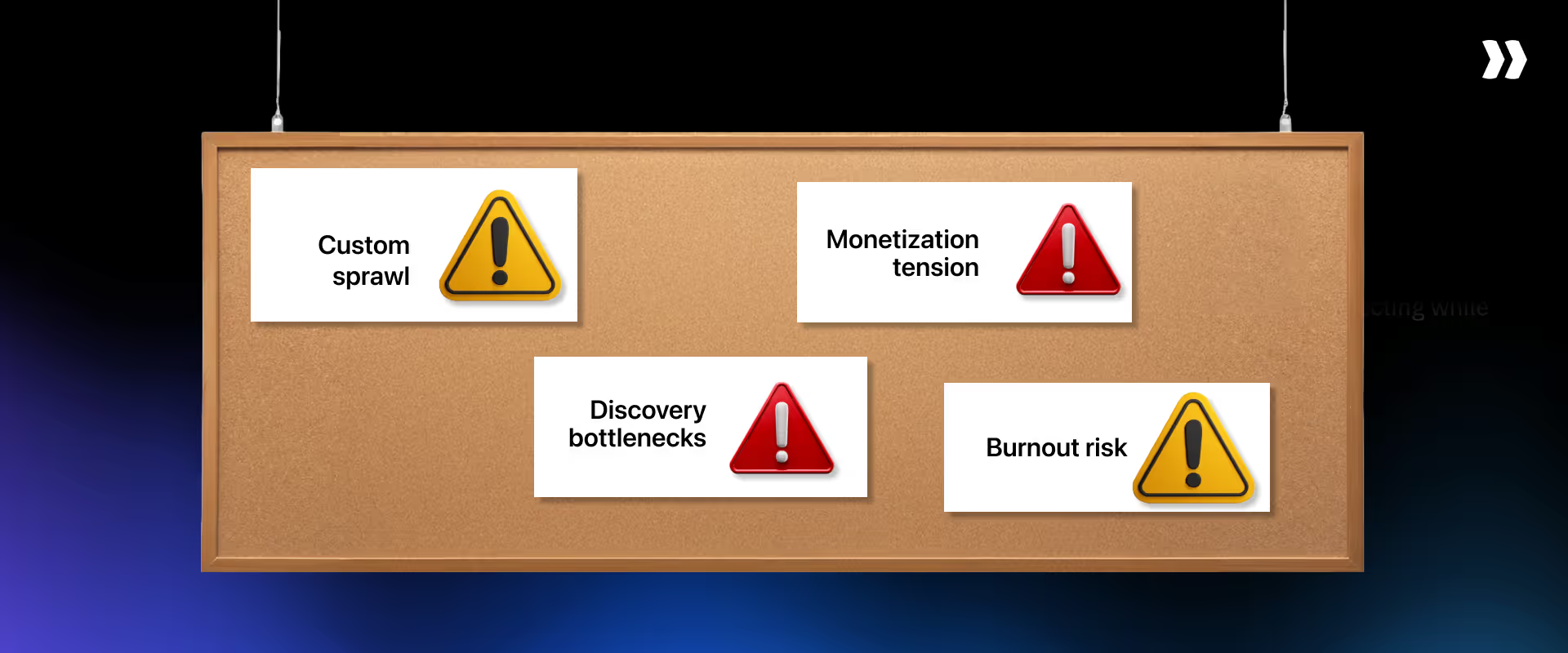
Here are the biggest risks leaders must navigate:
1. Custom solution sprawl
Embedded FDEs often ship fast, tactical fixes to unblock customers.
But without guardrails, this becomes a pile of one-off scripts, feature-flagged forks, and brittle patches that eventually slow down upgrades and create hidden tech debt for product teams.
Smart FDE orgs document aggressively, isolate repeatable patterns early, and productize only what scales.
2. Becoming a crutch for other teams
When sales, CS, or implementation get stuck, the easiest move is often: “Ask the FDE.”
But this is dangerous.
It creates dependency, erodes team maturity, and drains your hardest-to-hire engineers.
And emotionally? It burns FDEs out fast.
Nothing is more demoralizing for an FDE than feeling like every escalation lands on their plate because no one else wants to own it.
Healthy orgs define structured engagement rules — scope, milestones, and exit criteria — before every FDE assignment.
3. Talent scarcity (You need founders, not just engineers)
Great FDEs aren’t ordinary engineers. They code like ICs, communicate like product managers, and navigate customers like founders.
That hybrid skill set is rare — and expensive.
Hiring the wrong profile doesn’t just slow down the motion; it stops it. It frustrates the engineer and the customer.
4. Discovery bottlenecks
Implementations don’t fail because of configuration. They fail because teams don’t uncover the real constraints early enough.
Mapping a customer’s org chart, workflows, data mess, and political realities quickly is emotionally and cognitively demanding.
That’s why tools that speed up discovery, like structured project platforms, automated intake forms, or AI assistants, end up becoming invaluable.
5. Balancing monetization vs velocity
Every FDE org hits the same tension:
Do we charge for this work?
Or do we move fast to learn and land the account?
Push too hard on monetization, and customers feel nickel-and-dimed.
Push too hard on speed, and your margins evaporate.
If you’ve ever run PS, you know this emotional tightrope well.
The bottom line
The FDE org becomes a strategic asset only when leaders control sprawl, hire intentionally, streamline discovery, and set boundaries. Without discipline, the motion burns people out. With discipline, it becomes a moat.
Now that we’ve covered the risks of running an FDE function, let’s shift to the upside — the transformational impact FDEs have on onboarding and enterprise delivery.
How forward-deployed engineers improve customer onboarding & implementation
Anyone who’s delivered enterprise onboarding knows the truth: implementations rarely fail because the product is weak — they fail because the customer’s reality is far more complex than the playbook assumed.
Forward Deployed Engineers (FDEs) exist to eliminate exactly those blockers — and their impact on onboarding is transformational.
1. Reducing time-to-value for enterprise clients
Enterprise buyers expect value immediately, yet most delays come from issues onboarding teams can’t fix: missing APIs, messy data, odd workflow exceptions, and unexpected edge cases.
FDEs remove these delays by handling the heavy lifting themselves — diagnosing, fixing, and building solutions in real time.
A blocker that once stalled the project for 6 weeks becomes a 2-hour fix.
Faster fixes → faster deployment → faster value.
2. Solving integration & migration challenges
Integrations and migrations are the silent killers of onboarding.
A single broken mapping or brittle legacy script can freeze a multi-million-dollar rollout.
FDEs step in with engineering-level skills to repair data, build connectors, rewrite scripts, and optimize workflows — all within the onboarding motion, not through long engineering escalations.
3. Driving adoption through hands-on technical expertise
True adoption requires technical alignment, not just change management.
FDEs tailor the product to the customer’s real workflows, ensuring teams use it correctly from day one.
This drives deeper adoption, reduces resistance, and enables cleaner handoffs to CS.
4. Why PS + FDE = The highest retention engine
When onboarding succeeds, everything downstream gets easier:
• Fewer escalations
• Renewals feel natural
• Expansion opportunities appear earlier
• Customers feel the product was “built for them.”
FDEs turn onboarding from a risky phase into a competitive advantage — accelerating value, smoothing delivery, and strengthening long-term retention.
The strategic role of FDEs in professional services organizations

If you lead Professional Services, you’re measured on two things: how fast you deliver and how profitable that delivery is.
And while FDEs may initially seem like an optional luxury, their value becomes undeniable once you see what they unlock inside real enterprise projects.
Here’s where the impact becomes impossible to ignore:
1. FDEs as revenue multipliers
Enterprise customers don’t pay for features—they pay for outcomes.
When a critical workflow stalls or a promised integration lags, expansion slows, and renewal risk creeps in.
FDEs remove these friction points by solving high-value, technically complex problems that unlock:
• Faster expansions
• Cleaner upsells
• Smoother renewals
• Greater implementation capacity
Every blocker removed protects revenue—and often accelerates it.
2. FDEs as delivery accelerators
Most PS delays aren’t due to poor project management—they stem from hidden technical surprises no one accounted for.
FDEs eliminate those surprises by building or fixing what engineering can’t immediately prioritize.
The result? Shorter timelines, fewer escalations, and more successful go-lives per quarter.
3. FDEs as customer happiness drivers
Customers trust teams who can solve problems in the moment.
FDEs bring that confidence into every interaction—tailoring the product to the customer’s reality and ensuring teams adopt it correctly from day one.
That combination leads to stronger NPS, smoother renewals, and customers who genuinely feel supported.
Forward-deployed engineers + PS automation: The perfect combination

Forward-deployed engineers excel at solving customer-specific technical problems.
But even the best FDEs lose hours every week to tasks that aren’t engineering: chasing status updates, re-documenting steps, aligning stakeholders, and piecing together information scattered across Slack, spreadsheets, emails, and Jira.
This hidden operational drag slows down even the most talented engineers — and that’s where PS automation, especially Rocketlane, changes everything.
1. How FDEs use PS automation tools
FDEs work best when they have absolute clarity:
• What’s done
• What’s blocked
• What the customer expects
• What the timeline is
PS automation pulls all this into a single, structured workspace.
The result? FDEs stop wasting time coordinating and start spending time building.
2. Why FDEs need a unified project / Onboarding platform
When information lives everywhere, velocity dies.
A unified platform consolidates all tasks, requirements, dependencies, and customer updates into a single, clear blueprint.
No noise. No blind spots. No “What’s the latest?” chaos.
3. How Rocketlane enables FDEs to deliver faster
Rocketlane gives FDEs the operational backbone they’ve always lacked:
• Reusable playbooks for repeatable onboarding
• Automation that eliminates manual follow-ups
• Customer-facing project views for real-time alignment
• Resource management to protect bandwidth
• Task-level collaboration for fast, contextual problem-solving
• AI-Fills to automate task creation, project plans, and documentation using contextual intelligence
Everything happens in one place — so momentum never breaks.
4. How Rocketlane enables 10× faster FDE outcomes
The real magic isn’t adding new tools — it’s removing friction.
By eliminating context-hunting, alignment gaps, and repetitive admin work, Rocketlane frees FDEs to spend 90%+ of their time on actual engineering.
That shift leads to:
• Faster integrations
• Cleaner migrations
• Quicker go-lives
• Fewer escalations
• Stronger adoption
• Higher retention
In short: Rocketlane helps FDEs operate at their highest leverage — delivering the speed and precision your PS org needs to stay profitable and competitive.
When do you actually need an FDE?
Most teams don’t realize they need an FDE until they’re already deep in a messy implementation.
Everything starts smoothly until it doesn’t. A strange integration edge case appears, a data mismatch surfaces, a hidden workflow suddenly matters, and suddenly:
• PS is firefighting
• Engineering is frustrated
• The customer is losing confidence
If this feels familiar, here’s your practical decision matrix.
1. Signals you need an FDE
You likely need an FDE if any of these repeatedly show up in your delivery motion:
• Engineering keeps getting pulled into customer fixes
• Projects slip due to “unexpected” technical blockers
• Enterprise accounts require custom logic to reach value
• Sales are promising outcomes, the product almost supports
• AI/automation features break on messy real-world data
If even two apply, you’re not looking for extra support — you’re looking for stabilization.
2. When outsourcing or PS teams alone won’t work
Traditional PS teams and external integrators struggle when:
• The product is evolving quickly,
• The environment is complex, or
• The customer needs real-time technical decisions.
Only an embedded engineer who can build, troubleshoot, and adapt on the fly can bridge that gap effectively.
3. FDEs for scaling implementations
As deal sizes grow, implementation complexity scales faster than engineering bandwidth.
FDEs give PS a way to maintain velocity without overloading product teams — turning technical bottlenecks into delivery advantages and repeatable enterprise wins.
Cost, compensation & ROI of forward-deployed engineers
Let’s tackle the big question head-on: What do FDEs cost — and are they worth it?
Short answer: Yes. And the emotional truth behind the numbers matters just as much as the math.
1. Salary benchmarks (North America + Global)
Forward Deployed Engineers sit at the very top of the engineering market.
North America (General Market Salaries)
- $120K–$160K average total compensation for forward-deployed engineer roles
- Higher compensation for AI- or enterprise-focused companies.
Elite FDE/FDSE programs (Palantir, OpenAI, etc.)
Global & contracting markets
- Contract FDEs typically $60–$250/hr, depending on region and experience
- Enterprise-grade FDE contractors (Palantir-style) often bill £600–£700/day in Europe.
2. Cost vs value: Why FDEs pay for themselves
A single enterprise customer slipping or churning can put $200K–$1M+ ARR at risk.
And for PS leaders, nothing stings more than watching a logo churn not because the product failed — but because real-world implementation hit a wall your team couldn’t unblock in time.
That pain is far more expensive than any FDE salary could be.
FDEs exist to eliminate exactly those risks.
They prevent engineering derailment, accelerate onboarding timelines, fix high-stakes integrations, rescue at-risk projects, and reduce escalations that drain PS bandwidth.
If one FDE unblocks one major enterprise rollout, they’ve likely covered their entire cost.
Then add:
- Higher adoption
- Faster time-to-value
- Smoother expansions
- Fewer escalation cycles
- Product improvements powered by field insight
And the ROI compounds fast.
No fear-based selling. Just realism: one failed enterprise implementation can erase an entire year of PS progress. One great FDE can prevent it.
3. Building an internal FDE team vs contracting
Most organizations start with the same dilemma: “Should we build an internal FDE team or hire contractors?”
When to start with contracting
- Have inconsistent enterprise demand
- Want to validate the FDE motion.
- Need flexible capacity
- Are testing “services + engineering” delivery
- Need expertise now (vs. 60–120 days of hiring)
Contract FDEs ($60–$250/hr) are perfect for proving the motion without long-term commitment.
When to Build Internally
You should invest in internal FDEs when you notice:
- Repeated enterprise technical needs
- Consistent escalations to engineering
- AI/automation features needing field tuning
- Customers are expecting a deeper technical partnership.
- A desire for tight product feedback loops
- The need for predictable, scalable delivery
Internal FDEs deliver greater cost efficiency, deeper product knowledge, and long-term leverage.
Real-world examples of forward-deployed engineering teams

If you’re still wondering whether the forward-deployed engineer model is “real” or just startup jargon, look at who’s betting big on it.
Palantir’s FDE model: The original playbook
Palantir practically invented the modern Forward Deployed Software Engineer (FDSE). Their FDSEs embed deeply with a single customer at a time, shaping Palantir deployments across the government, aviation, and financial sectors.
The result?
Complex, high-risk deployments became long-term, high-value relationships.
At one point, Palantir had more FDSEs than traditional software engineers — because placing engineers close to the customer created near-unchurnable accounts.
That’s the classic margin-for-moat strategy: higher services investment leading to dramatically stronger, durable contracts.
Salesforce: FDEs for complex AI solutions
Salesforce deploys Forward Deployed Engineers for its highest-stakes AI implementations — the ones involving bespoke workflows, multi-system integrations, and real enterprise risk.
When the deal is big and the environment unpredictable, Salesforce sends FDEs to ensure the outcome lands.
Modern enterprise AI companies: Stripe, Datadog, AI startups & others
Forward-deployed roles are exploding across modern SaaS — especially in multi-product and AI-first companies.
- Stripe built a Revenue & Financial Automation FDE team to partner with strategic enterprise users and close product-market fit gaps.
- Datadog, OpenAI, Anthropic, Cohere, and other AI-native companies are hiring FDE-like roles at unprecedented rates — with job postings up 800–1000% in 2025.
These teams help enterprise customers operationalize complex AI systems, fine-tune models, and unlock usage-based revenue.
No hype — just market demand.
As products become more powerful, companies need engineers embedded where customer complexity truly lives.
How Rocketlane helps forward-deployed engineers deliver better outcomes
Forward Deployed Engineers excel at solving complex customer problems, but a significant portion of their time — 40–60% — is lost to administrative tasks rather than engineering work.
Instead of focusing on building, unblocking, and solving, FDEs often find themselves chasing context, updating stakeholders, and managing scattered information across tools.
This is where Rocketlane steps in as a game-changer, streamlining these tasks and freeing FDEs to focus on what they do best: driving technical outcomes.
No chasing. No follow-ups. No “What’s the latest?” confusion.
This single improvement returns hours of engineering time each week.
Let’s see a few more specific use cases.
1. One unified platform: Managing projects, people, and profits in one place
FDEs deliver their best work when they clearly understand:
- What’s been done
- What’s blocked
- When customer requirements are well documented
- What needs to happen now
Rocketlane pulls all of this into a single, structured, real-time view.
No Slack archaeology. No Notion maze. No scattered updates.
Your FDE starts every day with clarity — and speed.
2. Dynamic templates for standardized implementations
Every FDE knows the pain of rebuilding the same onboarding motions from scratch. Rocketlane solves this with a library of dynamic templates that standardize delivery and accelerate execution across every customer project.
Here’s how Rocketlane solved these blockers with a unified system
- Standardized project templates for repeatable delivery
Help FDEs launch projects instantly with pre-defined workflows, resource assignments, timelines, and dependencies—removing hours of manual setup. - Consistent documentation through reusable structures
Ensure every SOW, handoff doc, requirements spec, or integration guide follows the same consistent, high-quality structure your PS org expects. - Smarter data intake with structured form templates
Let FDEs collect customer requirements, technical details, and configuration inputs through structured forms that automatically populate your project workspace. - Outcome-focused reporting & dashboards for FDEs
Provide out-of-the-box visibility into project health, risks, timelines, utilization, and capacity. FDEs and PS leaders get instant insight without building dashboards from scratch—helping teams spot blockers early and keep customers aligned.
The Result:
With Rocketlane powering every repeatable motion, FDEs spend almost all their time on engineering and problem-solving—not recreating processes, documentation, or reporting.
3. Automation that removes FDE busywork
Rocketlane, using its AI layer, automates every repetitive coordination task FDEs hate:
- Status updates
- Reminders and follow-ups
- Customer nudges
- Task assignments
- Timeline communication
Which frees FDEs to spend their time on true engineering work:
- Integrations
- Custom logic
- Data workflows
- AI tuning
- Fixing complex edge cases
Not admin.
As a result, you get faster integrations, cleaner migrations, quicker go-lives, stronger adoption, fewer escalations, and a dramatically more profitable PS engine.
The Bottom Line - FDEs deliver value. Rocketlane helps them deliver it faster, cleaner, and more profitably.
4. Enhanced time tracking for project tasks & workload management
Rocketlane provides FDEs with a robust time tracking feature to ensure efficient workload management:
- Track time spent on specific project tasks and activities.
- Differentiate between billable and non-billable hours for accurate billing and transparency.
- Optimize resource allocation by getting real-time insights into how time is spent across tasks.
- Manage budgets effectively by tracking hours spent and staying within predefined budget limits.
- Improve reporting accuracy with timesheets that are easy to submit for client approval.
By using Rocketlane’s time-tracking, FDEs can stay on top of each project’s workload and budget, enabling more efficient resource allocation and ensuring no task is left behind.
5. A customizable client portal for seamless client engagement
Rocketlane’s client portal gives FDEs and clients a seamless, centralized space to track project progress and interact:
- Centralized project information: All client data, plans, and communications are stored in a single location.
- Real-time feedback: Clients can leave feedback and ask questions as they move through the project.
- Increased transparency: FDEs can share up-to-date progress, timelines, and any roadblocks.
- Improved client collaboration: Clients can view and interact with documents, timelines, and tasks directly in the portal.
- Simplified communication: No more jumping between tools—everything clients need is available in the portal.
The client portal enhances the client experience, helping FDEs manage expectations and engage in more productive, transparent communication, driving smoother project deliveries.
Conclusion: Why FDEs are the future of SaaS & professional services delivery
If this guide proves anything, it’s this:
Forward-deployed engineers aren’t optional anymore — they’re a strategic advantage for every modern SaaS and PS organization.
Products are more complex. Customer environments are messy. Expectations are higher than ever.
FDEs close the gap—turning technical chaos into smooth implementations, faster time-to-value, deeper adoption, and stronger renewals.
But even the best FDEs can only deliver at full power when the system around them eliminates friction.
That’s where Rocketlane becomes your multiplier.
As the leading PSA automation and customer onboarding platform, Rocketlane gives FDEs and PS teams the visibility, structure, automation, and shared alignment needed to deliver consistently excellent outcomes—without delays, rework, or confusion.
FDEs deliver technical impact. Rocketlane delivers operational excellence.
Together, they turn implementations into a predictable, profitable engine.

Authored by

Kailash Ganesh
Kailash Ganesh is a professional services researcher at Rocketlane with more than seven years of experience in content, research, and market analysis. He studies how enterprise PS teams are adopting agentic AI to transform delivery operations, has evaluated every major PSA platform in the category, and writes from the perspective of a practitioner who watches enterprise PS teams make these exact decisions daily.
Table of Contents

Regsiter for the live webinar


Great consultants didn't join your team to spend Fridays writing documentation.
Table of contents
18 of Forbes Cloud 100 chose Rocketlane. The best PS teams aren't waiting around.
FAQs
Is FDE a software engineer?
Yes — but not a typical one. An FDE is a software engineer with the added ability to work directly with customers, solve real-world technical blockers, build integrations, and tailor the product to complex environments. Think of them as engineers who code and deliver outcomes, bridging product capability and customer reality in real time.
Do all SaaS companies need FDEs?
Not necessarily — but any SaaS selling a complex, customizable, AI-driven, or enterprise-focused product will eventually need them. FDEs become essential when customers hit technical blockers, implementations slow down, or PS teams depend too heavily on engineering. If your product is powerful but hard to operationalize, an FDE isn’t optional — it’s your velocity engine.
How can FDEs collaborate better with PS teams?
FDEs and PS teams collaborate best when they share a single workspace, a single plan, and clear ownership. FDEs handle deep technical blockers; PS teams drive timelines and stakeholder alignment. Using a unified platform (like Rocketlane) for tasks, dependencies, updates, and customer-facing visibility keeps everyone synced, reduces escalations, and speeds up delivery without constant back-and-forth.
Why FDEs Will Become a Standard in PS Delivery
FDEs solve the exact problems slowing modern SaaS implementations: complex integrations, messy data, AI configurations, and product gaps. As customer expectations rise and products become more technical, PS teams can’t rely on configuration-only roles. FDEs bring engineering depth into delivery, enabling faster go-lives, higher adoption, and lower churn—making them the new baseline for profitable, predictable PS execution.
How Rocketlane Accelerates FDE-Led Implementations
Rocketlane removes the coordination and communication friction that slows FDEs down. With unified project tracking, reusable playbooks, automated updates, and a single shared workspace for customers and internal teams, FDEs spend more time solving technical problems and less time chasing context—the result: faster integrations, clearer alignment, reduced escalations, and consistently smoother enterprise go-lives.













Copyright © 2026 Rocketlane Corp. All rights reserved.


















.webp)