Proven PS strategies to rescue failed SaaS implementations

•
•
Summarize blog with






Failed implementations remain one of the toughest challenges in professional services (PS). McKinsey reports that 70% of digital transformations fall short of their intended goals.
When projects run late, go over budget, or deliver less than promised, the consequences extend far beyond immediate frustration. Customer trust weakens, time-to-value drags out, and the path to renewal and expansion becomes uncertain.
The good news is that failure does not have to be final. Clear frameworks and timely action can turn struggling projects around. More importantly, PS leaders can build repeatable systems that protect customers from failure in the first place and establish a reputation for delivering consistent outcomes.
How do you identify the early signals of a project in trouble? What practical steps can you take to bring it back on course? And how do you build a delivery model that prevents the same issues from recurring?
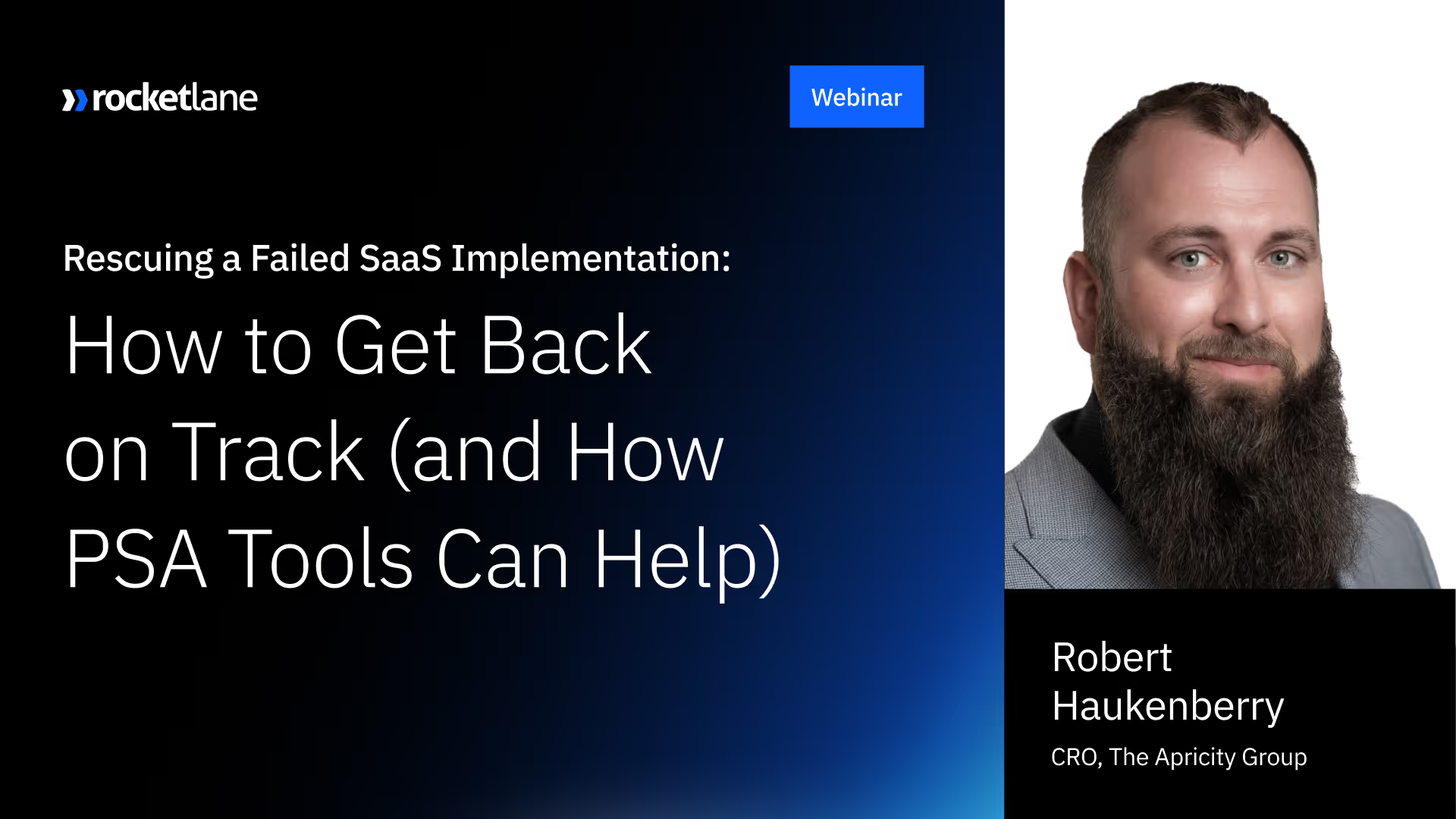
In a recent Rocketlane webinar, Robert Haukenberry, Chief Revenue Officer at Appreciate Group, shared his extensive experience leading professional services, process, and automation initiatives with Rocketlane and other professional service automation (PSA) tools. He outlined the early warning signs that signal a project is at risk, a step-by-step approach to rescue struggling implementations, and best practices to prevent future failures.
Read on for a summary of the session and practical insights PS leaders can take back to their teams to consistently deliver successful outcomes for every customer.
Why SaaS implementations fail
Failure in digital transformation is more common than most leaders expect. These failures show up at every stage: during implementation, in the post-go-live adoption phase, and even years later when systems fail to drive outcomes. On the surface, the reasons seem obvious—delays, budget overruns, low adoption. But when we zoom out, almost every breakdown ties back to three root causes: people, process, and visibility.
1. People
The most common breakdown is around people. Customers often underestimate how much change management matters. Expectations get misaligned. For instance, sales teams might promise a 90-day rollout, but the customer doesn’t have the resources to meet that timeline. Or end users may also resist change, finding ways to bypass the system if they don’t see the value.
To avoid these pitfalls, projects need strong alignment through:
- Clear purpose: Everyone should understand the “why” behind the project
- Executive commitment: Leaders must stay engaged with regular check-ins to keep momentum
- Stakeholder engagement: Weekly reviews with the right voices ensure issues don’t get buried
- Flexibility: A hybrid agile-waterfall approach works best—milestones for structure, sprints for iteration
Focus: Use a “parking lot” to capture nice-to-haves without letting them derail core delivery
2. Process
Every SaaS implementation is a process transformation, not just a deployment. Too often, customers try to copy legacy workflows into a new SaaS tool. At the other extreme, some teams come in with no processes at all, leaving implementation teams with nothing to build on.
To set the stage for success, PS leaders should:
- Map workflows early: Even a rough diagram sparks the right conversations
- Challenge legacy habits: Encourage teams to embrace best practices rather than copy old ones
- Balance configuration: Too much customization could result in technical debt, while too little tailoring leads to the risk of low adoption
3. Visibility
Even technically sound projects can be perceived as failures if customers don’t see progress and outcomes clearly. Lack of visibility is the main reason why projects drift. Scope, schedule, and budget slip until issues become too big to ignore.
True visibility needs to extend beyond go-live. Many teams treat deployment as the finish line, but it’s really the starting point. The post-go-live period, often referred to as the “valley of death,” is when adoption drops and ROI comes under scrutiny. Customers need hyper-care during this stage to build confidence and see value faster.
PS leaders can strengthen visibility by:
- Tracking key metrics: Scope, schedule, budget, adoption, and ROI
- Extending the roadmap: Include adoption milestones and business outcomes, not just deployment tasks
- Planning for change: In M&A environments, visibility must also cover future integrations
4 signs of a failed implementation
When implementations go off track, the signals are rarely loud and obvious. They tend to be subtle, easy to overlook, and easy to dismiss as temporary hiccups. Spotting these red flags early is critical. It gives professional services leaders the opportunity to step in, course-correct, and prevent projects from sliding into failure.
Here are the most common warning signs of a failing implementation:
1. Slipping milestones and burn rates
During implementation, common patterns point to underlying process gaps, resource mismanagement, or misalignment that require immediate attention. These patterns include:
- Milestones keep moving: Deadlines slip, and teams cannot explain why.
- Burn rates spike: For example, 150 out of 200 scoped hours may be consumed in the first two weeks. This usually indicates misaligned resources or poor tracking.
- Escalations outweigh wins: Executives hear more complaints than success stories, which shifts the overall tone from optimism to frustration.
2. Stakeholder disengagement
Momentum collapses quickly when champions and stakeholders step back from the project.
- Executive sponsors stop showing up: Without their presence, adoption energy begins to fade.
- Steering committee members or project managers disengage: When client-side leadership is absent, accountability drops.
- Subject matter experts disappear: Knowledge gaps emerge, which slow implementation and increase risk.
3. Post-go-live regression
If customers do not see the tool as part of their daily work, renewal and expansion are immediately at risk. The clearest signal of low adoption is when customers slip back into old habits.
- Reverting to spreadsheets or legacy tools: If users bypass the system for quick fixes, adoption has not taken root.
- Flat usage after go-live: When logins drop and features are not used, the project enters the so-called “valley of death”.
- Reports do not match reality: When PSA data does not reconcile with ERP or finance systems, trust erodes, and customers often return to shadow tracking.
4. Plateaued business value
Even when adoption appears stable at first, long-term success requires continuous evolution.
- Stagnant success metrics: Early KPIs are not revisited or adapted as the customer’s business changes.
- Static configurations: The system is not updated to reflect new processes, acquisitions, or shifting priorities.
- Declining relevance: Without iteration, the tool risks becoming a sunk cost rather than a strategic asset.
These issues are business risks. If ignored, they can undermine renewal, expansion, and customer advocacy.
The 5R framework for rescuing a failed implementation
Here’s a proven five-step framework to turn struggling implementations into success stories. This framework focuses on process first, with tools to help amplify the impact.
1. Reassess
Start by diagnosing the current state of the implementation:
- Identify adoption gaps and bottlenecks.
- Review resource constraints and allocation.
- Examine existing processes and workflows to pinpoint misalignments.
2. Realign
Reset expectations with leadership and stakeholders:
- Define success in terms of business outcomes, not just go-live dates.
- Revalidate organizational goals to ensure the implementation supports strategic priorities.
- Align executive sponsors on responsibilities, milestones, and reporting cadence.
3. Remap
Adjust processes to match SaaS best practices:
- Apply proven industry approaches. For instance, share how X percent of customers in similar contexts follow these practices.
- Provide thought leadership and guidance to help the customer optimize workflows.
- Ensure processes are structured for scalability and future growth.
4. Retrain
Re-engage users and show them the value of the system:
- Conduct hands-on workshops tailored to roles and responsibilities.
- Communicate the “what’s in it for me” clearly to end users.
- Build confidence and familiarity with features that drive adoption.
5. Relaunch
Reintroduce the tool into the organization with structured visibility:
- Consider a phased rollout to manage adoption effectively.
- Track milestones and adoption metrics continuously.
- Adjust based on feedback and ensure ongoing executive alignment.
PSA tools like Rocketlane make this framework actionable without replacing the underlying process, by ensuring:
- Project visibility: Track timelines, dependencies, and blockers across the practice.
- Resource management: Ensure the right people are in the right place at the right time.
- Change tracking: Monitor adoption, gather feedback, and adjust workflows dynamically.
- Success measurement: Tie implementation outcomes to business KPIs and customer value.
The 5R framework in action: A case study
Robert and his team rescued a struggling PSA implementation for a large enterprise customer. The project had dragged on for 24 months, consuming significant time, money, and resources. On paper, the system had everything: resource management, forecasting, and billing. However, adoption was nearly nonexistent. There was no roadmap, no executive cadence, and stakeholders were disengaged. The tool had become a glorified time tracker, with dashboards, resource planning, and project financials going unused.
Here’s how the team turned the project around:
- Assess the current state: Mapped workflows, usage patterns, and gaps to understand why adoption had stalled.
- Realign leadership and stakeholders: Established executive check-ins, clarified roles, and re-engaged sponsors to restore momentum.
- Retrain users: Delivered hands-on workshops tailored to daily tasks, showing how the system could simplify work and deliver real value.
- Relaunch the tool: Embedded it into daily operations, tracked adoption metrics, and created a roadmap for future functionality.
The key takeaway: it was not the software that failed. The problem was the process and adoption. By focusing on people, process, and visibility, Robert’s team turned a stalled implementation into a long-term success story. The customer went from using the tool only for time tracking to leveraging roughly 80 percent of its full capabilities.
Practical ways for PS leaders to manage at-risk implementations
For professional services leaders, taking action early can make the difference between a struggling project and a successful outcome. Here are concrete steps you can start implementing immediately:
1. Standardize playbooks
Consistency drives quality and repeatability while still allowing room for exceptions. Make sure to:
- Develop repeatable playbooks based on proven best practices.
- Keep them flexible to adapt to unique customer contexts.
2. Focus on adoption, not just go-live
Remember that success is measured by long-term adoption and business outcomes, not simply activating the system. Monitor whether the system is being embedded into daily workflows.
3. Build strong feedback loops
To ensure timely course correction, PS leaders need to:
- Check in frequently with your customer through monthly surveys, adoption reviews, and executive updates.
- Use quarterly business reviews (or creatively called “quarterly high-fives”) or similar cadences to proactively address emerging issues.
4. Track feasibility and accountability
Transparency builds trust and aligns expectations. The key is to
- Make progress transparent to both your internal team and the customer.
- Ensure everyone sees the same data on milestones, adoption metrics, and resource allocation.
5. Leverage PSA tools as a control tower
Treat your PSA software as more than a time tracker. It should act as a command center for the implementation to:
- Track scope, budget, resources, milestones, and adoption metrics in one place.
- Share visibility with the customer to ensure accountability and alignment.
6. Stay engaged post-go-live
Treat digital transformation as an ongoing process, not a one-time installation. This means that leaders need to:
- Continue executive sponsorship and engagement beyond launch to prevent adoption from declining.
- Regularly review and update processes, configurations, and tools to keep pace with evolving business needs.
Q&A on rescuing failed implementations
Many implementations fail or stall because of misaligned customer expectations. Project stakeholders are often not prepared for the level of work required. What steps could help mitigate this issue proactively?
Too often, project stakeholders are not ready for the work involved, which leads to project fatigue. To prevent this:
- Get professional services involved early in the sales cycle, either during discovery or a scoping call, to align expectations.
- Share any pre-work or “customer homework” upfront. This prepares them for what they need to do and prevents fatigue.
- Define success in terms of business outcomes, not just a go-live date.
Implementation teams struggle with customers being excited at the start but dropping off after a month or two, and sometimes fully ghosting us. How do you keep customers engaged?
To maintain engagement:
- Make sure executive management remains involved with regular check-ins.
- Use your PSA tool to share project status, tasks, and deliverables collaboratively with the customer.
- Track disengaged stakeholders early and escalate issues to executives before they become bigger problems.
- Set a check-in cadence that fits the project duration. For short projects, start and end check-ins may work; for longer projects, monthly reviews are best.
- Experiment with creative tactics, like refundable audit fees, to increase practical involvement and attendance in meetings.
Do you have tips on making implementations more scalable for lower-tiered customers, especially when workflows are complex?
Standardization and automation are critical:
- Templatize and automate as much as possible, while keeping room for exceptions.
- Shift pre-work to the customer wherever feasible, so your team can focus on delivery.
- Make clear what is required upfront to help lower-tiered customers stay on track and engaged.
Table of Contents

Regsiter for the live webinar


Great consultants didn't join your team to spend Fridays writing documentation.
Table of contents
18 of Forbes Cloud 100 chose Rocketlane. The best PS teams aren't waiting around.
FAQs













Copyright © 2026 Rocketlane Corp. All rights reserved.



















.webp)