Cost estimation in project management: The operator’s playbook for margin control and predictable delivery

•
•
Summarize blog with






A project estimated for two weeks quietly stretches to four. No one notices at first. The team is still working. The client still expects delivery. By the time the numbers catch up, the margin is already gone.
This is where most delivery problems actually start. Not during execution, but during cost estimation.
Cost estimation is the process of forecasting total delivery cost, effort, rates, expenses, and contingency, before work begins. In professional services, it determines profitability and becomes the baseline for margin control.
The problem is not that teams skip estimation. The problem is that they treat it as a planning step rather than a financial control system. The initial cost estimate is critical for assessing project feasibility and guiding project planning decisions.
Without continuous tracking, even a well-built project cost estimation quickly drifts, making it impossible to estimate project cost accurately or calculate project cost at completion.
When cost estimation breaks, everything downstream follows. Pricing decisions weaken. Forecasting becomes unreliable. Resource allocation turns reactive. And estimating project costs becomes guesswork instead of a repeatable process.
What is cost estimation in project management?
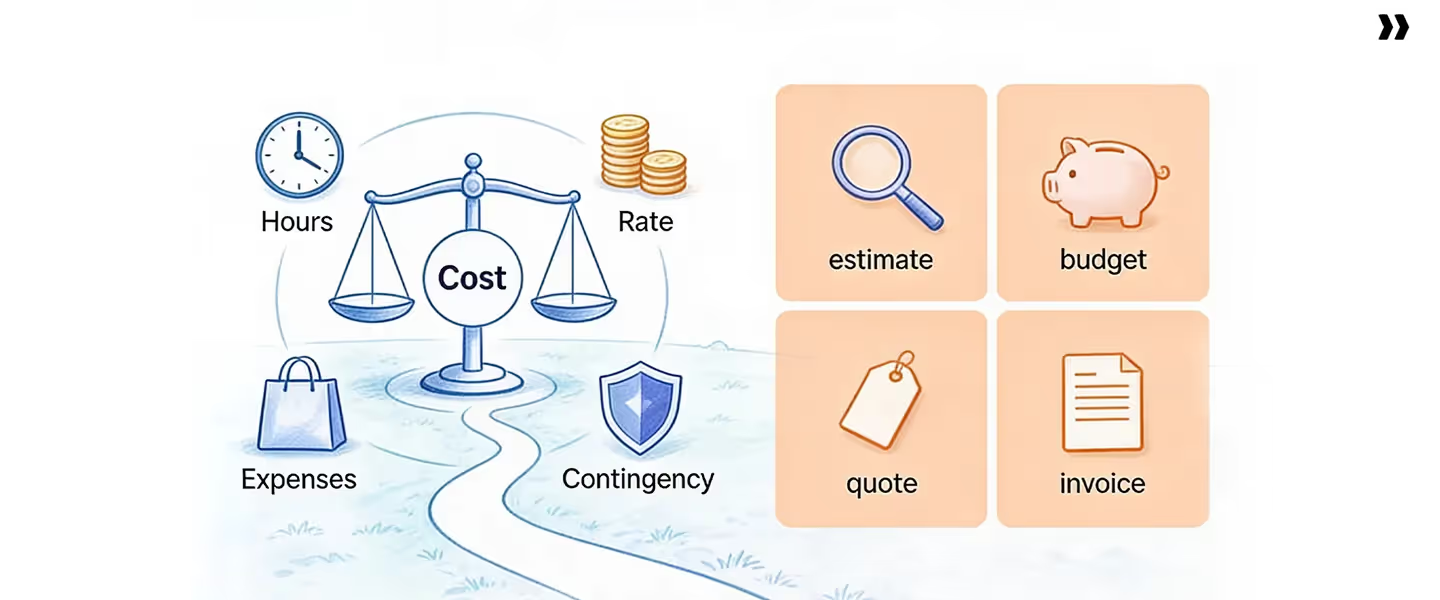
Cost estimation in project management is the process of forecasting the total cost required to deliver a project, including labor, resource costs, expenses, third-party costs, and contingency.
A project cost estimate defines the expected delivery cost prior to execution and serves as the baseline for project cost management, budgeting, and cost control.
In practice, cost estimation connects scope to effort, effort to resource rates, and rates to estimated costs. This allows teams to estimate project costs early, compare estimated and actual costs during delivery, and refine cost estimates using real data from previous projects.
Identifying the resources needed, such as labor, equipment, and materials, is essential for developing accurate project budgets and ensuring all expense categories are properly accounted for.
Without structured cost estimation, project cost calculation becomes inconsistent. Teams rely on assumptions, indirect costs get ignored, and the final project cost drifts far from the original cost estimate.
This is why accurate cost estimation in project management is the foundation for forecasting, pricing, and project budget planning.
Core formulas
- Cost = Hours × Rate + Expenses + Contingency
- EAC = Actual Cost + Estimate to Complete
- Margin % = (Revenue − Cost) / Revenue
These formulas turn estimation into a measurable system. Planned costs are incorporated into project budgeting to ensure financial control throughout the project lifecycle. Hours define effort. Rates define direct costs.
Expenses capture associated costs. Contingency protects against future costs and uncertainty.
Estimate at completion connects project cost estimation with real-time cost control. Instead of relying on the initial project cost estimate, teams continuously update estimated costs based on actual costs and remaining work.
This is where estimating project costs becomes a live financial process rather than a static document.
Cost estimate vs budget vs quote vs invoice
A cost estimate predicts the total project cost. A project budget controls spending during execution. The budget also serves as the cost baseline for measuring actual spending and maintaining control over project costs.
A quote converts the cost estimate into a price. An invoice reflects actual costs and delivered value.
Confusing these leads to poor cost estimation and budgeting in project management. Teams may treat pricing as estimation and budgeting as forecasting, which breaks down cost management and leads to inaccurate cost estimates.
Why is weekly EAC tracking critical for margin control?
If EAC is not tracked weekly, cost estimation becomes reporting instead of control. Estimating project costs must continue throughout the delivery process.
When the estimated project cost is recalculated using actual costs and remaining effort, teams detect variance early, adjust staffing, and protect the project margin before the total project cost exceeds the plan.
Why cost estimation matters now
Cost estimation matters because small errors in project cost estimation create disproportionate impact on margin, forecasting accuracy, and delivery scalability.
When teams estimate project cost incorrectly, the effect compounds across staffing, pricing, and cost management. Even minor mistakes in cost estimates lead to inaccurate forecasts, poor utilization, and unstable project budgets.
Accurate estimates are essential for project success and help prevent budget overruns by providing a reliable basis for financial control and decision-making.
Cost estimation in project management ensures that the project cost estimate, resource allocation, and delivery timelines stay aligned. Without it, estimating costs becomes guesswork, and project cost calculation loses reliability across similar projects.
Business impact
- 10 to 20% margin erosion
- 15 to 25% effort variance
- 2 to 4 week invoicing delays
These issues typically appear when the estimated project cost diverges from actual costs. Poor cost estimation affects project cost control, delays revenue recognition, and weakens forecasting accuracy.
Over time, repeated estimation errors distort cost management and reduce confidence in future cost estimates.
What this means operationally
Underestimation leads to overworked teams and rising indirect costs.
Overestimation leads to lost deals and reduced win rates.
Poor tracking leads to delayed invoicing and increased DSO.
When teams underestimate project cost, delivery absorbs the variance. When they overestimate, pricing becomes uncompetitive.
When cost estimation and budgeting in project management are disconnected from execution, estimated costs do not reflect real effort, creating gaps between the project cost estimate and actual costs.
Why utilization problems often start with bad estimates
Utilization problems often originate from bad cost estimates, not bad staffing. When effort is underestimated, teams appear overutilized.
When effort is overestimated, teams appear underutilized. In both cases, the issue starts with inaccurate project cost estimation, not resource availability.
Because utilization depends on planned hours, inaccurate estimation of project costs directly distorts utilization metrics. This leads to incorrect hiring decisions, poor capacity planning, and unreliable project cost forecasting.
The cost estimation operating model
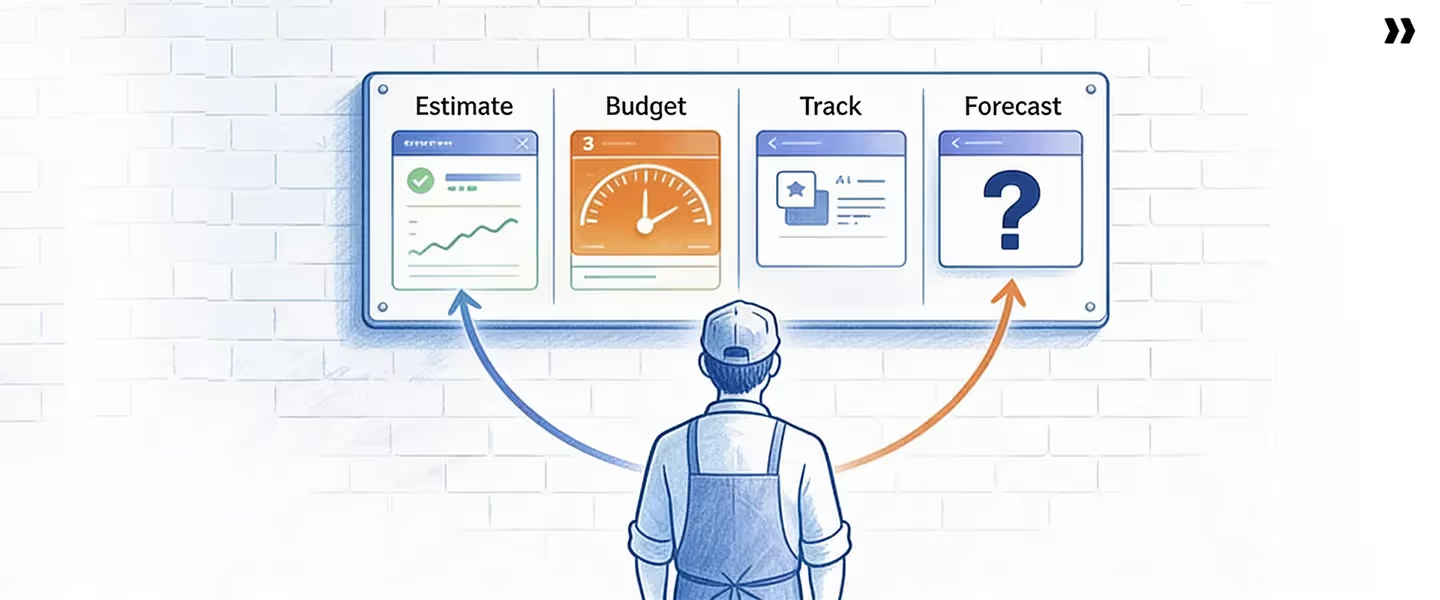
Cost estimation is a system connecting estimation, budgeting, tracking, and forecasting into a continuous control loop. Selecting appropriate project cost estimation techniques is essential for building a reliable operating model.
This operating model ensures that project cost estimation evolves using real-time data, allowing teams to adjust estimated cost, maintain cost control, and protect margin throughout delivery.
4-layer model
Each layer supports project cost management. The cost estimate predicts effort and resource cost. The budget controls spending.
Tracking compares estimated vs actual costs. Forecasting recalculates the estimated project cost at completion. When one layer fails, the project cost calculation becomes unreliable.
Decision insight
- If tracking is delayed, forecasting becomes irrelevant because actual costs are already incurred.
- If forecasting is missing, cost estimation becomes useless because the project cost estimate never updates.
This is why cost estimation and budgeting in project management must work alongside tracking and forecasting. Estimating project costs without feedback leads to inaccurate cost estimates and poor project cost control.
Why faster feedback improves estimation accuracy
Better cost estimation comes from faster feedback, not more upfront planning. When teams frequently compare estimated costs with actual costs, project cost estimation improves with each iteration.
Faster feedback reduces variance, improves forecast accuracy, and strengthens the quality of future project cost estimates.
Ongoing review and feedback are key to improving estimate accuracy, ensuring that cost forecasts remain precise and reliable throughout the project lifecycle.
Cost Estimation Control Loop™
The Cost Estimation Control Loop™ is a continuous loop where estimates are validated, corrected, and improved using real-time delivery data.
It connects project cost estimation, tracking, and forecasting so that the estimated project cost evolves during execution rather than remaining static.
This operating model ensures that project cost estimation evolves using real-time data, allowing teams to adjust estimated cost, maintain cost control, and protect margin throughout delivery. This approach is essential for managing project costs effectively.
Loop breakdown
Estimate → Execute → Compare → Reforecast → Improve
- An estimate defines the initial project cost estimate using effort and resource cost.
- Execute generates actual costs during delivery.
- Compare evaluates estimated vs actual costs and detects variance.
- Reforecast recalculates the total project cost using updated assumptions.
- Improve feeds the learnings back into future project cost estimation.
This loop strengthens cost estimation and budgeting in project management over time. Each cycle improves accuracy and reduces variance in future project cost calculation.
Business impact
- Early variance detection
- Improved forecast accuracy
- Compounding estimation quality
When teams run this loop, inaccurate cost estimation is identified earlier. The forecasted project cost becomes more reliable. Estimating project costs improves with each completed project because actual costs refine future cost estimates.
Why static estimates fail during delivery
If your cost estimate does not change during delivery, it is already wrong. Project conditions change, staffing shifts, and effort expand.
Static cost estimation ignores these factors, causing the estimated project cost to diverge from actual costs.
Continuous reforecasting keeps project cost estimation aligned with reality and protects margin.
Cost estimation maturity model
Cost estimation evolves as teams move from manual project cost estimation to data-driven forecasting.
The maturity of cost estimation in project management determines how accurately teams estimate project cost, track actual costs, and improve future project cost estimates.
Levels
- Level 1: Relies on spreadsheet-based cost estimation. Project cost estimates vary widely because estimating project costs depends on assumptions and memory. Direct and indirect costs are rarely consistent across projects.
- Level 2: Introduces templates for project cost estimation. This improves consistency, but cost estimates remain static. The estimated project cost is not updated using actual costs, so forecasting accuracy remains limited.
- Level 3: Uses PSA driven project cost management. Teams track estimated vs actual costs and improve project cost calculation. Visibility improves, but forecasting remains periodic rather than continuous.
- Level 4: Introduces EAC-driven cost estimation. Estimated project cost updates continuously using real-time tracking. This improves project cost control and makes cost estimation and budgeting in project management predictable.
- Level 5: Uses AI-driven cost estimation. Historical cost data, project complexity, and resource cost patterns improve the automatic estimation of project costs. This reduces variance and scales accurate cost estimation across teams.
Why most teams overestimate their estimation maturity
Most teams are one maturity level below what they believe they are due to poor time-tracking quality. If actual costs are incomplete, project cost estimation cannot improve. Even with structured cost estimation tools, inaccurate time data weakens project cost management and reduces forecasting accuracy.
Key components of a cost estimate
A complete cost estimate includes labor, expenses, contingency, and assumptions. These elements define the project cost estimate, shape project budget planning, and determine how accurately teams estimate project cost before delivery begins.
Labor defines an effort-based project cost. Expenses capture third-party and operational costs.
Contingency protects against future costs and uncertainty. Assumptions document conditions that affect the estimated project cost. Together, these components form the foundation of reliable project cost calculation.
Cost breakdown structure
Labor typically represents the largest portion of project cost. An incorrect role mix, underestimated effort, or ignored indirect costs lead to inaccurate cost estimates. This directly affects project cost management and forecasting accuracy.
Expenses include tools, travel, integrations, and third-party services. These associated costs are often excluded during estimating project costs, causing the final project cost to exceed the original cost estimate.
Assumptions define scope boundaries, dependencies, and delivery conditions. When assumptions are unclear, complex projects increase, and the estimated project cost becomes unreliable.
Why assumptions drive estimation accuracy more than calculations
Assumptions drive the accuracy of cost estimates more than calculations do. Project cost calculations can be mathematically correct, but if the assumptions are wrong, the estimated costs still fail.
For example, estimating project costs assuming one resource vs two changes the total project cost. Assuming customer readiness vs delays changes the effort. Assuming standard scope vs custom work alters indirect costs.
This is why documenting assumptions is critical for accurate cost estimation. It improves the consistency of project cost estimates, strengthens cost control, and reduces the variance between estimated and actual project costs.
Cost estimation techniques
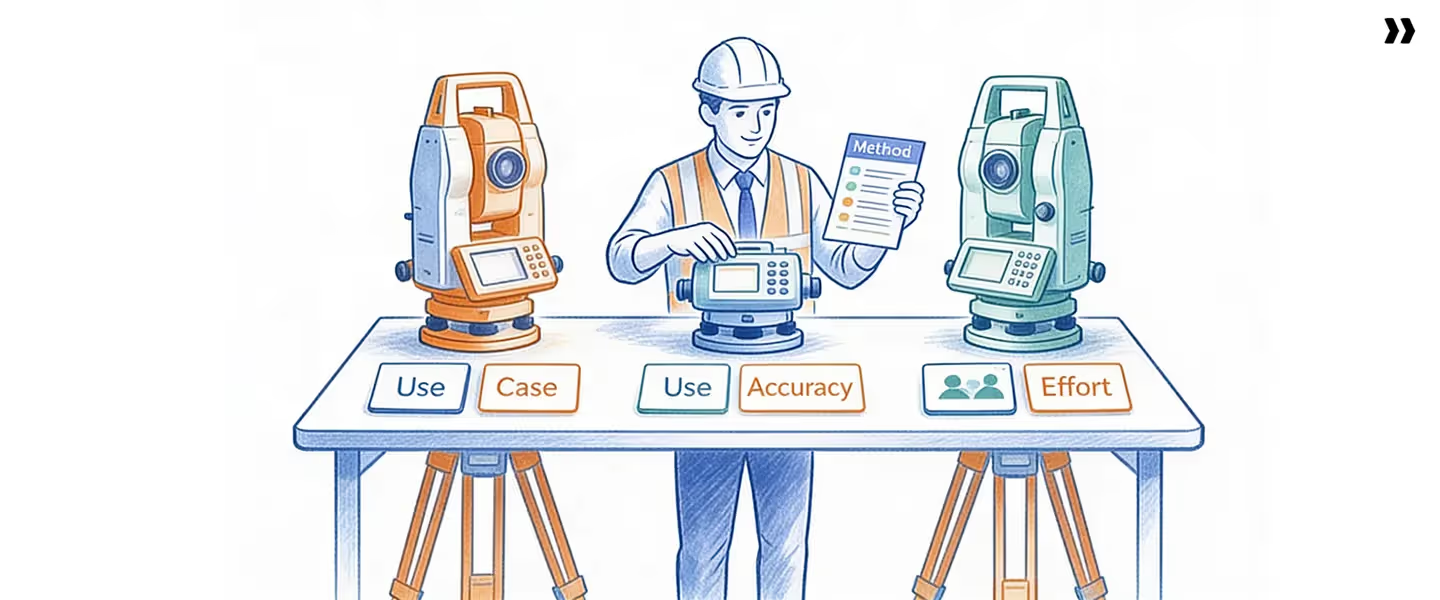
Common cost estimation techniques include analogous, parametric, bottom-up, top-down, and three-point estimation. Each method uses a different approach to estimating project costs, depending on the availability of cost data, scope clarity, and project maturity.
Analogous estimation relies on previous projects. Parametric estimation uses cost drivers and ratios. Bottom-up estimation calculates project cost at the task level.
Top-down estimation allocates the total project cost from a high-level estimate. Three-point estimation accounts for uncertainty using optimistic, pessimistic, and most likely values.
Comparison table
Analogous cost estimation is fast and useful when the scope is unclear. However, the accuracy of project cost estimates depends heavily on historical cost data.
Bottom-up project cost estimation builds a cost estimate from individual tasks. This improves accurate cost estimation but increases effort and requires a detailed scope.
Parametric cost estimation uses predefined cost relationships. This method works well for repeatable delivery but struggles with the complexity of unique projects.
When to use each estimation technique
- Use bottom-up cost estimation for fixed fee projects where the project cost estimate must be precise.
- Use parametric cost estimation for repeatable delivery where historical cost data is available.
- Use analogous cost estimation for early scoping when estimating project costs quickly is not as important as it is for later stages.
Top-down cost estimation works best for rough project cost estimation. Three-point estimation improves project cost calculation when uncertainty is high.
Why choosing the wrong estimation method creates major errors
- Choosing the wrong cost estimation method introduces more error than execution mistakes.
- Using analogous cost estimation for fixed-fee projects produces inaccurate estimates.
- Using bottom-up estimation for early scoping slows decision-making.
- Using parametric estimation without reliable cost data distorts the estimated project cost.
- The estimation method should match project maturity, scope clarity, and available data.
- Aligning technique with context improves the accuracy of project cost estimates and strengthens project cost management.
Fixed fee vs T&M cost estimation
Fixed fee cost estimation requires upfront accuracy, while T and M cost estimation requires execution discipline. Fixed-fee projects depend on precise cost estimates before work begins. T and M projects rely on tracking actual costs and continuously updating estimated project costs.
Comparison
Fixed-fee cost estimation focuses on accurately estimating project costs. If the project cost estimate is low, teams absorb the difference, and the margin erodes. This makes bottom-up project cost estimation and detailed project cost calculation critical.
T and M cost estimation focuses on cost control. Revenue depends on tracked hours, so inaccurate tracking leads to revenue leakage. Here, cost estimation and budgeting in project management rely on accurate time tracking and up-to-date cost estimates.
Why fixed fee projects fail due to effort control issues
Fixed-fee projects fail due to uncontrolled effort, not to incorrect pricing. The initial project cost estimate may be correct, but effort expands during delivery. When the estimated project cost is not updated, actual costs exceed the planned project budget.
This happens when estimating project costs does not continue after execution begins. Staffing changes, project complexity increases, and indirect costs grow. Without tracking and reforecasting, fixed-fee cost estimation becomes outdated, causing project cost estimates to diverge from reality.
How to estimate project cost (7-step framework)
.avif)
To estimate project cost, define scope, break work, assign roles, apply rates, add contingency, validate, and continuously reforecast. These seven steps connect effort-based estimation with resource cost, enabling accurate project cost estimates and better forecasting.
Step 1. Define scope
A clear scope is the foundation of cost estimation. If the scope is unclear, estimating project costs becomes assumption-driven and inaccurate. Define deliverables, phases, and dependencies before building the project cost estimate.
Step 2. Break work into tasks
Split the project into phases and tasks. This improves bottom-up project cost estimation and allows teams to estimate project cost at a granular level. Task-level estimation reduces variance in estimated costs.
Step 3. Assign roles
Map tasks to roles instead of individuals. This helps standardize project cost estimation and align with resource cost rates. Role-based estimating project costs improves consistency across projects.
Step 4. Apply rates
Multiply effort by role-based cost. This converts effort into direct costs and builds the core of the project cost calculation. Include indirect costs where relevant.
Step 5. Add contingency
Include contingency to account for project complexity and future costs. This protects the estimated project cost from uncertainty and improves cost estimation accuracy.
Step 6. Validate the estimate
Compare with previous projects and historical cost data. Validation ensures the project cost estimate aligns with realistic delivery patterns.
Step 7. Continuously reforecast
Update the estimated project cost using actual costs during delivery. Reforecasting improves project cost estimation and maintains accurate cost management.
Failure points
- Unclear scope leads to an inaccurate cost estimate
- No tracking leads to no cost control
- No reforecasting leads to delayed action
These failures break project cost estimation. Without tracking, estimated vs actual costs cannot be compared. Without reforecasting, the total project cost drifts unnoticed.
When to reforecast your project estimate
- If the variance is greater than 10 percent, reforecast the estimated project cost.
- If staffing changes, update the project cost estimate.
Reforecasting ensures project cost estimation remains aligned with delivery. Continuous updates improve forecasting accuracy and strengthen cost control.
Project cost estimation example
A practical project cost estimation example shows how small changes in staffing and effort impact total project cost.
Even when estimated hours remain similar, resource cost and role mix can significantly change the final project cost estimate.
Scenario
Scope
- Implementation setup
- Data migration
- Workflow configuration
- Training and go-live support
Estimated effort
- Implementation consultant: 40 hours
- Technical specialist: 24 hours
- Project manager: 16 hours
Rates
- Implementation consultant: 120 per hour
- Technical specialist: 140 per hour
- Project manager: 110 per hour
Project cost calculation
Implementation consultant
- 40 × 120 = 4,800
Technical specialist
- 24 × 140 = 3,360
Project manager
- 16 × 110 = 1,760
Estimated project cost
- Total project cost = 9,920
- Add 10 percent contingency
Estimated project cost = 10,912
This becomes the project cost estimate used for pricing and project budget planning.
Insight
Staffing mix changes margins faster than total effort does. If the same 80-hour shift is applied to higher-cost roles, estimated costs increase even when total effort remains constant. This is why cost estimation in project management must consider resource cost, not just hours.
For example, replacing 10 consultant hours with technical specialist hours:
- Consultant 30 hours = 3,600
- Technical specialist 34 hours = 4,760
- Project manager 16 hours = 1,760
New total project cost = 10,120
Project cost increases without a corresponding increase in total effort. This directly impacts pricing and project cost management.
What this means
Senior resource substitution reduces margin quickly. Higher cost roles increase the total project cost even if estimated hours stay the same.
Effort creeps across phases. Adding small effort increments in multiple phases increases the estimated project cost gradually, making the project cost estimation drift from the original estimate.
The 5 failure modes of cost estimation
Most cost estimation failures are not caused by math errors. They happen because project cost estimation is disconnected from execution. When project costs are done once and not validated against actual costs, the project cost quickly diverges from reality.
1. Memory-based estimation
Memory-based cost estimation relies on previous experience instead of structured cost data. Teams project cost using rough comparisons rather than a detailed project cost calculation. This leads to inconsistent project cost estimates and inaccurate cost estimation across similar projects.
2. Static estimates
Static project cost estimation assumes scope, staffing, and effort will not change. Once delivery starts, estimated costs remain frozen even when actual costs shift. Without updating project cost, forecasting becomes unreliable, and cost estimation and budgeting in project management break down.
3. Poor time tracking
Poor time tracking creates inaccurate actual costs. Without reliable data, project cost estimation cannot improve. Estimating project costs depends on comparing estimated vs actual costs, and missing time entries distort project cost management.
4. Hidden effort
Hidden effort includes meetings, rework, coordination, and delays due to dependencies. These indirect costs are rarely included in cost estimates. Over time, hidden effort increases the total project cost and weakens the accuracy of cost estimates.
5. Late visibility
Late visibility occurs when cost variance is detected too late. By the time actual costs exceed project costs, intervention is no longer possible. This weakens cost control and leads to inaccurate future project cost estimation.
Why time tracking quality determines estimation accuracy
Time tracking quality is the strongest predictor of estimation accuracy. Accurate time data improves project cost estimation by refining cost estimates using actual delivery effort. When time tracking is incomplete, project cost calculations become unreliable, and cost estimates continue to rely on assumptions rather than actual costs.
What best-in-class teams do differently
High-performing teams treat cost estimation as a continuous system, not a one-time project cost estimate. Instead of relying only on upfront project costs, they integrate estimated, actual, and forecast costs into an ongoing project cost management process.
Weekly EAC reviews
Best teams review estimates at the end of each week. They compare project costs with actual costs and update the project cost estimate early. This improves cost estimation accuracy and prevents the total project cost from drifting unnoticed.
Role based
Best teams estimate project cost using role-based rates instead of blended assumptions. Different resource cost levels significantly affect estimated costs. Role-based project cost estimation improves pricing and forecasting accuracy.
Phase level tracking
Best teams track project cost by phase instead of only the total project cost. This helps identify where the estimated project cost deviates from actual costs. Phase-level project cost tracking improves cost control and forecasting.
Feedback loops
Best teams continuously refine cost estimates using data from previous projects. They compare estimated vs actual costs, update assumptions, and improve project cost calculation over time. This strengthens cost estimation in project management and reduces variance.
Why estimation improves through feedback loops
Estimation improves through feedback, not better initial planning. Even a detailed project cost estimation cannot predict all variables. When teams track original costs and feed the results into future cost estimates, project cost estimates become more accurate. Feedback loops improve cost estimation accuracy, forecasting reliability, and the consistency of project cost management.
Cost estimation vs cost control
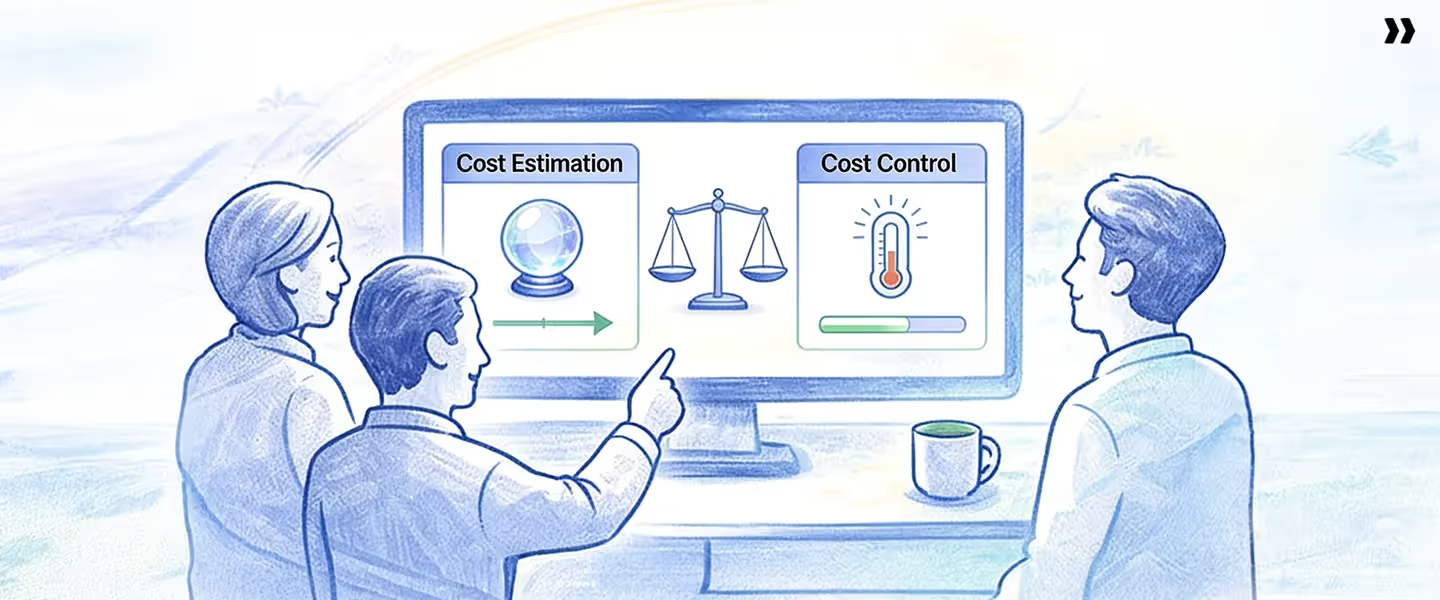
Cost estimation predicts cost, while cost control ensures execution stays within it. Cost estimation in project management creates the initial project cost estimate based on effort and resource costs. Cost control monitors actual costs, compares them against estimated costs, and updates forecasted project costs.
Comparison
Cost estimation happens before execution. It defines the project cost, the project budget, and the pricing assumptions. Cost control happens during delivery. It monitors project cost calculation using actual costs and prevents the total project cost from exceeding the plan.
When cost estimation and budgeting in project management are not supported by cost control, estimates lose relevance. Even accurate cost estimation cannot prevent margin erosion if tracking and reforecasting are missing.
Why most teams fail at cost control despite good estimates
Most teams invest in cost estimation but fail in cost control. They build a detailed project cost estimate, then stop monitoring estimated vs actual costs. As delivery progresses, hidden effort, staffing changes, and project complexity increase actual costs.
Without active cost control, the estimated project cost becomes outdated. Forecasting accuracy declines, and project cost management becomes reactive. Effective cost estimation requires continuous cost control to keep the project cost aligned with delivery.
Project cost KPIs and actions
Cost estimation becomes actionable only when teams track the right project cost KPIs. These metrics connect project cost estimation to execution and help teams detect when project costs are drifting from actual costs. Monitoring these indicators improves project cost management and strengthens cost control.
KPI table
Variance measures the gap between the estimated project cost and the actual costs. When the variance exceeds 10 percent, the project cost estimate must be updated. Reforecasting ensures the total project cost remains realistic and prevents margin erosion.
Utilization indicates whether the planned effort aligns with execution. Low utilization often signals overestimated project cost or poor resource allocation. Adjusting staffing improves project costs and stabilizes forecasting.
Lag measures delay in time tracking or cost updates. When cost data is delayed, the project cost calculation becomes outdated. Fixing compliance ensures estimated vs actual costs remain accurate.
How to act on cost variance and utilization signals
High variance requires staffing review. Reevaluate role mix, effort assumptions, and remaining work. Update the project cost estimate and reforecast the total project cost.
Low utilization requires rebalancing. Reallocate resources, adjust estimated costs, and align project cost estimation with actual delivery capacity.
Signs your cost estimation process is broken
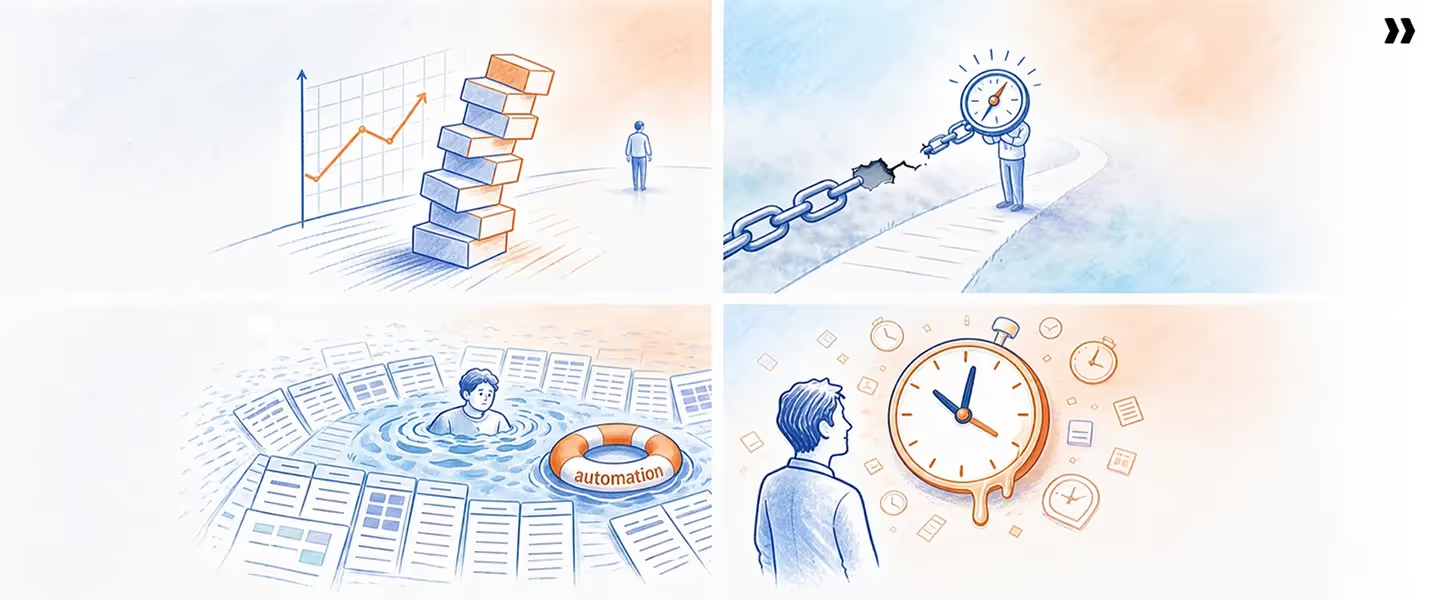
Cost estimation issues rarely appear as obvious errors. They show up as recurring variance, unreliable project cost estimate, and inconsistent forecasting. When these patterns repeat, the problem is not estimating project costs. The problem is the system behind cost estimation in project management.
High variance
Consistently large gaps between estimated and actual project costs indicate inaccurate cost estimation. High variance means project cost estimation assumptions are not validated. This weakens project cost management and makes forecasting unreliable.
No EAC
Without estimate at completion tracking, the estimated project cost never updates during delivery. Teams rely on the original project cost estimate even when actual costs change. This prevents cost control and leads to an inaccurate total project cost.
Spreadsheet dependency
Spreadsheet-based cost estimation creates a fragmented project cost calculation. Data is manual, tracking is delayed, and estimated costs are not connected to execution. This results in inconsistent project cost estimation and limited visibility into actual costs.
Why broken estimation is actually a system problem
This is not a cost estimation problem. It is a system problem. When estimation, tracking, and forecasting are disconnected, project cost estimation cannot improve. Accurate cost estimation requires structured data, continuous tracking, and feedback loops that align estimated costs with actual costs.
Why change your current process or tool?
Cost estimation breaks when the process cannot scale with project volume and complexity. As teams grow, manual project cost estimation and disconnected tools lead to inconsistent project costs. This leads to unreliable project cost estimates, delayed forecasting, and weak project cost management.
Spreadsheets do not scale
Spreadsheet-based cost estimation works for a few projects but fails at scale. Manual updates create inconsistent estimated costs. Version control issues distort project cost calculation. The estimated project cost is not connected to actual costs, making forecasting inaccurate. Over time, spreadsheet dependencies undermine cost estimation in project management and increase variance.
PM tools lack financial depth
Traditional project management tools track tasks but not project cost estimation. They capture progress but ignore resource cost, indirect costs, and project cost. Without financial visibility, teams cannot compare estimated vs actual costs. This limits cost control and weakens project cost management.
Why delayed data puts your margins at risk
If decisions rely on delayed data, the margin is already at risk. When actual costs are updated late, the project cost becomes outdated. By the time variance appears, the total project cost has already increased. Real-time tracking is essential for accurate cost estimation, early reforecasting, and protecting project margin.
When should you invest in a PSA?
As project volume increases, manual cost estimation and disconnected tracking start to break down. At this stage, project cost estimation requires a system that connects project costs, tracks actual costs, and forecasts total project cost in real time. This is when investing in a PSA becomes necessary for consistent project cost management.
Triggers
20 projects
Managing multiple concurrent projects makes spreadsheet-based cost estimation unreliable. The estimated project cost varies across teams, and the project cost calculation becomes inconsistent. A PSA standardizes project cost estimation and improves forecasting.
10% variance
If estimated and actual costs regularly differ by more than 10 percent, cost estimation accuracy is weak. This indicates poor tracking, inconsistent assumptions, or hidden effort. A PSA improves cost estimation in project management by connecting estimated costs with execution data.
No real-time visibility
When teams cannot see the project cost estimate, actual costs, and forecasted project cost in one place, cost control becomes reactive. Lack of visibility weakens project cost estimation and increases margin risk.
Why slow reporting indicates a system bottleneck
If reporting takes longer than decision-making, your system is the bottleneck. Delayed project cost calculation means the project cost is already outdated.
When actual costs are visible late, reforecasting happens after the variance occurs. Real-time visibility is essential for accurate cost estimation, early intervention, and reliable project cost management.
What to look for in cost estimation software
Cost estimation software should do more than generate a project cost estimate. It should connect estimating project costs, tracking actual costs, and forecasting total project costs in real time. Without these capabilities, cost estimation in project management remains static and difficult to control.
Real-time EAC
The software should continuously calculate estimates at completion using actual costs and remaining effort. Real-time EAC allows teams to update project costs early and improve project cost control. This prevents the total project cost from drifting beyond the original cost estimate.
Costing and resource integration
Cost estimation should be tied to resource planning. Role-based rates, staffing changes, and allocation updates must automatically adjust estimated costs. Integrating resource cost with project cost estimation improves accuracy and reduces manual project cost calculation.
Forecasting
Forecasting should project the total project cost before delivery is complete. The software should compare estimated vs actual costs, predict variance, and update project cost estimates dynamically. Forecasting ensures that cost estimation and budgeting in project management remain aligned with execution.
How does Rocketlane improve cost estimation?
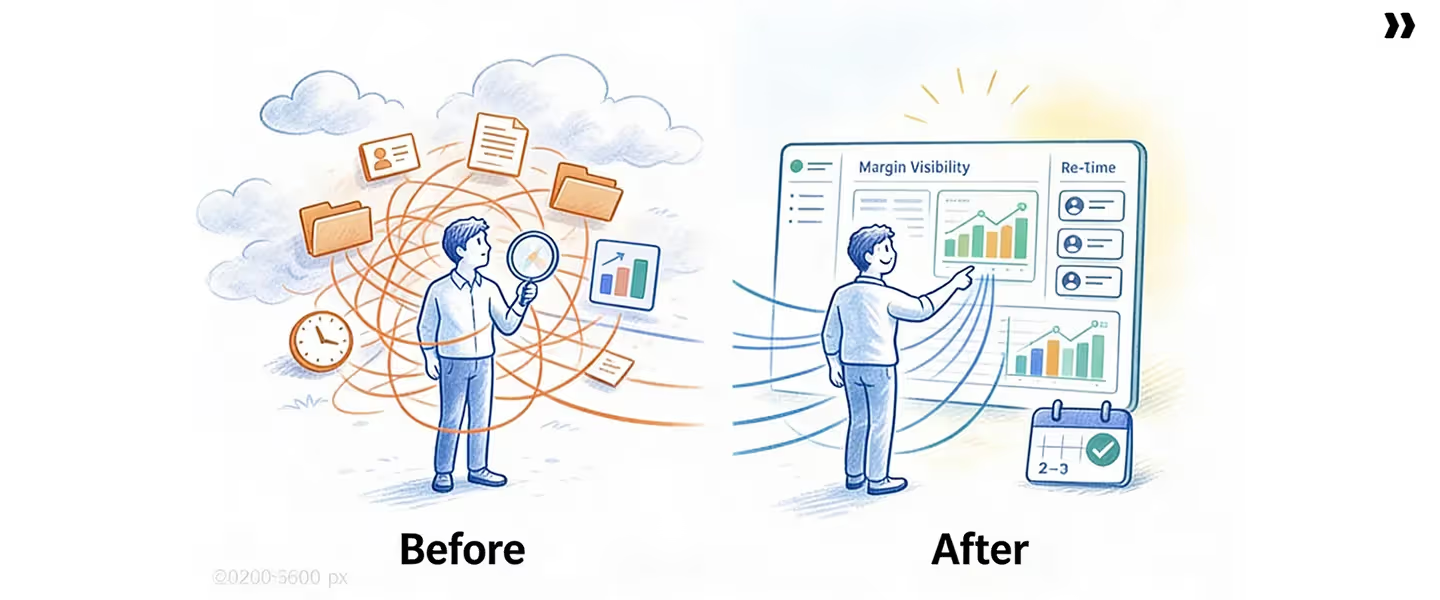
Disconnected systems make cost estimation difficult to maintain. When project cost estimation, tracking, and forecasting live in separate tools, the estimated project cost quickly becomes outdated.
Rocketlane, a unified system, connects project costs with execution and improves project cost management.
Before vs after
How Nitro transforms cost estimation workflows
Traditional cost estimation relies on manual effort, delayed reporting, and disconnected data, because estimates live outside the delivery system.
Rocketlane embeds cost estimation into the PSA, with Nitro agents enforcing governance, updating forecasts, and detecting real-time variance. This turns cost estimation from a planning step into a continuous financial control system.
AI insights
Nitro Financial Controller and Project Architect continuously watch delivery data, actual hours, staffing changes, and milestone drift against the cost estimate. Instead of memory-based guesses, teams get data-driven reforecasts and early variance alerts. When time or scope drift, Nitro flags it immediately with suggested corrective actions.
AI insights also identify risk early. If the project cost begins to drift, forecasting updates automatically. This allows teams to adjust staffing, update project cost estimates, and protect margins before total project costs increase.
Automation
Automation reduces manual project cost calculation. Scope, roles, and effort can automatically generate a project cost estimate. When staffing changes, the estimated costs update automatically. This keeps cost estimation and budgeting in project management aligned with execution.
Nitro Time Approver applies time-logging rules automatically as hours are entered, enforcing billable/non-billable discipline before approval. Nitro Project Architect simultaneously monitors all projects for milestone drift, budget pressure, and dependency stalls.
This move costs governance from manual review to continuous, automated oversight, enabling teams to manage more projects without adding headcount.
Governance
Governance enforces cost control during delivery. Time-tracking compliance, budget thresholds, and variance alerts ensure that project cost estimation remains accurate. When actual costs exceed project costs, teams receive early signals.
Governance connects cost estimation with execution discipline. This prevents hidden effort, improves project cost management, and strengthens forecasting accuracy.
Future of cost estimation

Cost estimation is moving from static planning to continuous financial control. Modern cost estimation in project management combines real-time data, AI forecasting, and automated decision-making. This shift improves the accuracy of project cost estimates and makes cost estimation adaptive rather than fixed.
Real-time estimation
Real-time cost estimation updates the project cost as delivery progresses. Actual costs, staffing changes, and scope adjustments automatically update the project cost estimate. This keeps project cost calculation aligned with execution and improves cost control.
AI forecasting
AI forecasting uses historical cost data, project complexity, and resource cost patterns to predict total project cost. Instead of relying solely on initial cost estimates, AI continuously improves project cost estimates. This reduces variance between estimated costs and actual costs.
Agentic systems
Agentic systems automate project cost estimation workflows. They generate a project cost estimate from the scope, update estimated costs when staffing changes, and trigger reforecasting when variance appears. This turns project cost management into a proactive system.
Common mistake vs. the right approach
Static cost estimation ignores delivery changes. Continuous reforecasting keeps the estimated project cost accurate. Monthly tracking delays visibility. Weekly EAC improves forecasting. Role-agnostic costing distorts the project cost estimate. Role-based costing improves cost estimation accuracy.
Conclusion
Cost estimation is not a planning step. It is a margin control system. The teams that perform consistently are the ones that update their estimates every week, reforecast when variance appears, and treat cost estimation as a continuous feedback loop. Static estimates lose margin. Live estimates protect it.
Accurate project cost estimation integrates effort, resource costs, tracking, and forecasting into a single system.
Platforms like Rocketlane bring this together by enabling real-time visibility into estimated vs actual costs, helping teams detect variance early, improve cost control, and strengthen project cost management throughout delivery.
Table of Contents

Regsiter for the live webinar


Great consultants didn't join your team to spend Fridays writing documentation.
Table of contents
18 of Forbes Cloud 100 chose Rocketlane. The best PS teams aren't waiting around.
FAQs
What is cost estimation?
Cost estimation is the process of forecasting the total project cost before execution using effort, resource rates, expenses, and contingency. In project management, it creates the initial project cost estimate, supports budgeting, and enables teams to compare estimated vs actual costs and update forecasted project costs during delivery.
Why is cost estimation important?
Cost estimation is important because it determines project profitability, pricing accuracy, and resource planning. Accurate project cost estimation helps teams control budgets, reduce variance, improve forecasting, and avoid margin erosion. Without structured estimating of project costs, delivery decisions become reactive, and the total project cost becomes unpredictable.
What is the cost estimation formula?
The basic cost estimation formula is cost equals hours multiplied by rate plus expenses plus contingency. This converts effort into estimated costs, forming the project cost estimate. Teams then compare project cost with actual costs and calculate the estimate at completion to keep project cost forecasting accurate.
What are the types of cost estimates?
Common types of cost estimates include rough order of magnitude, budget, and definitive estimates. Rough estimates are used during early scoping, budget estimates support planning, and definitive estimates are used for pricing and delivery control. Each type improves the accuracy of project cost estimation as scope clarity increases.
What tools help with cost estimation?
Cost estimation tools, such as PSA platforms, help automate project cost estimation, track actual costs, and forecast total project costs. These tools connect project costs with resource planning and time tracking. Platforms like Rocketlane provide real-time visibility, improve cost control, and reduce variance between estimated and actual costs.













Copyright © 2026 Rocketlane Corp. All rights reserved.


















.webp)