A guide to mastering profitability in professional services

•
•
Summarize blog with






A professional services (PS) business is fundamentally different from most of its industrial and retail counterparts. This is because the primary offering cannot be standardized. A PS firm builds its reputation by providing customized and highly personalized services that draw from the unique skills of individuals.
This means that many of the conventional management techniques and principles may not apply to a PS business. Competing in a domain where the firm not only needs to fight for clients, but also think of ways to hire, manage, and retain talented professionals fundamentally alters the path to profitability.
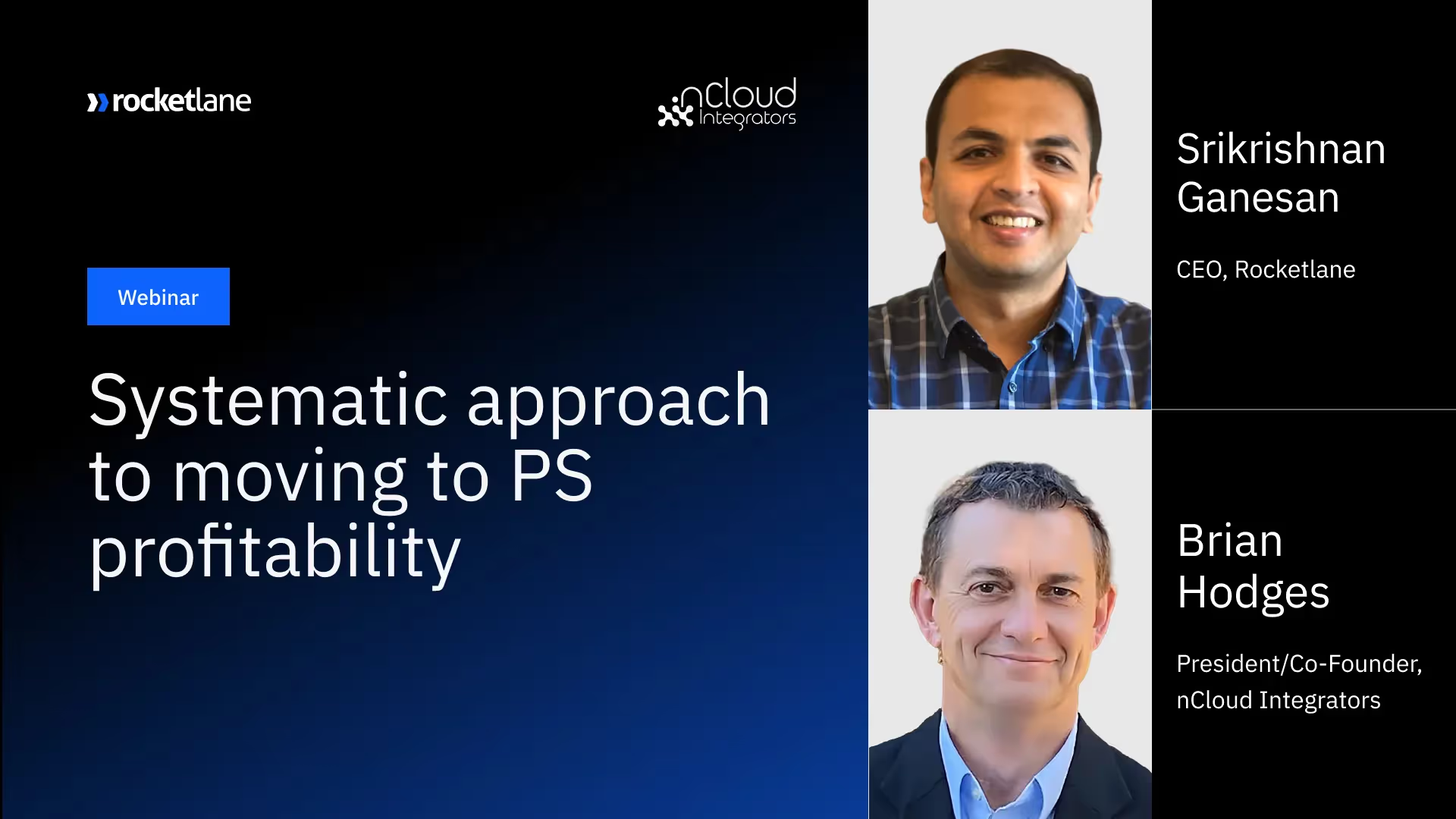
Our CEO Srikrishnan Ganesan and Brian Hodges, President of nCloud Integrators, share their blueprint on how the modern PS firm can build a roadmap to achieve profitability.
The shift from growth to profitability
In recent years, the tech industry has experienced a significant shift in focus from pure growth to sustainable profitability. This change has impacted professional services organizations, pushing them to reevaluate their strategies and operations. Despite increasing bill rates, many PS teams are seeing shrinking margins due to rising costs and market competition.
To give you an overview, profit margins were down 4% in 2023 for services teams, many of whom discovered that increasing bill rates alone wasn’t enough to maintain profitability.
This made two things abundantly clear:
1. PS leaders must focus on margins, utilization, and operational efficiency
2. Creating a self-sustaining, profitable PS organization is more important than ever
This means that PS leaders will need to hunker down and think about what really matters to their orgs. This requires leaders to come up with a comprehensive charter for their orgs.
Establishing a clear charter for your PS organization
One of the fundamental steps in driving profitability is establishing a clear charter for your professional services organization. This charter should outline the primary mission, financial model, key performance indicators, and core activities of your PS team.
Here are the key components of a PS charter:
- Primary mission: Revenue and margin, customer adoption, and partner enablement
- Financial models: Revenue forecasts, cost structures, margins by timeframe
- KPIs: Projects delivered, time to value, customer satisfaction scores
- Core activities and potential risks
A clear charter:
- Aligns the entire organization on the PS team's purpose
- Reduces time spent explaining the "why" behind decisions
- Facilitates decision-making and resource allocation
- Helps in communicating value to other departments and leadership
Once you have a clear charter that your business is anchored around, you can then work towards improving the core metrics that dictate the success of a professional services firm.
Maximizing utilization: strategies for success
For PS firms, billable utilization is the metric that dictates the overall profitability of the firm. Generally speaking, most, if not all of your strategies will need to be oriented towards improving billable utilization. This ensures that your team is firing on all cylinders, with little to no instances of employees being ‘on the bench’.
Here are a few ways to improve utilization:
- Implement shared services models (e.g., Technical Architecture Manager roles)
- Create clear rules of engagement for resource sharing across departments
- Use data analytics to identify utilization patterns and opportunities
- Implement proper time tracking and categorization
In addition to improving utilization, PS firms will also need to learn the art of hiring, managing, and retaining talented professionals. People are the beating heart of a PS firm, and an ill-managed team would either increase operating costs, or result in employee churn. The latter is particularly insidious for it leads to loss of context, which in turn forces firms to hire and train replacements under exceedingly tight constraints.
Here are a few tips to improve resource management:
- Reflect the true shape of effort in resource planning
- Use AI-powered tools for optimal resource allocation
- Cross-train resources to fill gaps in demand
- Regularly analyze utilization forecasts to identify and address potential gaps
That being said, it’s one thing to improve billable utilization, but another thing to ensure that you’re matching the right person, to the right job, at the right time.
Optimizing rates and revenue streams
While utilization focuses on how often your team is billing, optimizing rates ensures you're maximizing the value of each billed hour. The idea here is to ensure that each employee is matched to projects that they are perfectly suited to and can command a good premium for.
Here are a few tips to optimize your rates:
- Implement a tiered rate structure based on project duration or complexity
- Charge premium rates for short-term engagements
- Leverage global delivery models to balance costs and rates
- Analyze profitability by project type and adjust pricing accordingly
In addition to optimizing rates, it would also help PS firms to think of alternate ways to make the most out of their team’ expertise. This calls for exploring adjacent revenue streams, the likes of which could help them during periods when demand for services is low.
Here are a few to build alternate revenue streams:
- Explore offerings directed towards Technical Account Managers (TAM)
- Develop managed services and retainer-based engagements
- Create value-based pricing models for certain services
Once you’ve gotten to fixing billable utilization and have tweaked your rate cards for maximum profitability, the next step is to think about bringing in efficiency.
Enhancing project efficiency
Even though PS firms are built on standardization, it is possible to enforce uniformity across internal processes and operating protocols that allow it to function like a well-oiled machine.
Healthy margins are as much a function of project efficiency as everything else, and PS leaders would benefit from looking at every aspect of the firm's internal workings and eliminate friction wherever possible. With the democratization of agentic technologies (LLMs), this has never been easier to do.
Here are a few tried and tested tips to improve project efficiency:
- Develop and implement a standardized delivery methodology
- Create project templates that reflect your methodology
- Use automation to reduce administrative overhead and mental clutter for consultants
- Regularly measure and monitor project progress against your methodology
Every PS firm has a slew of activities that lend themselves to automation opportunities readily. Here are a few ‘low-hanging fruits’ that PS leaders can look at:
- Task reminders and notifications
- Status updates and reporting
- Resource allocation and scheduling
- Client communication and engagement
Want to automate your internal processes but don’t know where to start. We have a guide to get you started.
There’s only so much that a PS leader can solve within the firm. Beyond a certain point, additional gains will need to come from managing clients. Finding the right clients, setting proper expectations, and holding them accountable to predetermined timelines.
Increasing client accountability
Client engagement and accountability play a significant role in project success and profitability. What this means is that as a PS leader, it’s on you to draw out guardrails and boundaries to avoid mishaps in planning, scope creep and unrealistic timelines and expectations.
Here are a few pointers to help manage client expectations:
- Execute thorough project kickoffs with all stakeholders
- Clearly identify and communicate client deliverables and timelines
- Use a client-facing project portal for transparency and engagement
- Implement automated reminders for client tasks and deliverables
- Establish a clear escalation process for delays or issues
Once you improve your baselines metrics and have a solid strategy for managing your clients, you can then look at the longer run. As of the time of writing this article, AI and partner ecosystems are likely to play a prominent role in how PS firms grow and retain their competitive edge.
Leveraging AI for improved efficiency and insights
Artificial Intelligence (AI) is becoming increasingly important in professional services.
AI applications in professional services:
- Conversational AI for meeting summaries, action items, and documentation
- AI-powered resource allocation and project staffing
- Predictive analytics for project profitability and risk assessment
- Pattern recognition in historical project data for continuous improvement
Building a partner ecosystem for scalability
Partners can help PS organizations extend their reach beyond their native capabilities. This not only increases the action radius of any lean PS firm, but also opens up new avenues of profitability.
Benefits of building and maintaining a partner ecosystem:
- Increased delivery capacity without fixed overhead
- Access to specialized skills and knowledge
- Ability to serve a wider geographic area
- Potential for new revenue streams through partner programs
It’s not enough to have a partner ecosystem in place. You also need to have a robust system to manage it as it evolves over the years:
- Use a centralized project management platform to collaborate with partners
- Establish clear governance and communication processes
- Align partner incentives with your profitability goals
- Regularly assess partner performance and contribution to overall profitability
Achieving and maintaining profitability in professional services requires a multifaceted approach that addresses utilization, rates, project efficiency, and client engagement. By implementing these strategies, PS leaders can create a more resilient and profitable organization. As the industry continues to evolve, staying adaptable and leveraging new technologies like AI will be crucial for long-term success in the professional services space.
More Resources:
Table of Contents

Regsiter for the live webinar


Great consultants didn't join your team to spend Fridays writing documentation.
Table of contents
18 of Forbes Cloud 100 chose Rocketlane. The best PS teams aren't waiting around.
FAQs












Copyright © 2026 Rocketlane Corp. All rights reserved.

















.webp)