4 tips to ensure a smooth SMB implementation and onboarding

•
•
Summarize blog with






Further reading
- High-touch vs. self-serve customer onboarding for SMBs with Richard Benavides
- How to build a customer onboarding framework
- Decoding customer onboarding at Insent
- The Customer Onboarding Maturity Model
Placed right at the top of the post-sale funnel, customer onboarding is a critical step for customer retention for organizations of all sizes. Unlike in enterprise customer onboarding, where various teams work together to provide a great customer experience, SMBs usually have smaller teams and limited resources for impementation and onboarding customers.
However, there are systems and processes that you can put in place to provide a smooth and seamless SMB onboarding and implementation experience for your customers.
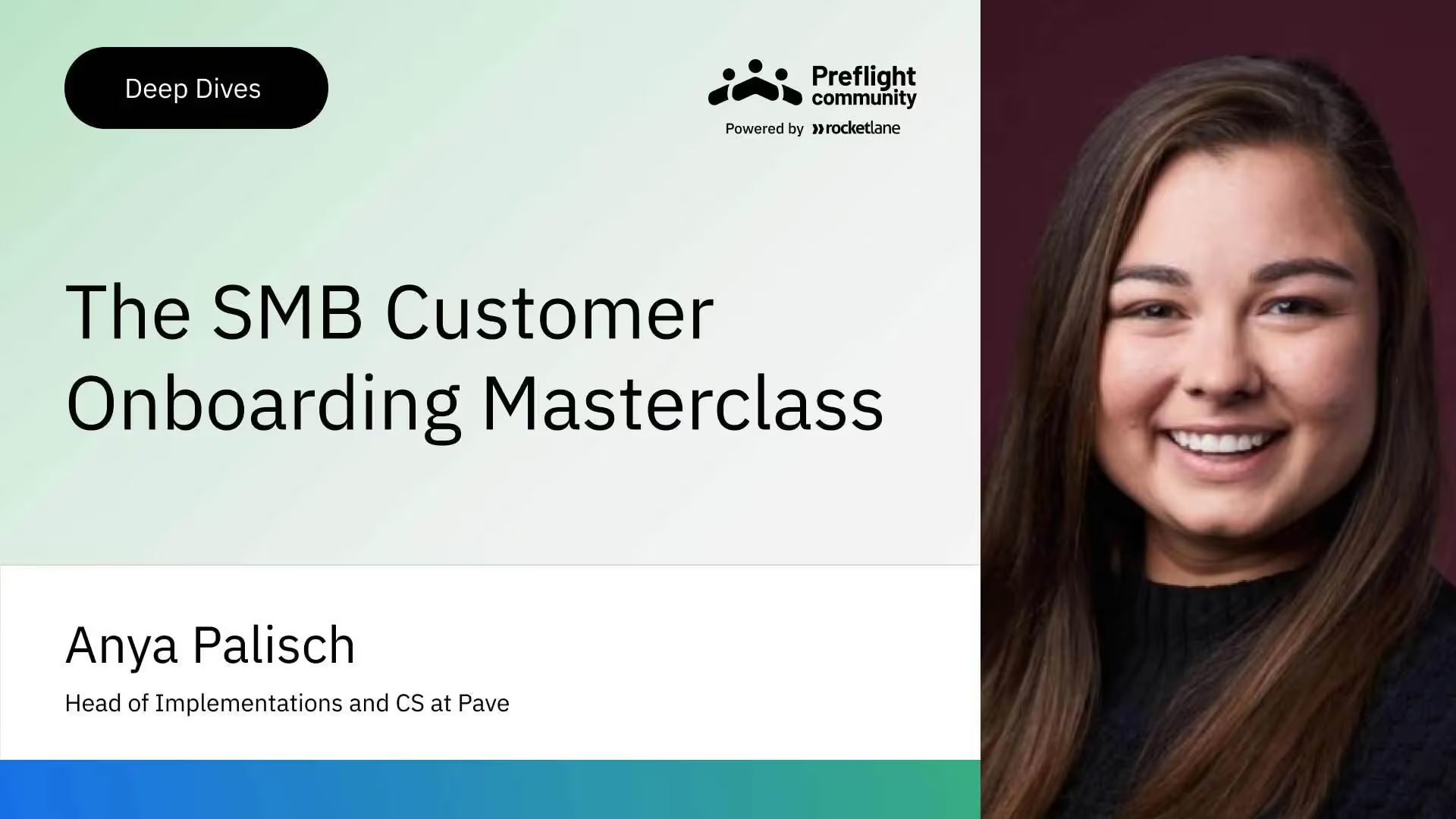
In this Deep Dives session, Anya Palisch, Head of Implementation and CS at Pave, sheds light on SMB customer onboarding and reveals valuable tips on how to seamlessly onboard an SMB customer.
Here are the topics that Anya discussed:
- The three levels of optimization for SMB onboarding and customer experience
- Analyzing which optimization to provide for the customers
- Tips on SMB implementation and onboarding
- Things to keep in mind while hiring a team member, and more
So, let’s dive right into it!
SMB customer onboarding and implementation is a volume exercise, and knowing what you’re optimizing for is important throughout the journey.
While a lot of customers want a self-service implementation, always ask yourself whether it is possible for them to complete the entire implementation process by themselves or if they need some level of guidance for it to be effective.
Three levels of optimization for SMB customer onboarding
No touch: Automate everything so your team needs to proactively handle just off-track customers.
Here’s what this approach typically entails:
- No joint project planning: With this approach, you could have customers who don’t know what to do, and when. Provide your customer with detailed instructions on how to go through the onboarding and implementation process.
- Reactive vs. proactive project management: Instead of proactively going to the customer on a one-to-one basis, let them come to you with any questions they have.
- No named contacts for implementation: Instead of named contacts, assign a support team, or a platform like Zendesk, to handle incoming requests or queries.
Low touch: Automate the easy processes so that the teams can solve the hard ones.
This approach has:
- Limited joint project planning. Include ten minutes of project planning with the customer instead of two or three upfront sessions, as in enterprise project planning.
- Reactive vs. proactive project management. Have the customers reach out with any queries they may have, but include a few proactive touchpoints in the process.
- Personalized outreach for portions of the SMB implementation. Provide personalized outreach for portions that might be difficult for the customer to implement independently.
Premium feel: Add a human touch to the process and guide the customer down the happy path to onboarding.This includes
- Lightweight project planning: Collaborate on some lightweight project planning with the customers.
- Named contacts and proactive outreach: Have named contacts to answer any of the customer’s questions and follow a proactive approach.
- Predetermined high-value milestones and activities: Have your team support customers through predetermined high-value milestones and activities to help them quickly reach their ‘aha’ moment.
- 1:1 training sessions. Provide one-on-one training to the customers to give them a premium feel.
Analyzing which optimization to provide for the customers
- Look at the project’s end-to-end workflow and determine how to provide the right information to the customer along the way.
- Inject touchpoints that are good for your business.
- Find the ‘aha’ moment with your customer and develop a plan around it.
- Provide premium support to your customers the first time they implement a product and ensure them that you will help them do it effectively.
- Consider your business and financial goals while designing the optimization for your customer.
Tips on SMB implementation and customer onboarding
1. Be prescriptive
As you engage with a diverse range of personas – from founders to office managers and account executives, be explicit in your instructions to ensure that you deliver the optimum customer onboarding experience across roles.
- Tell your customers what SMB implementation will look like early and often!
- Build out standard implementation packages with (relatively) cookie-cutter steps. Even if you don’t charge for implementation, provide your sales team with a crisp set of slides, a one-pager, or a sample project plan and train them on how to explain the implementation packages to the customers.
Offer the customers the option of a paid premium experience. This sets the right expectations with the customer.
- Start with the same standard project plan and subtract the items that don’t apply. Start with a big project plan and then reduce it to what the customer needs – instead of having your team build something from scratch.
- Create email templates for all common situations. Ensure that you have standard email templates for common situations that your team can modify and send to customers. Tools like Outreach can help you create these email templates.
- Develop phone call scripts for repeatable calls. Have at least five different repeatable phone call scripts for your sales team. his will ensure that your positioning and offerings remain consistent,
- Be tough when needed! Tell your customers what they need to do in order for you to be able to do your part. Having this kind of conversation is extremely important, especially when your customer is veering off-course.
2. Automate
SMB is a game of optimization and efficiency. Figuring out what you can and can't automate along the way is extremely important. Here are a few things to keep in mind:
- Project management tooling: A project management tool ensures you have a sense of where your customers are in the implementation process. A project management tool like Rocketlane can improve your project management capabilities.
- Meeting booking: Seek the help of your sales team to automate meeting bookings. Tools like Chili Piper and Calendly make sure you have your regular event-type setup, and your calendar blocking is in place.
- Training delivery: Upgrade your Zoom account so you can lead training through webinars for a group of twenty customers instead of one. Launching a community or a learning platform isalso a great way of delivering training to customers.
- Key data point collection: Tracking usage, adoption, and customer lifecycle data can be really critical. Provide the customer with an in-product questionnaire asking them about key dates and deadlines to collect initial details. This helps you with the project planning and prevents unnecessary back-and-forth with the customer.
- Email automation: Whether it is through a drip campaign, from your product, or individually with a tool like Outreach, you can automate introductions and completion emails.
- Introduction and completion. Have a system in place to introduce customers to the customer support team at the end of implementation.
- Help/support documents. Make sure you embed help articles/support documents in key places. For example, include a help center link or a video in your emails to provide customers with visibility and easy access to the right resources.
3. Communicate clearly and consistently
Usually, when companies move to a low or no-touch model in SMBs, the level of communication tends to drop. Don’t let that happen to your customers.
It is critical to let them know what’s next, what is and isn’t on track, and what they need to do – especially since you could be dealing with a broad set of personas.
- Move quickly after the contract closes. If you take too long between the sign-up and implementation, the customers might get frustrated and sign-up for a different product that could do their implementation quicker.
Aim to get the customer from the contract to start using your product quickly.
- Give a preview of the entire process. Provide an end-to-end preview of what is going to happen in the next few days, weeks, or months. In every meeting or conversation, set the next step and provide them with a deadline.
- Let customers know when they are heading off-course. There is a difference between being nice and being kind. Being kind means that you need to be honest with your customers and help them do the right thing.
- Don’t do it alone: Moving to low or no-touch scaled SMB customer onboarding is a company-wide undertaking. And while the implementation team is responsible for doing the actual work, there are things that require collaboration and assistance from other teams.
If you are a one-person team, focus on a handful of high-impact projects and use your limited resources to knock them out. Here are some questions you must ask yourself:
- Can you give the sales team a one-pager and a single pre-implementation task for completion?
- Is there a single workflow you can scope out and ask R&D to build in a quarter?
- Could you run light marketing on your own using a drip email tool or webinars?
- Can someone from the finance team help you get a lightweight model for headcounts or gross margins in place that you can maintain yourself?
- Can your implementation team help with customer enablement by writing help articles?
- Can someone from the analytics team help you figure out where you lose customers?
Things to keep in mind while hiring for your implementation team
Hiring the right kind of people could go a long way in providing a quick and seamless SMB implementation for your customers. Here are some insights to help you:
The ‘right’ people for SMB customer onboarding and implementation
- Concise communicators: Hire people who can get to the point quickly. While interviewing, you could ask them to present a topic within a time limit. Sticking to the time limit is a great indicator that a person is a concise communicator.
- DIY-ers: In an SMB, it is crucial for a team to wear multiple hats and complete various kinds of tasks to ensure a smooth implementation.
- Ruthless prioritizers: Your team is going to have a lot of customers to handle and should be able to rank the most important ones naturally.
- Quick learners: Since there is a wide variety of people the team would be working with, they need to come up to speed and become experts in the field very quickly.
- Customer-centric (ish): Your team should be able to consider customer-centricity as an optimization problem. Many companies hire people who would do anything and everything to make the customer happy, but that might not be the right approach when hiring for an SMB. Your team should be able to assess how much time they should dedicate to each customer while prioritizing their time and efforts as well.
Here are a few people who may not be a great fit for an SMB onboarding approach:
- Customer happiness geeks: SMB customer onboarding is not the best place for those who say they love doing everything for customers. Their focus must be on getting things done optimally and quickly.
- (Only) entry-level employees: Entry-level employees need a lot of guidance and support. Ensure that you also hire experienced professionals who act as pace-setters and help the managers bring entry-level employees up to speed.
- Long-term relationship managers. People who have solely worked in enterprises could find it difficult to deliver in an SMB setup where the pace is very different.
- Non-industry experts. Hire at least one industry expert. In SMBs, many customers might not know much about what they are trying to set up. An industry expert could help support these customers and provide them with the guidance they need.
Provide a seamless SMB customer onboarding and implementation with Rocketlane
Rocketlane’s customer onboarding and implementation software makes SMB onboarding smooth and quick, while ensuring a splendid onboarding experience for the customers.
Here are a few of Rocketlane’s impressive customer onboarding features:
- Collaboration with customers: Share your documents and updates with your customer in real-time – and all in one place.
- Visibility into all projects: From goals to project statuses and customer sentiments, view all your project updates at a single glance. Avoid delayed milestones with in-depth risk analysis and automated project reports. Your customers also get their exclusive, branded, interactive customer portal that they can use to access project updates in real-time.
- Tailored project templates: Create project templates based on the customer segments, including industry, size, maturity level, or implementation complexity.
- Consistent and streamlined workflows: Ensure consistent workflows and spot areas of improvement by using reusable templates.
- Effortless set-up: No need to create projects from scratch. Create tasks, project plans, and documents with a single click.
- Interactive walkthroughs of the onboarding process: Provide a simple and interactive walkthrough of your onboarding process to enable customers to go through implementation with ease.
Rocketlane: Your SMB customer onboarding and implementation champion
Providing consistent and efficient SMB onboarding and implementation to your customers is like weaving a flawless tapestry. Each thread of the process intricately connects, requiring careful attention to detail, skillful coordination, and a masterful touch to create a seamless and captivating outcome.
With Rocketlane, you can automate your processes, stay updated about your project’s progress, and offer a consistently delightful customer experience every step of the way.
So, skip the wait and onboard your customers the Rocketlane way.
Book a demo with Rocketlane and begin your customer onboarding journey today!
Frequently asked questions
1. What are the different types of customer onboarding?
There are three broad types of customer onboarding:
High-touch. This is a human-centric approach where customers get personalized digital engagement throughout their onboarding journey.
Low-touch. In a low-touch approach, the customer is provided with detailed resources to help them
Tech-touch.Tech-touch is a self-serve model where the user signs up to the product and learns about the features by using the product themselves. This allows them to find value in the product almost instantly.
You can read more about the types, steps, and best practices of customer onboarding, here
2. What is SMB customer onboarding?
Ans. SMB onboarding is the process of helping an SMB customer to use a new software or service for their business. This includes setting up of the accounts, walking them through the various processes required to complete the set-up, and guiding them through the first few steps of using the software efficiently.
SMB onboarding helps the customers smoothly transition into the new software and achieve value out of it as soon as possible.
3. What is enterprise customer onboarding?
Ans. Enterprise onboarding is the process of bringing new enterprise customers to a platform or a service. It ensures the successful adoption of the platform by the organization.
Enterprise onboarding includes setting up of customer accounts, the migration and integration of data into the new platform, and training sessions for the customers to educate them on how to make the best of the platform according to their goals and requirements.
Table of Contents

Regsiter for the live webinar


Great consultants didn't join your team to spend Fridays writing documentation.
Table of contents
18 of Forbes Cloud 100 chose Rocketlane. The best PS teams aren't waiting around.
FAQs













Copyright © 2026 Rocketlane Corp. All rights reserved.


















.webp)